A buyer-focused editorial guide to the condo amenities that make serious entertaining feel effortless, private, and operationally sound in South Florida’s luxury market.
For South Florida buyers who entertain seriously, the question is not simply whether a residence can host a dinner. The sharper question is whether the building can support the invisible choreography behind it: arrival, staging, warming, plating, clearing, and departure, all moving with quiet precision.
That is why catering flow has become one of the more discerning ways to evaluate a luxury condominium. A beautiful dining room matters, but it is only one part of the experience. If staff must cross guest spaces with supplies, if elevators are shared at the wrong moments, or if there is nowhere to stage glassware, the residence may photograph beautifully yet perform poorly.
The same principle applies from Brickell to Miami Beach, whether a buyer prioritizes a Terrace, Balcony, Pool, or New-construction address. The best entertaining residences are planned with both glamour and logistics in mind. They give guests the view and atmosphere while giving hosts the infrastructure to keep service composed.
1. Service elevator access - discreet vertical movement
The most important amenity for serious hosts is often the least visible. Dedicated or well-managed service elevator access allows catering teams, florists, rental vendors, and private staff to move without turning the main lobby or residential elevator into a work corridor.
For buyers, the point is discretion. A service elevator does more than move people and equipment. It protects the mood of arrival, keeps guest-facing spaces calm, and allows setup to happen without announcing itself. In a high-service building, this can be the difference between an event that feels improvised and one that feels professionally composed.
2. Back-of-house staging room - the pause before presentation
A staging room gives catering teams a place to organize before anything reaches the residence. That may mean tray assembly, floral holding, linen sorting, beverage setup, or simply a quiet area that keeps the operational side of the evening out of view.
The best staging areas are close enough to be useful and separated enough to preserve privacy. For hosts who entertain often, this is not a bonus room in the abstract. It is the pressure valve that keeps preparation from spilling into the arrival sequence, the elevator landing, or the living room.
3. Catering kitchen or warming pantry - separation of prep and party
A show kitchen is designed to be admired. A catering kitchen or warming pantry is designed to work. Serious hosts benefit from a secondary prep zone where dishes can be warmed, plated, garnished, and cleared without overtaking the main kitchen or interrupting guests.
The distinction matters most during seated dinners, cocktail receptions, and holiday gatherings. A well-placed warming pantry lets the host keep the primary kitchen elegant and social while giving staff a functional service space. In luxury entertaining, separation is not formality for its own sake. It is what allows ease.
4. Loading and delivery coordination - arrivals without friction
Even the most polished private dinner begins with boxes, garment bags, flowers, ice, rentals, and staff arrivals. Buildings that handle loading and delivery coordination well make the entire event feel smoother before the first guest appears.
Buyers should think beyond whether there is a loading area. The practical question is how it connects to service routes, elevators, holding areas, and the residence itself. When these pieces align, setup becomes calm. When they do not, the host may be forced to manage logistics at precisely the moment hospitality should begin.
5. Outdoor entertaining support - terrace service that behaves like an interior
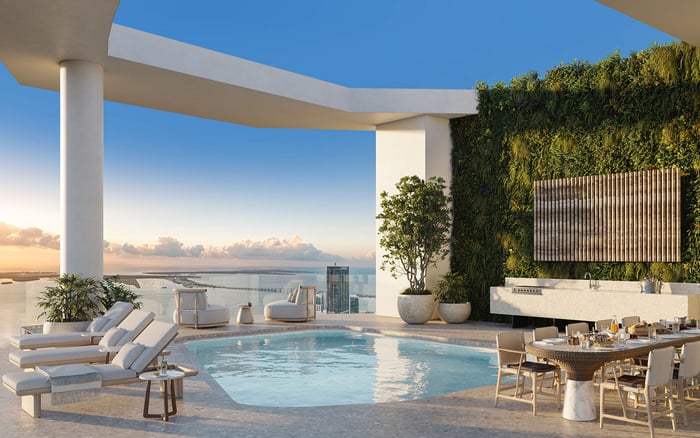
South Florida entertaining often moves outdoors, but an outdoor space only works for catered events when it is supported like a true living area. Circulation, shade, serving surfaces, proximity to prep areas, and the path between kitchen and terrace all shape how well the evening functions.
A large terrace can be seductive, yet size alone is not enough. The stronger amenity is outdoor serviceability: space for stations, a natural route for staff, and enough flexibility to separate lounging, dining, and service. A beautiful view may attract guests, but flow is what lets them stay comfortably.
Catering flow begins on paper. Before falling in love with finishes, buyers should study the relationship between the elevator landing, kitchen, dining area, terrace, powder room, and service spaces. If every operational route crosses the main seating area, the residence may be less event-ready than it appears.
Look for short, intuitive paths. The kitchen should connect cleanly to dining and outdoor areas. Staff should be able to enter, work, and exit without interrupting guest circulation. Storage should sit close to where items are used. Powder rooms should be accessible without sending guests through private bedroom corridors.
The strongest layouts create a gracious separation between public, private, and service zones. That separation does not have to feel rigid. In contemporary South Florida design, it often appears as a subtle sequence of thresholds, vestibules, secondary corridors, and concealed storage. The effect is refined rather than formal.
A view can sell the dream, but building operations determine whether that dream performs. Serious hosts should ask how catering teams are approved, where deliveries arrive, whether service elevators can be reserved, and how far vendors must travel from loading to residence.
It is also worth asking how the building handles larger private events. Policies around guest registration, valet timing, elevator use, music, outdoor areas, and vendor insurance can shape the experience as much as the residence itself. These questions are not unglamorous. They are the foundation of effortless hospitality.
Inside the residence, buyers should imagine the full arc of an evening. Where do flowers go before placement? Where does ice wait? Where are trays cleared? Can staff reset glassware without entering the center of the party? If the answers are obvious, the home is likely designed for more than casual entertaining.
South Florida adds its own layer of complexity. Heat, humidity, sunset timing, waterfront breezes, valet flow, and indoor-outdoor movement all influence how a catered event should be planned. Residences that support hosting well do not fight these conditions. They absorb them with shade, circulation, storage, and service access.
For the ultra-premium buyer, the ideal is a home that feels relaxed while operating with discipline. Guests should remember the conversation, the lighting, the terrace air, and the dinner. They should not remember carts, boxes, crowded elevators, or staff improvising around an inconvenient layout.
This is where amenities become more than a checklist. A pool deck may be beautiful, but the question is whether it supports hospitality. A private dining room may be elegant, but the question is how food arrives and clears. A balcony may expand the experience, but the question is whether it can be served gracefully. The best buildings understand that luxury is not only what is seen. It is what has already been solved.
What is catering flow in a luxury condo? Catering flow is the way staff, supplies, food, beverages, and service move through a building and residence during an event.
Why does service elevator access matter for hosts? It keeps setup and breakdown discreet, protecting the guest experience from operational traffic.
Is a catering kitchen more important than a show kitchen? For frequent entertaining, a catering kitchen or warming pantry can be more functional because it separates preparation from presentation.
What should I ask about loading areas? Ask where vendors arrive, how they reach the residence, and whether the route avoids guest-facing spaces.
Can a terrace work for formal entertaining? Yes, if it has sensible circulation, service access, shade, and enough space for dining or beverage stations.
Do building rules affect private events? Yes, guest registration, elevator reservations, vendor access, valet timing, and noise rules can all influence hosting.
What floor plan features help catered dinners? Look for clear routes between kitchen, dining, outdoor areas, powder rooms, and any secondary service spaces.
Is a large residence automatically better for hosting? Not always. Layout and service logic often matter more than raw square footage.
How can buyers evaluate privacy during events? Study whether staff can work without crossing bedrooms, main seating areas, or guest arrival paths.
What is the most overlooked entertaining amenity? Back-of-house staging is often overlooked, yet it can dramatically improve setup, service, and breakdown.
If you'd like a private walkthrough and a curated shortlist, connect with MILLION.
If branded residences are on your mind — as a home or as an allocation — we would be glad to share what we are seeing, privately.
Begin a quiet conversation