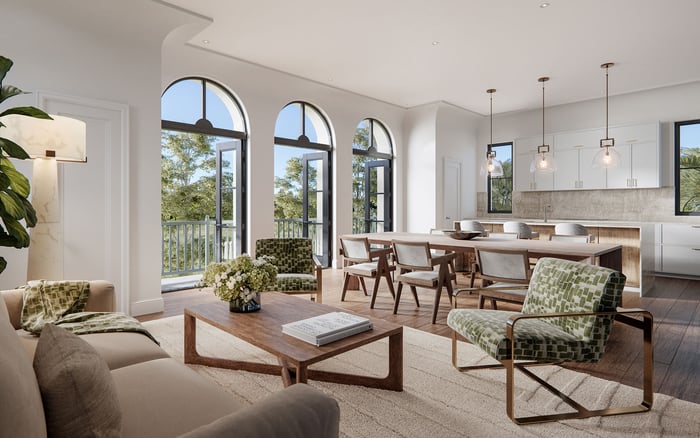
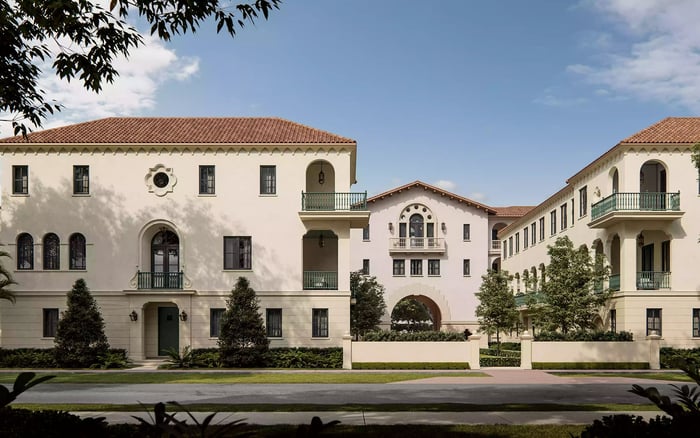
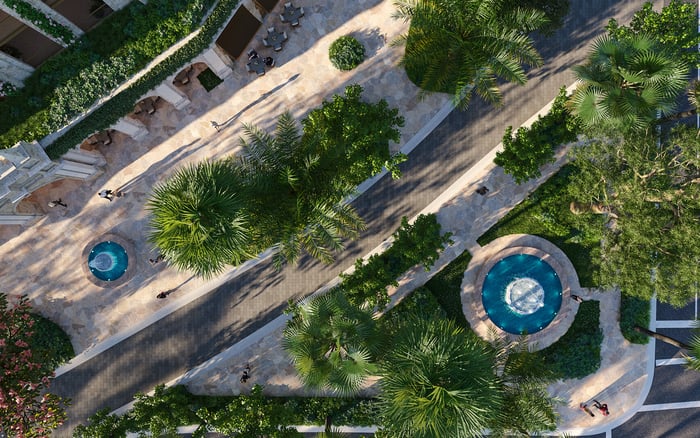
For buyers drawn to Coral Gables for its cultivated streets, architectural continuity, and human-scale living, The Village at Coral Gables sits within a broader local logic: walkability here is not accidental, and Mediterranean character is not a marketing veneer. This MILLION editorial examines why that combination continues to resonate with discerning purchasers who prefer context, texture, and neighborhood identity over the anonymity of conventional tower living.
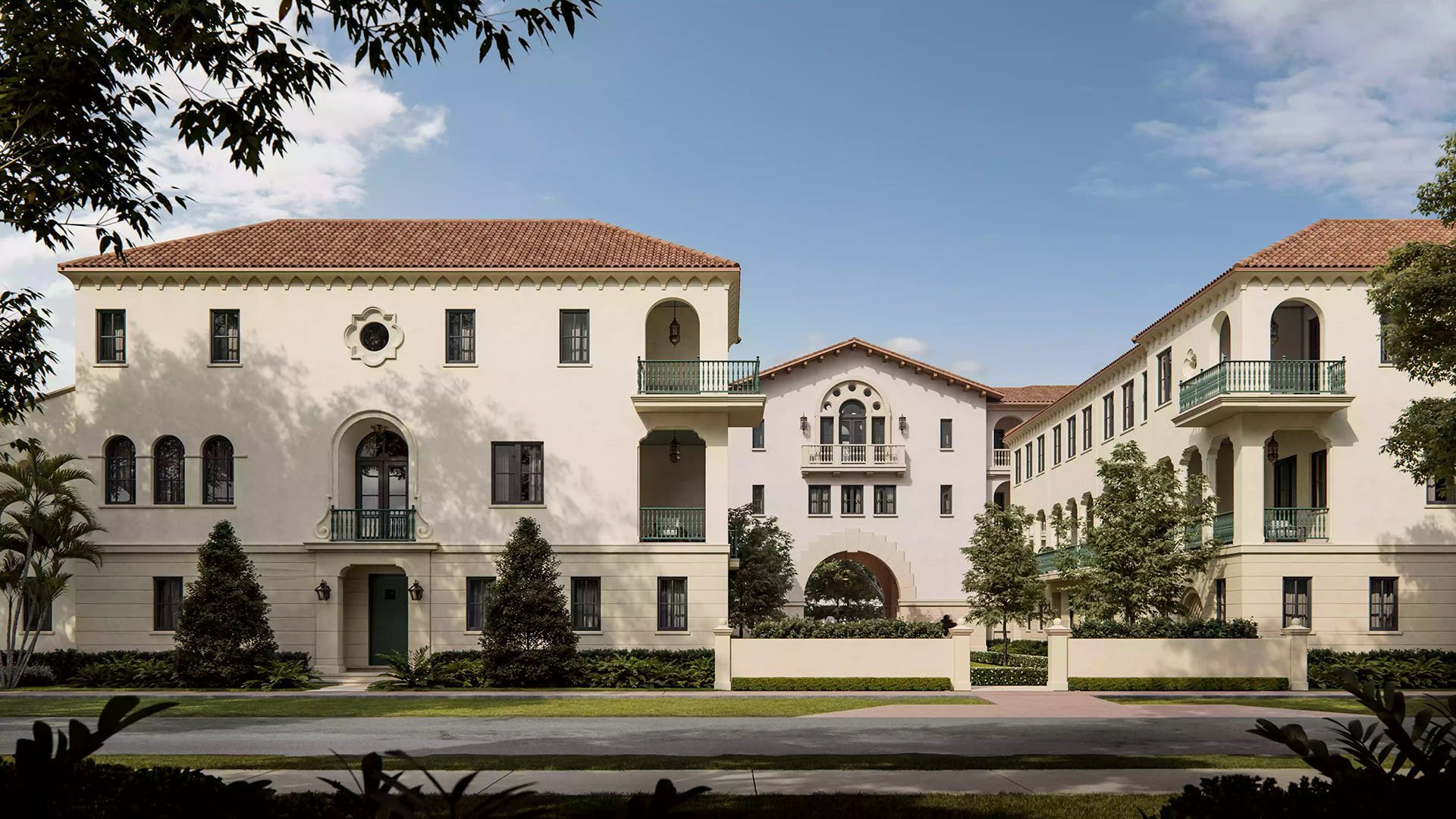
There is a distinct South Florida buyer who wants urban convenience without giving up domestic intimacy. This buyer wants to walk to dinner, coffee, services, and social engagements, but does not want to return home through a grand yet impersonal condo lobby. They want architecture with memory: courtyards, arcades, textured façades, traditional rooflines, and streets that feel shaped for people rather than traffic flow alone.
That is why Coral Gables continues to hold a singular place in the regional luxury conversation. The city has long supported compact, mixed-use planning patterns that favor walkable neighborhoods over strictly single-use districts. Its development framework also places unusual emphasis on context, compatibility, and urban design. For a sophisticated buyer, that matters because lifestyle quality is rarely just about square footage. It is about whether a home belongs to a coherent public realm.
Within that setting, The Village at Coral Gables appeals not as an isolated address, but as part of a larger civic fabric. The draw is the promise of daily life shaped by proximity, visual continuity, and recognizable neighborhood character.
In many luxury markets, walkability is a fortunate byproduct. In Coral-gables, it is more deliberate. Local planning policy supports mixed land uses, pedestrian circulation, high-quality streetscapes, and a reduced visual dominance of parking in urban settings. Those ideas may sound technical, but buyers experience them in simple, tangible ways: shorter errands, more pleasant sidewalks, and blocks that invite lingering instead of rushing back to the car.
That structure is one reason the city’s commercial life feels unusually integrated with residential living. Dining, retail, and professional services are concentrated in accessible districts, making car-light daily routines more plausible than in much of South Florida. For the luxury buyer who values time, convenience, and aesthetic order, that translates into a different kind of prestige. It is less about spectacle and more about ease.
This is also why boutique and low-rise formats continue to hold such appeal here. A buyer comparing Coral Gables with more vertical submarkets may admire the polish of waterfront towers elsewhere, whether in 2200 Brickell or Arbor Coconut Grove, yet still prefer the sense of embeddedness that Coral Gables offers. In the Gables, the walk to a restaurant or appointment often feels like part of the residential experience rather than a transition out of it.
Coral Gables does not merely reference Mediterranean architecture. It actively protects a visual identity shaped around it. Design standards reinforce the elements most associated with the city’s signature language: textured façades, arcades, courtyards, and traditional roof forms rooted in Mediterranean and Spanish-influenced architecture. Architectural review and entitlement oversight help ensure that new development contributes to a cohesive public realm rather than disrupting it.
For luxury buyers, this directly affects value. Character reinforced by policy tends to feel more durable than character created by branding alone. In practical terms, that means the surrounding environment is more likely to sustain the mood that attracted the buyer in the first place. Streets remain legible. Buildings relate to one another. Public-facing design is expected to align with neighborhood identity.
Historic preservation controls strengthen that effect in significant areas by limiting out-of-context alterations. The result is not a static museum condition, but a city where architectural continuity remains visible and meaningful. For a buyer considering The Village at Coral Gables or nearby options such as Ponce Park Coral Gables and Cora Merrick Park, the appeal is often tied to this continuity as much as to the residence itself.
Condo anonymity is not necessarily a critique of luxury towers. In many cases, tower living is exceptional. But some buyers begin to resist the standard high-rise formula: long interior corridors, heavily privatized arrival sequences, and a subtle separation from the street that makes the home feel detached from neighborhood life.
Coral Gables offers an alternative. The city’s review process places importance on how projects meet the street, and its design guidance favors buildings that help shape a human-scale public realm. That tends to support residential formats with more tactile identity and a more immediate relationship to their surroundings.
For the buyer who wants to feel known by place rather than buffered from it, this distinction is essential. They are not rejecting luxury. They are refining it. They want privacy, but not impersonality. They want distinction, but not visual noise. They want architecture that reads as residence first and commodity second.
This sensibility also explains why the Boutique and Townhouse mindset has enduring appeal in the Gables. Even where inventory and pricing vary across the city, centrally located residences with strong architectural identity often command attention because they satisfy an increasingly specific brief: convenience without crowd logic, elegance without excess standardization.
For a buyer assessing The Village at Coral Gables, the right lens is not simply price per square foot. It is lifestyle fit within Coral Gables’ planning and design ecosystem. The first question is whether the home supports a genuinely walkable routine. Can daily rituals unfold on foot with ease and pleasure rather than effort? In this market, that convenience often underpins long-term desirability.
The second question is architectural endurance. In Coral Gables, buyers are not purchasing into a neutral backdrop. They are stepping into a city where compatibility, streetscape quality, and Mediterranean character are part of the broader framework. That can matter to future resale because the surrounding environment remains part of the asset.
The third question is emotional texture. Does the setting feel domestic, legible, and grounded? For many purchasers, that is the decisive advantage over more anonymous high-rise options. The experience of moving through a courtyard, along a shaded frontage, or through a block with architectural rhythm can feel more personal than entering a vertical complex designed to serve scale above all else.
Coral Gables spans a wide price range, from comparatively smaller attached residences to multimillion-dollar luxury homes, yet premium pricing in walkable and centrally located product continues to make sense within the city’s logic. Buyers are paying not only for a residence, but for planning discipline, design stewardship, and a daily environment that tends to age gracefully.
That is what separates enduring luxury from transient appeal. In some parts of South Florida, the story is view, amenity, and height. In Coral-gables, the story is often street, proportion, materiality, and the subtle confidence of a place that already knows what it is. For purchasers who value that certainty, The Village at Coral Gables represents an especially compelling expression of the area’s appeal.
Why do buyers choose The Village at Coral Gables over a typical tower residence? Many are seeking walkability, architectural character, and a more intimate relationship to the street and neighborhood.
Is walkability really part of Coral Gables’ long-term appeal? Yes. The city’s planning framework supports mixed-use patterns, pedestrian circulation, and quality streetscapes.
What makes Coral Gables feel different from more vertical luxury districts? Its human-scale environment, Mediterranean design language, and emphasis on contextual development create a more grounded residential experience.
Why does Mediterranean architecture matter to buyers here? It contributes to identity, visual continuity, and a sense of permanence that many buyers find more compelling than generic design.
Does Coral Gables protect its architectural character? Yes. Design review, compatibility standards, and preservation controls help maintain neighborhood quality over time.
Is The Village at Coral Gables best suited for full-time residents or second-home buyers? It can appeal to both, especially buyers who prioritize daily convenience and a sense of place over tower-style anonymity.
How should a buyer assess value in this part of the market? Beyond pricing, they should weigh walkability, architectural endurance, and how well the home fits Coral Gables’ public realm.
Are Boutique residences especially attractive in Coral Gables? Often, yes. Buyers drawn to lower-scale, character-driven living frequently prefer the Boutique feel over larger condo formats.
What role does the surrounding neighborhood play in resale? A great deal. In Coral Gables, the consistency of streetscape and design identity can strengthen long-term desirability.
Is Coral-gables still relevant for luxury buyers seeking refinement rather than spectacle? Absolutely. Its appeal lies in composure, craftsmanship, and an urban lifestyle shaped by beauty and proximity.
For a tailored shortlist and next-step guidance, connect with MILLION.
If branded residences are on your mind — as a home or as an allocation — we would be glad to share what we are seeing, privately.
Begin a quiet conversation