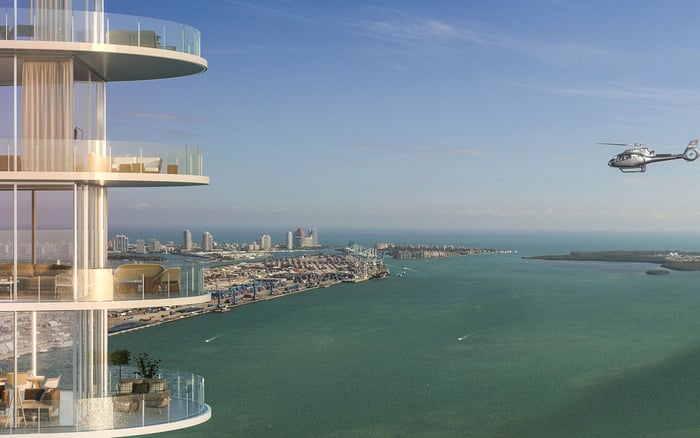
A discreet buyer’s guide to flood-disclosure review at The Ritz-Carlton Residences® Sunny Isles, focused on documents, insurance, building systems, resale context and advisor-led due diligence.

At The Ritz-Carlton Residences® Sunny Isles, the first impression is inherently architectural: glass, height, arrival sequence, horizon and service culture. Yet for sophisticated buyers, the more consequential review often begins after the visual appeal. A flood-disclosure review is not a sign of hesitation. It is a sign of seriousness.
For oceanfront and near-ocean luxury property, the question is not simply whether a residence feels protected, elevated or impeccably maintained. The sharper question is what the documents state, what the building’s systems support, what the insurance language may imply and how future buyers may interpret the same information when the residence returns to the market.
This is especially relevant in South Florida, where lifestyle value and coastal exposure often coexist. Disciplined buyers do not treat flood disclosure as a narrow legal form. They treat it as part of the property’s investment biography, one that can influence financing comfort, insurance expectations, carrying-cost analysis, renovation strategy and resale positioning.
A disclosure is best understood as an entry point. It may identify known conditions, prior claims, owner knowledge or building-level representations, but it should not be asked to carry the full burden of due diligence. A polished residence can still require a layered review of association documents, insurance summaries, building communications, engineering context and any available history of water intrusion or storm-related repair.
The distinction matters. Flooding can be discussed at multiple levels: individual unit, common area, garage, mechanical area, amenity level, podium, frontage, landscaping or access route. A buyer should not accept a broad answer when the real exposure may be specific. The relevant question is not simply, “Has it flooded?” It is, “What exact area, under what circumstances, with what remedial action, and with what documentation?”
When a seller or representative provides a response, the next step is to connect that answer to the record. If the response concerns a past event, look for repair records, board communications or insurance discussion. If the answer concerns resilience, ask what systems support that statement. The goal is not alarm. The goal is alignment between representation and documentation.
Luxury buyers are accustomed to judging quality through finishes, service, views and floor-plan logic. Flood review requires a different gaze. It asks the buyer to look below the private residence and consider the infrastructure that protects the experience above it.
Important areas for review may include garage levels, lobby elevations, drainage design, pumps, waterproofing details, emergency power, mechanical-room placement, elevator systems and access points. Even where a private residence sits high above grade, the building’s daily function may depend on lower-level systems. A residence can have extraordinary views and still warrant careful review of how the building performs at its base.
This is where premium representation becomes practical rather than ceremonial. A buyer’s counsel, inspector, insurance advisor and property consultant should be aligned before a major commitment is made. Their work should be coordinated, not sequential, because flood-related questions often overlap. Insurance language may point to building systems. Building documents may point to maintenance reserves. Maintenance history may point to future capital planning.
Insurance should be reviewed early, not treated as a closing-week formality. For a high-value condominium purchase, the buyer should understand the relationship between the master policy, the owner’s policy, deductibles, exclusions, special assessments and lender expectations. The most elegant tower can still produce complicated insurance questions if the buyer waits too long to examine them.
The review should focus on both coverage and the transferability of risk. What does the association policy address? What remains the owner’s responsibility? How are deductibles allocated after an event? Are there details that could affect future budgeting? These questions are not designed to diminish enthusiasm. They are designed to prevent surprise.
For cash buyers, insurance discipline remains important. The absence of a lender does not eliminate the economics of risk. For financed buyers, lender requirements may introduce additional timing pressure. Either way, an informed review can help distinguish between an ordinary coastal consideration and a material concern.
A flood-disclosure review is also a resale strategy. The buyer who asks better questions today is often better positioned to answer questions tomorrow. In the ultra-premium tier, future purchasers tend to scrutinize not only design and address, but also documentation quality. Clean records, clear explanations and organized files can become quiet advantages when it is time to sell.
For a buyer cataloging the opportunity, the language may include The Ritz-Carlton Residences® Sunny Isles, Sunny Isles, oceanfront, waterview, second-home and resale. Yet each label should be tested against the physical and documentary realities of the asset. A view is emotional. A disclosure file is evidentiary. Both matter.
This is particularly important for owners who may use the residence seasonally. A second-home owner may not be present during every storm event, board meeting or building update. That makes document access, management responsiveness and advisor oversight more important, not less.
The best time to ask direct questions is before the negotiation is shaped by attachment. Buyers should ask whether there has been any known water intrusion affecting the unit, limited common elements or common areas relevant to daily use. They should ask whether any flood-related insurance claims, repairs or assessments have been discussed by the association. They should ask how the building manages drainage, emergency power and access after severe weather.
Equally important, buyers should ask for clarity on definitions. “No issue in the unit” does not necessarily answer whether there was an issue elsewhere in the building. “No current problem” does not necessarily answer whether a past event was repaired. “Managed by the association” does not necessarily answer whether future costs could be assessed to owners.
In luxury real estate, the strongest questions are calm, specific and document-driven. They invite facts rather than reassurance. If the answers are strong, the buyer gains confidence. If the answers are incomplete, the buyer gains leverage or time.
A strong advisory team should make the process quieter, not louder. The buyer should not need drama to obtain clarity. The proper approach is precise document requests, careful reading, targeted follow-up and a written summary of open items before deposit deadlines or closing milestones.
Legal counsel can examine disclosure obligations and contract protections. An insurance advisor can clarify coverage and probable owner responsibilities. A qualified inspector or building professional can focus attention on physical systems. A market advisor can consider how the answers may influence resale narrative and buyer perception.
The goal is not to transform a residence into an engineering case study. The goal is to match the purchase price, personal use and risk profile with a complete understanding of the asset. For a property of this caliber, elegance should extend to the diligence process.
Is flood-disclosure review necessary for a high-floor residence? Yes. A high-floor home may still depend on lower-level systems, access, elevators, garages, mechanical areas and association-managed infrastructure.
Should buyers rely only on the seller disclosure? No. The disclosure should be compared with association records, insurance information, inspection findings and any available repair history.
What is the most important flood-related question to ask? Ask what exact area was affected, when it occurred, how it was repaired and what documentation supports the answer.
Can insurance review wait until the end of closing? It should not. Insurance can affect carrying costs, lender comfort and the buyer’s understanding of risk allocation.
Does an oceanfront location automatically mean unacceptable risk? No. The issue is not the coastline alone, but how the building, documents, insurance and maintenance history address coastal conditions.
Should cash buyers still review flood insurance details? Yes. Even without lender requirements, insurance terms and association responsibilities can affect long-term ownership costs.
How does flood disclosure affect resale? Future buyers may ask similar questions, so organized records and clear answers can support confidence when the property is marketed.
What if the answers are incomplete? Incomplete answers should prompt follow-up, advisor review and, when appropriate, contract protections or additional time before commitment.
Who should be involved in the review? Buyers typically benefit from coordinated input from counsel, insurance guidance, inspection expertise and a luxury market advisor.
Is this review about avoiding the purchase? Not necessarily. It is about buying with precision, understanding and documentation appropriate to a significant coastal asset.
If you'd like a private walkthrough and a curated shortlist, connect with MILLION.
If branded residences are on your mind — as a home or as an allocation — we would be glad to share what we are seeing, privately.
Begin a quiet conversation