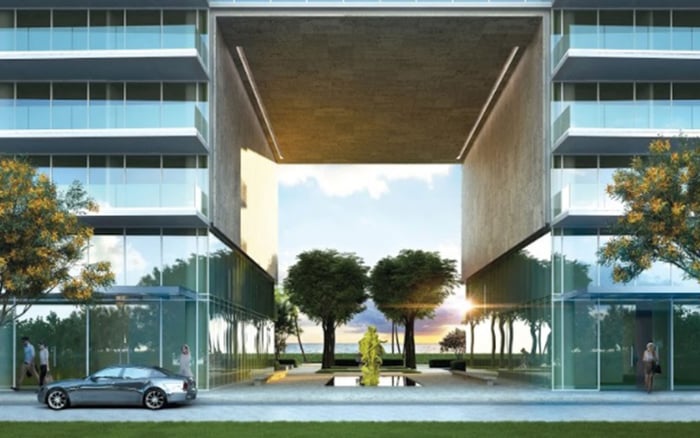
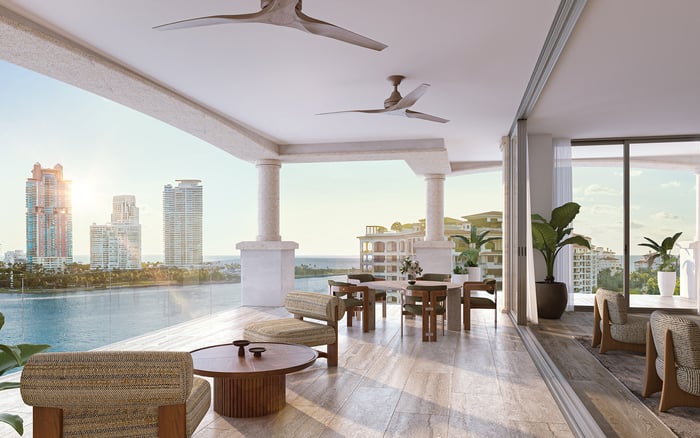
A buyer-focused comparison of The Residences at Six Fisher Island and Rivage Bal Harbour, examining how ferry-only arrival versus bridge-connected access shapes privacy, daily mobility, pricing, and lifestyle fit for South Florida’s ultra-luxury purchaser.
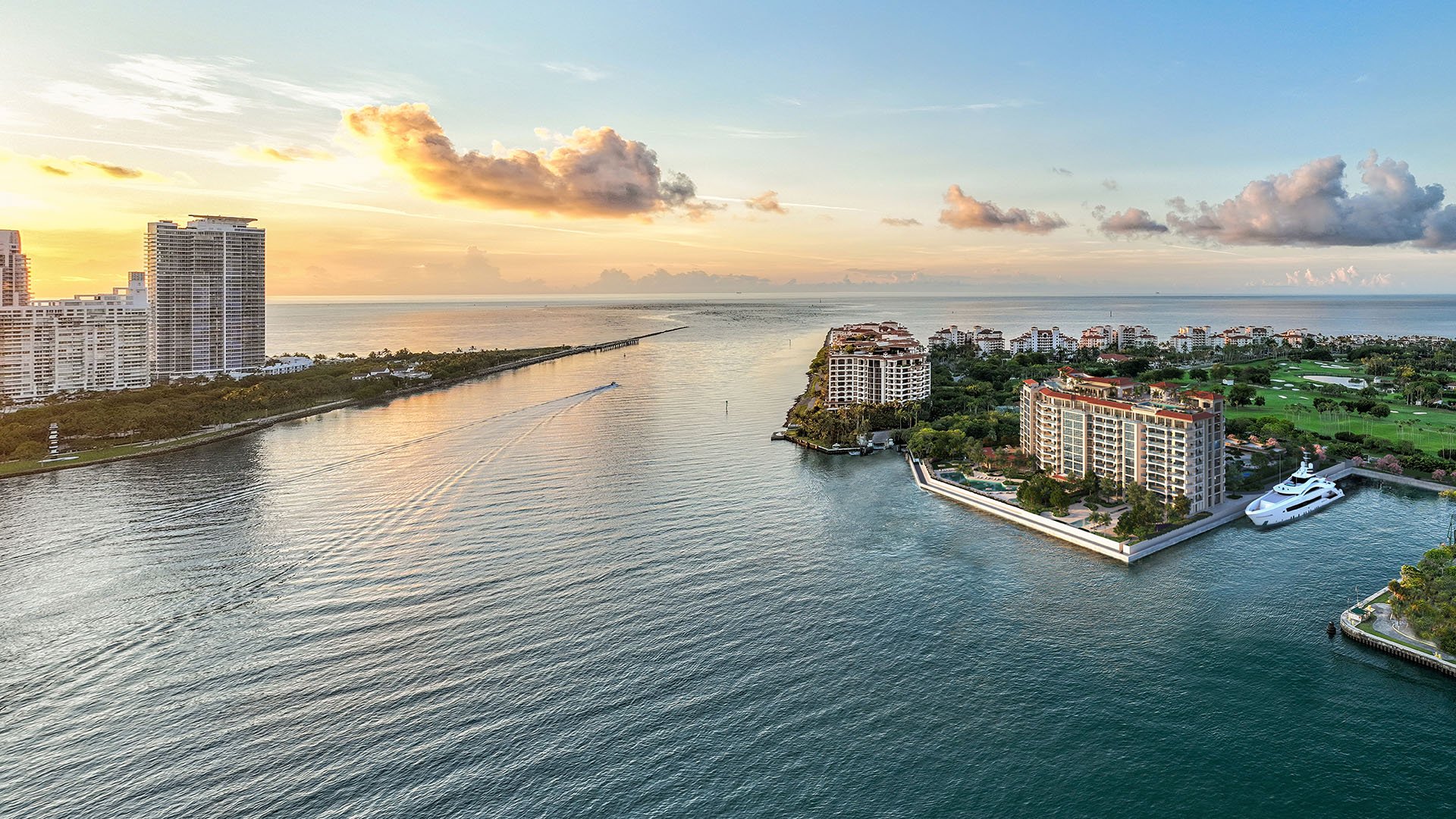
At the top of South Florida’s residential market, access is not a logistical footnote. It is often the clearest expression of how a buyer wants to live. In the comparison between The Residences at Six Fisher Island and Rivage Bal Harbour, the central distinction is not simply architecture, pricing, or amenities. It is the route home.
One address sits on a private island off Miami Beach with no bridge or causeway. The other rises along the bridge-connected barrier-island corridor of Bal Harbour, where residents can arrive by car through the local road network. That difference shapes nearly every aspect of ownership, from the cadence of a weekday schedule to the meaning of privacy itself.
For the buyer considering Fisher Island versus Bal Harbour, this is ultimately a choice between deliberate separation and seamless integration. Both are unmistakably luxury propositions, but they serve different instincts.
At Six Fisher Island, arrival is part of the residential experience. Fisher Island is reached by private ferry or private boat, and the absence of a bridge is one of the community’s defining features.
That condition gives the island a level of insulation that is difficult to replicate anywhere else in Miami Beach. Residents are not merely buying an oceanfront apartment in a prestigious setting. They are buying into a gated community where the threshold between public city life and private residential life is unusually firm.
The appeal is obvious for buyers who value removal from traffic, casual pass-through activity, and the normal visual rhythm of a connected urban coastline. Fisher Island’s identity has long been tied to extreme exclusivity, private beach access, and a self-contained environment with dining, spa, golf, marina, and sports amenities. It functions less like a standard condominium setting and more like a highly curated enclave.
For those already familiar with the island through The Links Estates at Fisher Island, Six Fisher Island sits within a rarefied context where the journey home reinforces the address.
Rivage Bal Harbour reflects a different luxury logic. Rather than using distance from the mainland as a filter, it pairs beachfront positioning with conventional vehicular accessibility. Residents can move in and out of Bal Harbour through an established road network, allowing direct daily connectivity to the broader Miami-Dade landscape.
That matters more than many glossy brochures imply. Bridge-connected living simplifies the routine movements of modern wealth: school runs, business appointments, dinner reservations, medical appointments, airport transfers, household staffing, and spontaneous use of the city. For buyers who want oceanfront prestige without reengineering daily patterns, Rivage presents a more fluid proposition.
Buyers comparing Rivage with nearby peers such as Oceana Bal Harbour and Arte Surfside will recognize the appeal of this corridor: ultra-luxury living that remains connected to the broader social and commercial fabric of the coast.
In practical terms, Rivage is less ceremonial than Fisher Island and more frictionless. For some buyers, that is not a compromise. It is the point.
The clearest way to evaluate these two projects is to ask which form of luxury matters more: controlled isolation or unrestricted mobility.
Six Fisher Island offers privacy that begins before one reaches the front door. Because there is no bridge or causeway, the island maintains a degree of scarcity and separation that feels qualitatively different from a conventional luxury tower. The setting naturally limits incidental access and contributes to a more discreet residential atmosphere.
Rivage, by contrast, favors continuity with the mainland. Its residents retain the convenience of ordinary road access while still enjoying a top-tier beachfront setting. This usually appeals to buyers who split time between multiple homes, maintain active business schedules, or simply prefer a less choreographed version of exclusivity.
Neither model is inherently superior. The decision turns on temperament. If an owner wants the home to feel like a retreat from Miami, Fisher Island is the stronger answer. If the owner wants a luxury residence that keeps Miami instantly usable, Bal Harbour has the edge.
These addresses are often discussed in different pricing bands, even though both operate in the ultra-luxury category. The directional difference presented in the market is that Six Fisher Island sits above Rivage Bal Harbour, reflecting the premium buyers often assign to privacy, island separation, and scarcity.
This is why the comparison is not simply about product. It is about purchaser identity. Six Fisher Island skews toward buyers seeking maximum insulation, trophy positioning, and a community culture tied to selective club life. Rivage attracts buyers who still want a sophisticated oceanfront address, but without giving up the ease of a conventional ownership pattern and bridge-connected accessibility.
The most revealing test is not a holiday weekend. It is an ordinary Tuesday.
On Fisher Island, daily life can feel exceptionally contained. That is one of its strongest luxuries. Beach access, recreation, marina use, wellness, and dining are woven into the island environment itself, reducing the need to move outward unless one chooses to. For a second-home owner or a buyer who wants retreat-level calm, this can be ideal.
Yet the same structure asks for a certain mindset. Guests, service flows, and mainland errands all move through a system defined by ferry access. Ownership can also involve a club-and-community culture in which membership transfer terms may affect the resident experience.
At Rivage, the routine is easier to improvise. Residents can maintain a beachfront lifestyle while moving naturally through the rest of the city. That flexibility can be decisive for buyers who prioritize convenience alongside prestige.
Choose Six Fisher Island if the highest value lies in controlled access, social discretion, and a residential experience that feels physically separated from Miami’s usual tempo. It suits buyers who see exclusivity not as branding, but as infrastructure.
Choose Rivage Bal Harbour if the priority is refined oceanfront living with easier day-to-day movement and a more conventional path in and out of the property. It suits buyers who want luxury without logistical ceremony.
In that sense, this is not a debate between better and worse. It is a debate between two elite definitions of convenience. One treats privacy as the ultimate convenience. The other treats mobility that way.
Is Six Fisher Island more private than Rivage Bal Harbour? Yes. Its ferry or boat access creates a stronger threshold from the mainland than a bridge-connected property.
Does Fisher Island have road access from Miami? No. There is no bridge or causeway, so access is through private ferry service or private boat.
Is Rivage Bal Harbour easier for daily commuting? Yes. Its Bal Harbour location allows direct vehicular access through local roads and bridge connections.
What is the main lifestyle difference between these two projects? Six Fisher Island emphasizes separation and privacy, while Rivage Bal Harbour emphasizes beachfront living with easier daily mobility.
Which project feels more retreat-like? Six Fisher Island generally feels more retreat-oriented because the arrival process itself reinforces privacy and distance from the mainland.
Which project is better for buyers who want simpler in-and-out access? Rivage Bal Harbour is the clearer fit for buyers who want to move through Miami-Dade without a ferry transfer.
Does Fisher Island offer a more self-contained environment? Yes. The island is known for private beach access and a broader amenity environment that supports staying on-island for much of daily life.
Do membership considerations matter on Fisher Island? They can. Buyers should review any membership or transfer terms carefully during due diligence.
Is this comparison really about convenience? Yes, but in two different forms. One project defines convenience as privacy and insulation, while the other defines it as easier daily connectivity.
What is the best way to shortlist comparable options for touring? Start with location fit, delivery status, and daily lifestyle priorities, then compare stacks and elevations to validate views and privacy.
For a confidential assessment and a building-by-building shortlist, connect with MILLION Luxury.
If branded residences are on your mind — as a home or as an allocation — we would be glad to share what we are seeing, privately.
Begin a quiet conversation