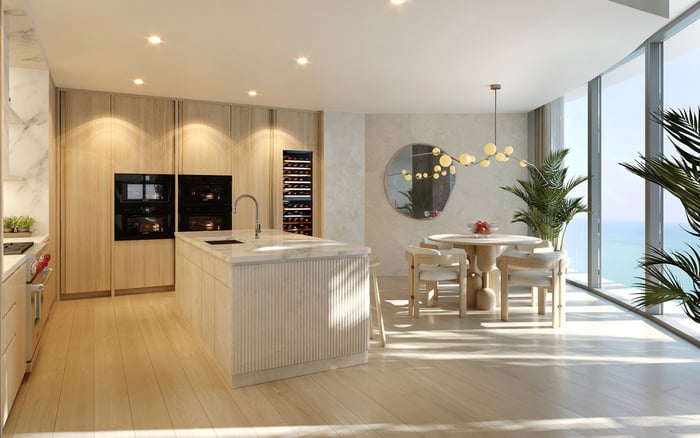
A buyer-focused due-diligence view of The Residences at Six Fisher Island and Rivage Bal Harbour, emphasizing staff circulation, laundry logistics, vendor access, and the invisible systems that allow an ultra-luxury residence to operate with estate-level discretion.

At the top end of South Florida’s condominium market, the most revealing due-diligence questions are often not about stone, glass, or water views. They are about movement. How does a chef enter with provisions? Where does a housekeeper stage linens? Can a nanny move between family spaces without crossing a formal arrival sequence? Does a vendor visit create friction at the residence door, the elevator bank, or the building’s security perimeter?
That is the lens through which serious buyers should evaluate The Residences at Six Fisher Island and Rivage Bal Harbour. Both belong in the ultra-luxury conversation, and both should be considered as more than elegant homes. For owners with chefs, housekeepers, laundresses, nannies, personal assistants, private security, drivers, and rotating vendors, the residence becomes an operating platform. Its success depends on whether daily service can be delivered with the calm and discretion expected from a private estate or a boutique hotel floor.
This is also why the language of Fisher Island and Bal Harbour matters. These are not purely seasonal-use markets for every buyer. Many global families expect a South Florida residence to perform with the same discipline they associate with serviced homes in London, New York, or Dubai. In that context, pre-construction review and second-home planning should include operational choreography from the first floorplan conversation.
A household staff plan begins with people, but it is resolved through architecture and building operations. A residence that photographs beautifully may still struggle if staff circulation, storage, service entries, laundry movement, catering access, and trash removal all depend on the same paths used by owners and guests.
At The Residences at Six Fisher Island, the buyer’s question should be how lifestyle and operational demands meet. The Fisher Island setting carries clear privacy and exclusivity cues, but due diligence should go deeper than the island narrative. If the home will be staffed daily, buyers should test how many people may be working at one time, where they enter, where they pause, where they store supplies, and how their movements intersect with family life.
At Rivage Bal Harbour, the same discipline applies in a different coastal context. Bal Harbour buyers often expect refined, hotel-level ease, yet that ease is created by practical systems. A floorplan should be read not only for bedroom count and entertaining scale, but also for how groceries, catering, maintenance, luggage, laundry, and waste move through the home and building without becoming visible events.
The most sophisticated residences allow staff to support the household without becoming part of the foreground. That does not mean hiding people. It means giving professional service the routes, rooms, storage, and access controls required to operate with dignity and precision.
Laundry is one of the clearest stress tests in an ultra-luxury residence because it is relentless. Sheets, towels, beachwear, children’s clothing, uniforms, table linens, robes, guest bedding, and delicate wardrobe care all create volume. During high-occupancy periods, an undersized or poorly placed laundry area can become the point where the illusion of effortless living begins to fail.
A buyer should ask where the laundry room sits in relation to bedrooms, staff areas, service access, and storage. If linens must cross formal entertaining rooms, private family lounges, or a primary arrival gallery, the residence may not support the level of discretion the owner expects. If the laundry room is isolated from storage, staff may spend unnecessary time moving between closets, service areas, and machines. If capacity is insufficient for peak use, the household may depend more heavily on outside vendors, introducing additional access and security considerations.
The right laundry plan should answer several questions at once. Can multiple staff members work without blocking circulation? Is there space for sorting, folding, hanging, staging, and temporary storage? Can clean and soiled items move separately? Is there a practical path from bedrooms and bathrooms to laundry and back again? In an oceanfront lifestyle, where towels, beachwear, and guest turnover can be part of the daily rhythm, this issue becomes even more important.
Service corridors and service elevators are not secondary luxuries. They determine whether a residence can function without staff and vendors crossing formal zones. In the strongest back-of-house environments, housekeeping, catering, trash, groceries, luggage, maintenance, and deliveries have a discreet path that is legible to staff and protected from guest-facing spaces.
For The Residences at Six Fisher Island and Rivage Bal Harbour, the buyer should avoid assuming that a prestigious building automatically resolves these details. Instead, the due-diligence walk-through should follow the likely journey of a normal service day. A chef arrives with provisions. A housekeeper needs fresh linens. A driver brings luggage. A vendor needs supervised access. A maintenance technician enters for a scheduled appointment. Each scenario should be mapped from building entry to residence entry, and from residence entry to the relevant work zone.
The question is not simply whether there is a service elevator. It is how that elevator connects to the residence, whether it is convenient enough to be used consistently, and whether building rules support the intended staffing model. If the path is awkward, staff may default to the most direct route, even when that route crosses family or entertaining areas. Over time, that becomes an operational flaw rather than a minor inconvenience.
The more complex the household, the more important access control becomes. Every vendor visit is a point of exposure. Caterers, florists, wardrobe specialists, repair technicians, cleaners, delivery personnel, and personal service providers all need entry protocols that protect the household without creating a burdensome daily ritual.
Security due diligence should examine how outside vendors are identified, admitted, escorted, and released. Buyers should understand whether service access is separated from resident and guest arrival, how vendors reach the residence, and where they wait if they arrive early. The objective is not only privacy. It is continuity. A household with a full staff should not have to reinvent logistics every time a new vendor comes to the property.
For global families, this can be especially important. The residence may be occupied by different family members at different times, supported by rotating staff and outside specialists. A clear operational structure protects the experience of luxury by reducing confusion, interruption, and unnecessary visibility.
Before signing, buyers should request the materials and conversations needed to evaluate daily operations. That includes actual floorplans, service elevator relationships, staff entry points, laundry-room dimensions, storage areas, trash routes, catering paths, vendor procedures, and building rules. Renderings and finish palettes cannot answer these questions alone.
Walk the plan as if the residence were fully occupied for a long weekend. Where do extra linens go? How does breakfast service work when guests are still sleeping? Can housekeeping reset bedrooms without crossing a lunch setup? Where do deliveries land? How does luggage move from arrival to closets? Can maintenance access mechanical or service areas without entering private rooms unnecessarily?
The ideal outcome is a residence that feels serene because the systems are doing their work quietly. When staff, vendors, supplies, and waste have thoughtful routes, the owner experiences ease rather than management. That is the real test for both The Residences at Six Fisher Island and Rivage Bal Harbour: whether each home can support private-estate expectations inside a condominium setting.
Why should ultra-luxury buyers evaluate staff logistics before finishes? Finishes shape the first impression, but staff logistics shape daily life. A beautiful residence can still feel strained if service movement is exposed or inefficient.
What makes laundry placement so important in a large residence? Laundry volume rises quickly during family visits, guest stays, and beach-heavy use. Poor placement can create bottlenecks and visible linen movement.
Should buyers ask about service elevators? Yes. Buyers should understand not only whether service elevators exist, but how they connect to the residence and whether staff will realistically use them.
How should a buyer assess household staff needs? Start with a realistic staffing model that includes housekeepers, chefs, nannies, assistants, security, drivers, and vendors. Then test the floorplan against that model.
Are service corridors only relevant for very large households? No. Even part-time staff, caterers, and maintenance vendors need discreet circulation if the owner expects a polished daily experience.
What is the biggest mistake buyers make in operational due diligence? Many buyers focus on views, amenities, and finishes while assuming back-of-house systems will work. The better approach is to test ordinary service scenarios in detail.
How does vendor access affect privacy? Every vendor visit creates an access-control moment. Clear arrival, escort, and release procedures help protect privacy and reduce disruption.
Can a condominium operate like a private estate? It can, if the residence and building support staff movement, storage, laundry, deliveries, and security with minimal friction.
What should buyers verify before making project-specific conclusions? Buyers should verify actual floorplans, service layouts, laundry dimensions, storage, access routes, and building rules directly during diligence.
Why compare South Florida residences with London, New York, or Dubai standards? Many global families expect the same level of serviced-residence discipline across markets. South Florida homes must increasingly meet that operational benchmark.
If you'd like a private walkthrough and a curated shortlist, connect with MILLION.
If branded residences are on your mind — as a home or as an allocation — we would be glad to share what we are seeing, privately.
Begin a quiet conversation