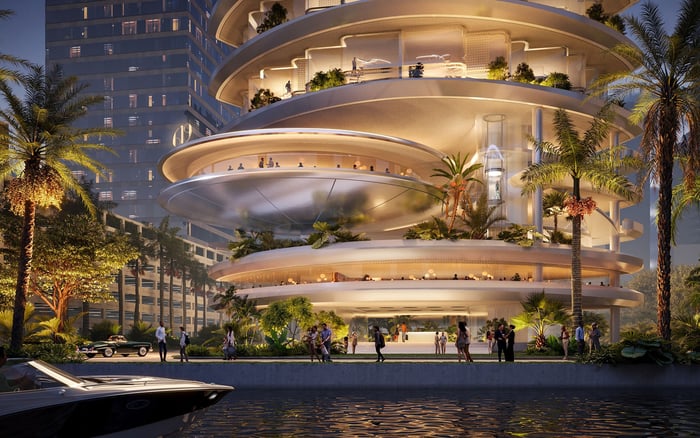
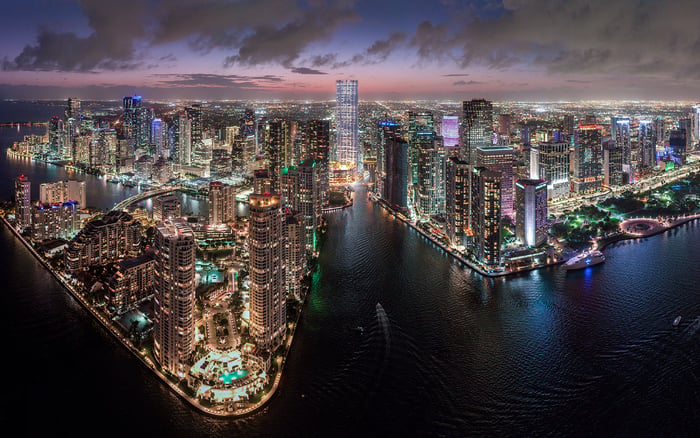
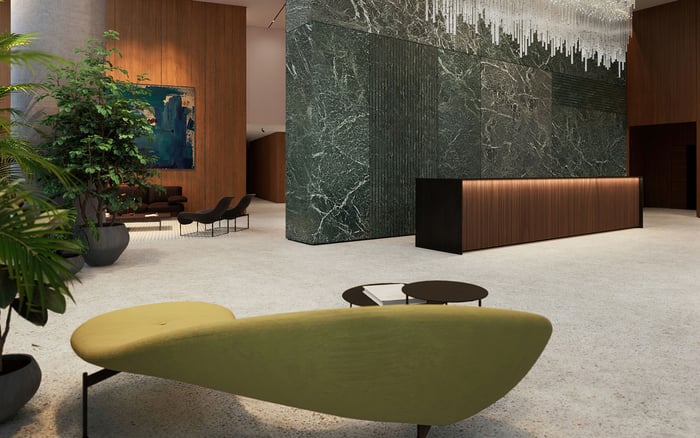
A buyer-oriented comparison of The Residences at Mandarin Oriental, Miami and 888 Brickell by Dolce & Gabbana, focused on how brand culture shapes privacy, scale, arrival, and daily familiarity in Miami’s ultra-luxury residential market.
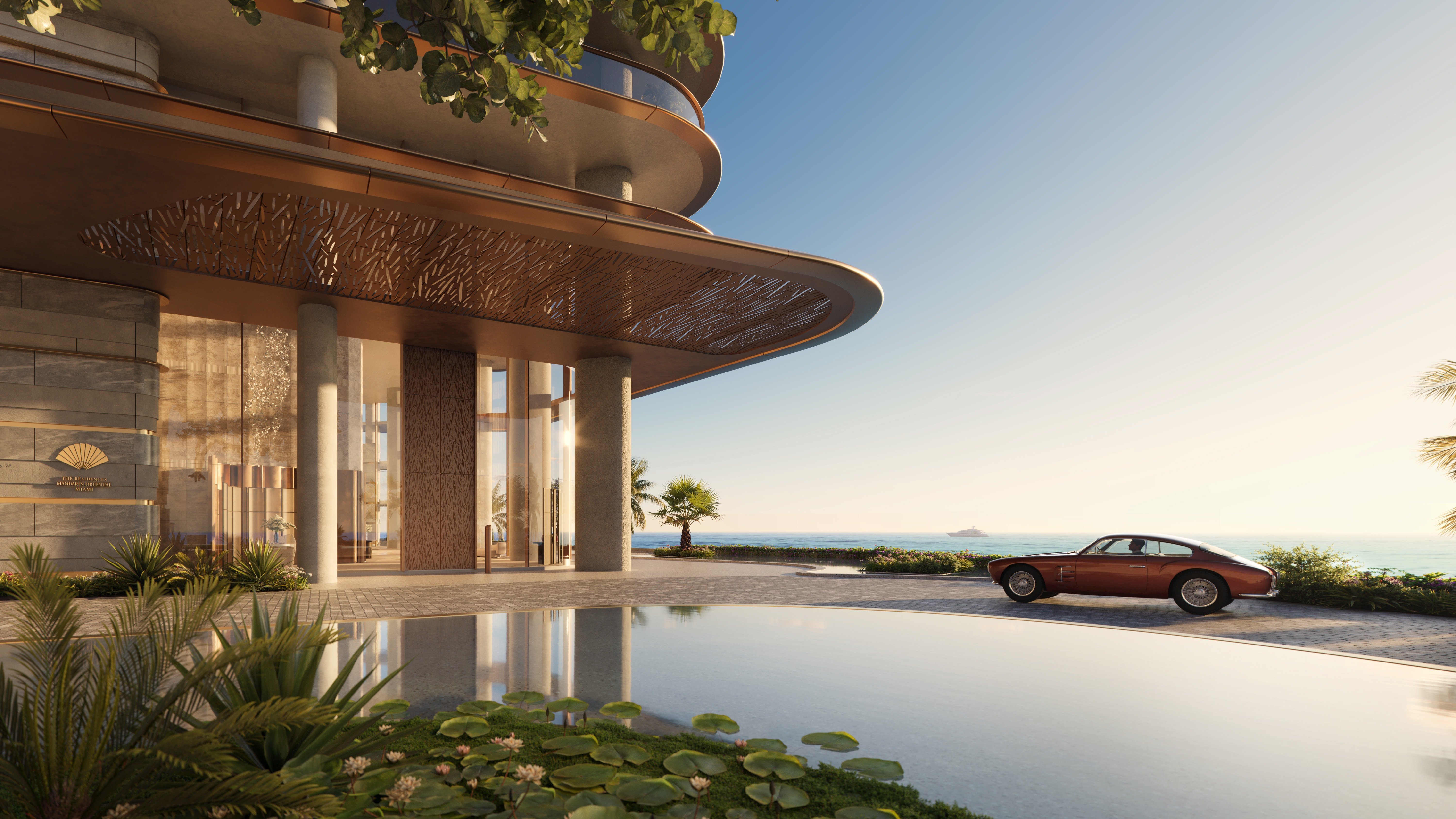
In Miami’s ultra-luxury residential market, brand is often discussed through finishes, amenities, and global cachet. Yet for a buyer, the deeper question is not only which name appears at the porte cochère. It is how that name shapes the rhythm of daily life.
The Residences at Mandarin Oriental, Miami and 888 Brickell by Dolce & Gabbana represent two distinct models of branded residential living. One is grounded in hotel-bred hospitality, discretion, and retreat. The other is shaped by fashion-house glamour, vertical presence, and a more extroverted relationship with the city. Both belong in the conversation around elite Miami living. They simply speak different languages.
For a buyer comparing these Miami and Brickell residences, the useful question is not which is more luxurious. It is whether home should feel like a private sanctuary with controlled thresholds, or a fashion-forward urban stage where arrival, design, and skyline identity carry greater social charge.
The Residences at Mandarin Oriental, Miami is framed around the familiar codes of high hospitality: service, discretion, recognition, and calm. Its Miami setting is central to that identity, supporting a more buffered residential atmosphere than a tower positioned purely around the central business district experience.
That distinction matters. A residence can sit close to the energy of Brickell without behaving exactly like the most visible mainland towers. The experience can feel more filtered, more deliberately paced, and more residential in tone. For buyers who want Miami access without the full sensory intensity of a highly public arrival, that difference becomes part of the luxury proposition.
At The Residences at Mandarin Oriental, Miami, the brand culture points toward retreat rather than display. The likely resident experience is defined by service recognition, controlled access, and a quieter form of privilege. The best version of that lifestyle is not about being seen from the lobby. It is about being known without needing to explain oneself.
This is where a hospitality brand can be especially powerful. A residence shaped by hotel service culture may create smaller-feeling arrival sequences even within a large luxury environment. Staff familiarity, discreet circulation, and private lobby behavior become part of the architecture of comfort.
888 Brickell by Dolce & Gabbana approaches residential identity from a different cultural source. It is not rooted in the etiquette of a calm hotel retreat. It is rooted in fashion, spectacle, and design as self-expression.
That makes its Brickell location feel essential rather than incidental. The project is positioned as a fashion-branded luxury residential tower within the dense urban fabric of Brickell, with an emphasis on skyline presence and a more theatrical residential posture. The core idea is closer to a vertical resort in the central business district, where architecture, interiors, and arrival all contribute to an image-driven experience.
For certain buyers, that is precisely the point. The appeal of 888 Brickell by Dolce & Gabbana is not only private comfort. It is the feeling of entering a branded world with visual intensity and social voltage. The building culture is more extroverted, more performative, and more aligned with Miami as a global stage.
This does not make it less residential. It makes the residential proposition different. A fashion-branded building can turn scale into identity. It can make common spaces feel less like hidden thresholds and more like curated scenes. For those who want their home to participate in the pulse of Brickell, that cultural logic can be compelling.
Lobby behavior is one of the clearest differences between these two models. In an ultra-luxury residence, the lobby is not merely a room. It is a social instrument. It determines who sees whom, how quickly residents pass through, and whether arrival feels intimate or public.
At The Residences at Mandarin Oriental, Miami, lobby privacy is framed as filtered and discreet. The culture favors controlled access and service-led intimacy. The ideal arrival is composed, polished, and quietly efficient. A resident may value being recognized by staff, guided with minimal friction, and shielded from unnecessary public exposure.
At 888 Brickell by Dolce & Gabbana, the lobby logic is more performative. It is more likely to embrace the social visibility of a fashion house and the urban drama of Brickell. Arrival can become part of the experience, not something to be minimized. For buyers who enjoy design impact, social energy, and a sense of place within the city’s vertical theater, that visibility may feel like an asset.
Neither model is inherently superior. The difference is personal. Some buyers want the lobby to disappear into the choreography of privacy. Others want it to announce the building’s identity from the first step inside.
Resident familiarity is the softer but perhaps more consequential difference. Luxury is often imagined as space, views, or amenities. In daily life, however, luxury can be the sense that the building understands one’s routines.
The Mandarin Oriental model is more likely to foster recognition and routine. Its hospitality culture supports repeat interactions, service memory, and a more intimate residential cadence. Over time, that can make a building feel less anonymous, even at the highest end of the market.
888 Brickell by Dolce & Gabbana is framed as more scene-driven and potentially more anonymous in its social texture. That can be attractive for residents who prefer energy over familiarity, or who want a home that feels cosmopolitan, fluid, and connected to the movement of Brickell. In this context, anonymity is not necessarily a drawback. It can be a form of freedom.
For a new-construction or pre-construction buyer, this distinction should be considered as seriously as views or floor plan. The question is whether daily life should be structured around familiar service and retreat, or around metropolitan momentum and visual intensity.
Building scale is often reduced to skyline profile, but in branded residences, scale is also psychological. A tower can be tall and still feel intimate if its thresholds are quiet. A building can be private yet still feel grand if its design language seeks attention.
The Residences at Mandarin Oriental, Miami uses its brand culture to create a smaller-feeling residential environment, even while participating in Miami’s ultra-luxury market. Its context reinforces the impression of separation and sanctuary.
888 Brickell by Dolce & Gabbana uses scale differently. Its value is tied to skyline presence, fashion identity, and an urban resort concept set within Brickell. It is meant to register as a statement, not only as a shelter.
This is why the phrase exclusive area can mean different things in Miami. For one buyer, exclusivity is a buffered setting and a private arrival sequence. For another, exclusivity is a branded address with strong visual identity in the center of the city.
The cleanest comparison is this: Mandarin Oriental is about being cared for discreetly, while Dolce & Gabbana is about living inside a more expressive design culture. One leans into hospitality and retreat. The other leans into fashion and presence.
A buyer who travels frequently, values personal recognition, and wants residential life to feel composed may naturally gravitate toward the Mandarin Oriental model. A buyer who wants a bold Brickell address, dramatic design language, and a more urban social setting may find 888 Brickell by Dolce & Gabbana more aligned with their lifestyle.
The best decision is not made by counting amenities. It is made by imagining the first five minutes after arriving home, then the next five years of daily repetition. In branded luxury, culture becomes habit. Habit becomes atmosphere. Atmosphere becomes the real residence.
How do these two Miami projects differ in overall culture? The Residences at Mandarin Oriental, Miami is framed around hospitality, discretion, and retreat. 888 Brickell by Dolce & Gabbana is more fashion-forward, theatrical, and urban.
Is one project more luxurious than the other? The better question is which form of luxury fits the buyer. One emphasizes sanctuary and service familiarity, while the other emphasizes visibility and design drama.
Why does setting matter for The Residences at Mandarin Oriental, Miami? Setting shapes how arrival, privacy, and daily pace are perceived. In this comparison, the Mandarin Oriental model is treated as calmer and more retreat-oriented.
Why does Brickell matter for 888 Brickell by Dolce & Gabbana? Brickell reinforces the project’s urban identity and skyline presence. Its central setting suits a more extroverted and image-driven residential concept.
Which project is likely to feel more private at arrival? The Mandarin Oriental model is framed as more filtered and discreet. Its hospitality culture favors controlled access and quieter lobby behavior.
Which project is likely to feel more social? 888 Brickell by Dolce & Gabbana is framed as more performative and scene-driven. Its fashion-house identity supports a more visible social atmosphere.
Does brand culture affect more than interiors? Yes. Brand culture can shape arrival, lobby thresholds, service style, resident familiarity, and the emotional scale of the building.
Which buyer may prefer The Residences at Mandarin Oriental, Miami? A buyer who values discretion, service recognition, and a sanctuary-like setting may prefer the Mandarin Oriental residential culture.
Which buyer may prefer 888 Brickell by Dolce & Gabbana? A buyer who wants strong design identity, skyline presence, and urban energy may prefer the Dolce & Gabbana model.
What is the best way to shortlist comparable options for touring? Start with location fit, delivery status, and daily lifestyle priorities, then compare stacks and elevations to validate views and privacy.
If you'd like a private walkthrough and a curated shortlist, connect with MILLION.
If branded residences are on your mind — as a home or as an allocation — we would be glad to share what we are seeing, privately.
Begin a quiet conversation