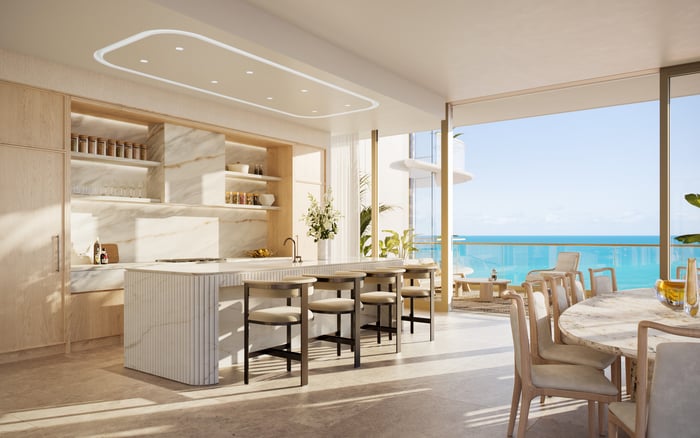
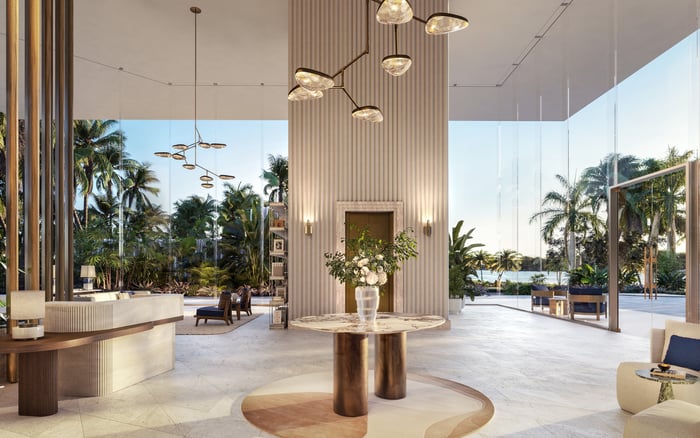
A buyer-focused look at The Perigon Miami Beach through the lenses that matter most in ultra-prime oceanfront living: privacy, spatial depth, and site scale.

The Perigon Miami Beach occupies the rarefied category of luxury oceanfront residential development, where the promise is not simply a view of the Atlantic. For sophisticated buyers, the more important question is how the building turns oceanfront land into daily comfort: how private the home feels, how layered the plan is, and how much true oceanfront presence the site provides.
That distinction matters because “oceanfront” is not a single, uniform condition. Two residences can both face the water and live very differently depending on floor height, exposure, terrace orientation, amenity adjacency, glass treatment, and the relationship between tower and beach. The Perigon Miami Beach belongs in the Miami Beach conversation around oceanfront living, beach access, balcony design, and new-construction planning, but buyers should evaluate it with precision rather than assumption.
A useful starting point is The Perigon Miami Beach itself: its central value proposition is Atlantic Ocean proximity and a beach lifestyle, yet the premium depends on how effectively that proximity is controlled. The best oceanfront residences feel open to the horizon without feeling exposed to the shoreline.
In Miami Beach, privacy is rarely absolute. The beach is active, neighboring buildings can frame certain exposures, and outdoor terraces can be visible from multiple angles. The buyer’s task is to understand how the design reduces those pressures.
Setback is one of the first variables to study. A building positioned with meaningful visual separation from public oceanfront areas can create a calmer residential experience, especially on lower and mid-level floors. The point is not only distance from the sand, but also how landscape, elevation, and building orientation mediate the sightline between residence and beach.
Balcony depth and configuration deserve equal attention. Deep terraces can create usable outdoor rooms, but their privacy depends on whether they are recessed, exposed, angled, or stacked in a way that allows neighbors to see across. A generous terrace that feels open at noon may feel far less private at night if lighting, glass, and adjacent sightlines are not considered.
Facade treatment matters as well. Glass is essential to the oceanfront experience, but buyers should ask how the specifications balance transparency, reflectivity, glare, and outside visibility. The ideal result is a residence that holds the view while reducing the sense of being on display.
In the ultra-luxury tier, “depth” is often mistaken for square footage alone. A large residence can feel shallow if the plan lacks sequence, separation, and functional layering. By contrast, a well-planned home creates a clear rhythm between arrival, entertaining areas, family space, bedrooms, service zones, and terraces.
For The Perigon Miami Beach, depth should be read through the organization of public and private zones. Buyers should look for a gracious transition from entry to living areas, appropriate separation between primary and secondary suites, and a terrace relationship that supports both entertaining and retreat. The most compelling oceanfront plans make the water present without allowing it to dominate every moment of the home.
Depth also applies to the building as a whole. Amenity areas, circulation, wellness spaces, lounges, pools, and private residential floors should feel organized rather than compressed. This is where newer oceanfront design can distinguish itself from older Miami Beach inventory, where site planning and amenity footprint may not reflect contemporary expectations for privacy, wellness, and service.
Buyers considering 57 Ocean Miami Beach or Shore Club Private Collections Miami Beach will recognize the same principle: the most important evaluation is not whether a property is near the water, but how intelligently the building turns that water into livable space.
Scale is not only height, and it is not only frontage. It is the relationship between the tower, its site, the beach edge, the amenity footprint, and neighboring buildings. In a market as visually dense as Miami Beach, the feeling of openness can be as valuable as the view itself.
A strong oceanfront site gives a residence more than scenery. It can create a sense of arrival, a more generous transition from lobby to landscape, and a stronger boundary between private amenities and the public beach environment. Buyers should pay close attention to how the building meets the ground, where pools and lounges are positioned, and how residents move between home, amenities, and sand.
This is also where comparisons become useful. A buyer may look from Miami Beach to nearby Surfside, considering properties such as Eighty Seven Park Surfside or The Surf Club Four Seasons Surfside to understand how different oceanfront settings produce different sensations of openness, seclusion, and resort energy. The comparison is less about ranking projects than clarifying what kind of waterfront life feels natural.
Amenity placement is one of the most overlooked due diligence issues in luxury condominiums. Pools, lounges, gyms, spa areas, and outdoor decks can enrich daily life, but they can also introduce noise, movement, and visual exposure near certain residences.
Buyers should study the vertical separation between amenity levels and private residential floors. A residence immediately above or beside a busy amenity zone may live differently from one that is meaningfully separated. The question is not whether amenities are impressive, but whether they are positioned to preserve calm.
Acoustic privacy is equally practical. Oceanfront living includes the sounds of surf, wind, beach activity, service movement, and neighboring homes. The quality of glazing, the configuration of terraces, and the distance from high-use amenity spaces can influence how serene a residence feels during peak hours, weekends, and evenings.
For buyers evaluating The Perigon Miami Beach, the most important questions are direct. How private does the residence feel from the beach? How deep and usable are the floor plans and terraces? How much oceanfront presence does the site truly provide?
Those questions should be asked residence by residence. A higher floor may offer stronger visual privacy, but a lower floor may have a different relationship to landscape and beach access. A larger terrace may be a major advantage, but only if its orientation and enclosure support real use. A dramatic amenity program may elevate the building, but only if it does not compromise the quiet of private floors.
At this level, the purchase is not merely a decision about address or view. It is a decision about the choreography of daily life: waking to the Atlantic, hosting without exposure, moving through amenities without friction, and feeling that the building has enough scale to absorb activity gracefully.
What is the main buyer consideration at The Perigon Miami Beach? Buyers should focus on privacy, spatial depth, and oceanfront scale rather than treating the view alone as the full value proposition.
Why does privacy matter so much in an oceanfront condominium? Oceanfront homes must balance open water views with visibility from the beach, neighboring properties, terraces, and amenity areas.
How should buyers evaluate balcony privacy? Review terrace depth, orientation, enclosure, stacking, and whether the outdoor space feels recessed or exposed from adjacent viewpoints.
What does architectural depth mean in this context? Depth refers to layered planning, separation between public and private zones, terrace usability, and the organization of amenities.
Is every oceanfront residence equally private? No. Floor height, exposure, setback, glass treatment, amenity adjacency, and neighboring buildings can all change the lived experience.
Why is setback from the beach important? Setback can create visual separation between residences and public oceanfront activity, especially for lower and mid-level homes.
Can amenities affect residential privacy? Yes. Pools, lounges, gyms, and spa areas may influence noise, movement, and sightlines for nearby residences.
What should buyers ask about acoustic comfort? They should consider beach activity, amenity use, neighboring units, glazing quality, and terrace configuration.
How should The Perigon be compared with older Miami Beach inventory? Buyers should compare openness, amenity depth, site planning, and the degree of separation between public and private spaces.
What is the simplest due diligence framework? Ask how private the home feels, how usable the plan and terraces are, and how much oceanfront presence the site provides.
For a discreet conversation and a curated building-by-building shortlist, connect with MILLION.
If branded residences are on your mind — as a home or as an allocation — we would be glad to share what we are seeing, privately.
Begin a quiet conversation