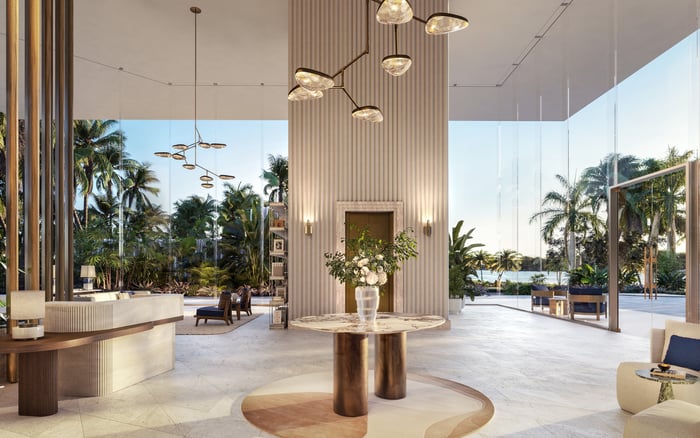
A buyer-focused comparison of The Perigon Miami Beach and Forté on Flagler West Palm Beach through the lens of household operations, guest movement, vendor access, and privacy during private events.

For buyers weighing The Perigon Miami Beach against Forté on Flagler West Palm Beach, the most consequential question is not simply which residence feels more glamorous. It is which building can support a household in motion: hosting, entertaining, receiving vendors, or moving family members through the property while guests are present.
Event privacy is not a mood. It is an operating system. It depends on how people arrive, where they wait, which elevators they use, how catering teams move, where valet overflow is staged, and whether resident corridors remain insulated from event activity. Until those details are confirmed in sales materials, condominium documents, or written building policies, the safest comparison is a disciplined due-diligence framework rather than a declared winner.
The Perigon Miami Beach is the Miami Beach option in this comparison. Forté on Flagler West Palm Beach is the West Palm Beach option. Each belongs to a different social and geographic context, yet both should be examined with the same operational rigor if the buyer’s priority is discretion during private gatherings.
In ultra-premium South Florida living, the event is often secondary to the household behind it. A dinner for friends, a philanthropic reception, a family celebration, or a seasonal gathering can bring drivers, florists, caterers, stylists, musicians, security personnel, and guests into the building. The question is whether that activity remains contained, choreographed, and largely invisible to residents who are not participating.
For a principal residence, privacy protects daily rhythm. For a second home, it protects ease of arrival and the ability to host without turning the property into a public-facing stage. In framing the decision, a buyer might call it a Miami Beach versus West Palm Beach question, shaped by oceanfront expectations, second-home use, and the household’s tolerance for shared circulation.
The most elegant building can underperform for privacy if guests, staff, and residents converge in the same lobby, elevator bank, or corridor at peak event moments. Conversely, a building with less obvious drama can feel highly private if its procedures are precise, its access points are controlled, and its staff understands confidentiality as part of daily service.
The Perigon Miami Beach should be evaluated as the Miami Beach choice for buyers who want coastal presence with a serious privacy review. The essential diligence question is whether the building separates resident, guest, service, vendor, and event circulation paths in a way that protects household life during hosted gatherings.
A buyer should ask how invited guests are admitted, whether guest-list controls are formalized, and whether the building can distinguish among a resident’s personal visitor, an event attendee, a vendor, and a catering team. The distinction matters. Without clear protocols, even a beautifully managed arrival can become porous once a guest count grows or outside staff begin moving through the property.
Elevator access deserves particular attention. The relevant questions are not limited to whether private elevators exist in general language. Buyers should verify which elevators are available during a private event, whether floors are access-controlled, and whether residents can move from parking, valet, or lobby areas to their homes without crossing the event path.
Amenity reservations require the same scrutiny. If an event space can be reserved, buyers should confirm how the reservation affects adjacent areas, whether resident-only zones remain protected, and whether noise, photography, vendor staging, and guest overflow are governed by written rules. The goal is not to assume weakness. It is to confirm the building’s privacy architecture before relying on it.
Forté on Flagler West Palm Beach should be framed as the West Palm Beach option for the same household-operations test. Its market setting is different from Miami Beach, but the privacy questions do not become softer. Buyers should still ask whether resident, guest, service, vendor, and event movement are separated in practice, not only in presentation.
For Forté on Flagler West Palm Beach, the most useful review begins with arrivals. How are guest vehicles managed during a private gathering? Is valet staging clearly defined? Where do vendors unload? Can catering teams access the relevant service areas without passing through primary resident spaces? These questions determine whether an event feels gracefully absorbed by the building or visibly imposed on it.
Security staffing should also be confirmed in writing. A building may feel controlled on a quiet weekday, but private events test staffing patterns. Buyers should understand whether additional personnel are required, whether the building approves outside security, how guest lists are checked, and how uninvited visitors or media-sensitive situations are handled.
As with The Perigon Miami Beach, a buyer should avoid concluding that privacy is protected until the operating documents support that conclusion. The value is not merely in what a residence offers, but in how consistently the building can preserve separation between private household life and social activity.
For both buildings, the diligence should move from aesthetics to choreography. Begin with circulation. Ask for a clear explanation of the resident path, guest path, service path, vendor path, and event path. If those paths overlap, ask when, where, and under whose supervision.
Next, review elevator rules. Confirm whether access controls are floor-specific, whether event guests can reach residential levels, and whether staff can move vertically without using resident elevators. If the answer depends on staffing discretion rather than formal policy, that should be noted in the purchase evaluation.
Catering access is another decisive issue. A building that welcomes private events should be able to explain loading, staging, refrigeration if applicable, service timing, cleanup, trash removal, and staff departure without improvisation. The same applies to florals, production equipment, photography, and entertainment vendors.
Valet and driveway management can be equally revealing. During an event, the exterior arrival becomes part of the privacy envelope. Buyers should ask whether overflow is planned, whether resident arrivals are prioritized, and whether guest traffic can be held away from private residential thresholds.
Finally, ask about confidentiality. Staff rules, vendor conduct, photography restrictions, and guest behavior policies can be as important as architecture. A building designed for discretion should be able to describe how discretion is maintained.
A buyer comparing The Perigon Miami Beach and Forté on Flagler West Palm Beach should resist the easy temptation to declare one building more private without verified operating details. The better approach is to rank each property against the household’s real use cases.
If the household hosts seated dinners, the focus should be catering routes, service elevators, noise rules, and cleanup procedures. If the household hosts receptions, the focus shifts to guest-list control, valet staging, lobby management, and restroom access. If family members or staff must move privately during events, then resident corridor exposure and elevator separation become central.
The strongest purchase decision will come from asking each sales team or building representative the same questions, requesting written confirmation where possible, and reviewing condominium documents before relying on verbal assurances. In luxury real estate, privacy is often promised in tone. Buyers should make sure it is protected in procedure.
Which building is more private during events? A definitive winner should not be declared without confirmed operating rules for guest movement, vendor access, elevators, security, and amenity reservations.
What should buyers ask The Perigon Miami Beach first? Ask whether resident, guest, service, vendor, and event circulation paths are separated during private gatherings.
What should buyers ask Forté on Flagler West Palm Beach first? Ask how guests, catering teams, vendors, and residents move through the building when an event is underway.
Do private elevators automatically solve event privacy? No. Buyers should verify how elevator access is controlled during events and whether guests can reach residential levels.
Why is valet staging important? Valet staging affects the first privacy boundary, including resident arrivals, guest congestion, and the visibility of an event.
Should amenity reservations be reviewed before purchase? Yes. Buyers should understand how reserved spaces affect adjacent areas, resident access, noise, guest overflow, and staffing.
What matters most for catering access? Confirm loading, service routes, staging, cleanup, trash removal, and whether catering staff avoid primary resident spaces.
Can a building feel private but still have weak event controls? Yes. Quiet daily conditions may not reveal how the building performs when guests and vendors arrive at scale.
Are written rules better than verbal assurances? Yes. Written policies and condominium documents create a clearer basis for evaluating privacy, staffing, and access control.
What is the best way to shortlist comparable options for touring? Start with location fit, delivery status, and daily lifestyle priorities, then compare stacks and elevations to validate views and privacy.
For a discreet conversation and a curated building-by-building shortlist, connect with MILLION.
If branded residences are on your mind — as a home or as an allocation — we would be glad to share what we are seeing, privately.
Begin a quiet conversation