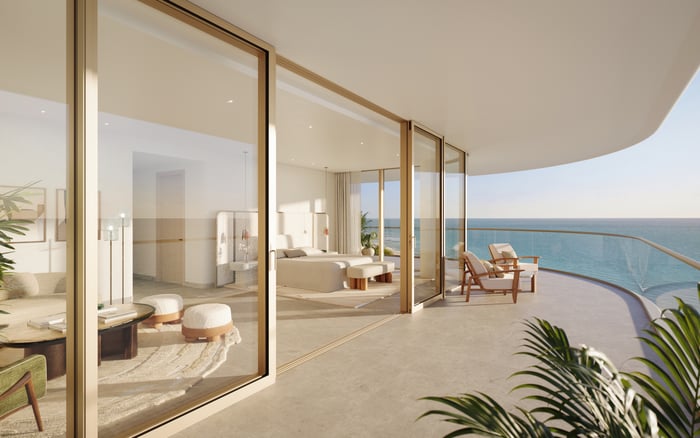
An editorial analysis of The Perigon Miami Beach as a lock-and-leave second-home decision for international buyers weighing U.S. dollar exposure, pre-construction timing, and Miami Beach’s safe-haven appeal.

For international buyers, The Perigon Miami Beach occupies a more complex decision field than a typical luxury condominium purchase. The immediate appeal is clear: an ultra-luxury Miami Beach condominium, framed by an oceanfront or beachfront setting, with the service logic of a full-service residential building rather than the operational burden of a privately managed house.
The sharper question is not simply whether the project is desirable. It is whether a buyer from Latin America, Europe, or Canada should view The Perigon Miami Beach as a lock-and-leave second home while also managing the timing of a U.S. dollar-denominated acquisition.
That distinction matters. A second home is often emotional, but an international second home is also a currency decision, a liquidity decision, and a lifestyle logistics decision. In portfolio terms, the conversation touches Miami Beach, oceanfront living, pre-construction timing, second-home use, investment logic, and The Perigon Miami Beach at once. The buyer is not only comparing views, finishes, and service. The buyer is deciding whether to convert capital into Miami Beach real estate now, or wait for a more favorable moment in the foreign-exchange cycle.
The lock-and-leave model has particular appeal for owners who may use a residence seasonally, intermittently, or around school calendars, business travel, holidays, and family office commitments. The underlying promise is simple: arrive to a residence that feels private, polished, and ready, without taking on the operational demands of a single-family estate.
For a buyer who lives outside the United States, that simplicity is not a minor amenity. It can be the reason the purchase works. A full-service condominium model reduces the friction of ownership when the owner is abroad. The home can function as a personal base in Miami Beach rather than a management project requiring constant attention.
That is the heart of The Perigon Miami Beach question. The asset is not being evaluated only as a beautiful residence. It is being evaluated as a second-home system. The more international the owner’s life, the more valuable that system becomes.
For non-U.S. buyers, the purchase is effectively priced in dollars, even when the family’s wealth, income, or operating currency may be tied to another jurisdiction. That creates a layered decision. A buyer may like the project, want the lifestyle, and believe in Miami Beach, while still hesitating because of exchange-rate movement.
This is where many buyers overcomplicate the question. Trying to time both the Miami condominium cycle and the foreign-exchange cycle can lead to paralysis. If a buyer waits for a softer local market, the dollar may move unfavorably. If the buyer waits for a better currency window, the preferred residence may no longer be available on the same terms. The decision becomes less about finding perfection and more about defining acceptable risk.
For families already committed to a long-term Miami presence, the relevant question is not whether currency will move. It will. The better question is whether the residence solves a durable lifestyle and wealth-planning need that remains valid across currency fluctuations.
Pre-construction buying is often discussed as a sales process, but for international buyers it can also become a currency-risk framework. A staged deposit schedule can separate the decision to secure a residence from the timing of full capital deployment. That does not remove currency risk, but it may change how the risk is experienced.
Rather than converting the entire purchase amount at once, buyers often think in phases: initial commitment, subsequent deposits, and final closing obligations. Each step can be considered against the buyer’s home currency, liquidity profile, and broader balance sheet. This is especially relevant when the buyer’s assets are distributed across currencies, businesses, or jurisdictions.
The essential point is discipline. A buyer should not treat pre-construction timing as merely administrative. It is part of the economics of ownership. The purchase price, currency path, deposit timing, and intended holding period are all connected.
Miami’s safe-haven appeal is not only about tax, weather, or capital mobility. It is also about emotional familiarity for global buyers. Miami Beach offers a recognizable international language: waterfront living, resort sensibility, cultural access, and a global peer group that understands the logic of owning a residence there.
That is why The Perigon Miami Beach occupies a particular lane. Its appeal is expressed through design, pedigree, beachfront position, service model, and timing considerations. Those ingredients matter because buyers in this tier are rarely purchasing shelter alone. They are buying certainty of use, confidence of arrival, and a private address that can anchor their South Florida life without demanding daily management.
For many international families, Miami Beach also functions as a meeting point. It can be easier for relatives from different countries to gather in South Florida than in a more remote leisure destination. The residence becomes part retreat, part family hub, and part capital allocation.
There are circumstances in which waiting is rational. If a buyer’s home currency is under acute pressure, if liquidity is temporarily constrained, or if the family is not yet certain it will use Miami Beach regularly, patience can be prudent. A lock-and-leave residence still needs to be used enough, or valued strategically enough, to justify the commitment.
Waiting can also make sense when the buyer has not yet clarified the role of the home. Is it primarily a winter residence, a school-year base, a family gathering place, or a long-term store of dollar-denominated wealth? The answer shapes tolerance for currency movement and market timing.
But waiting has its own cost. In the ultra-luxury tier, the most suitable residences are not always interchangeable. A buyer delaying for a marginally better exchange rate may lose the specific combination of building, exposure, floor level, plan, and emotional fit that made the purchase compelling in the first place.
Committing can make sense when the buyer has already decided that Miami Beach is a long-term personal market. In that case, The Perigon Miami Beach becomes less about short-term timing and more about securing a residence aligned with the family’s future use.
The lock-and-leave profile supports that logic. If the service model lowers ownership friction, and the beachfront setting supports repeated use, the residence can become a practical part of international life rather than an occasional indulgence. For a buyer with dollar exposure already, or with a desire to increase dollar-denominated real estate holdings, the decision may be easier to absorb.
The strongest buyers tend to separate desire from discipline. They may love the idea of the home, but they still model deposit timing, currency exposure, carrying costs, and holding period. That is the right posture. Luxury does not eliminate financial analysis. It demands better analysis.
The Perigon Miami Beach should be read as a lock-and-leave second-home decision with a currency overlay, not as a simple amenity comparison. For the right international buyer, the project’s appeal is the convergence of beachfront Miami Beach living, full-service simplicity, and the ability to hold a U.S. dollar-denominated residential asset in a globally recognized market.
The risk is not that currency timing matters. It plainly does. The risk is allowing currency timing to become the only lens. A residence of this kind is meant to serve a life, not merely a spreadsheet. The best decision will balance both.
Is The Perigon Miami Beach best understood as a primary home or second home? For many international buyers, the stronger framing is as a lock-and-leave second home in Miami Beach. Its appeal still depends on how often the owner expects to use it.
Why does currency timing matter for international buyers? The purchase is dollar-denominated, while many buyers hold wealth or income in another currency. Exchange-rate movement can materially change the effective cost.
Should buyers wait for a better exchange rate? Waiting can help if the buyer has a clear currency view, but it can also mean losing the preferred residence. The decision should weigh both market timing and personal use.
How do pre-construction deposits affect currency risk? Staged deposits may spread capital conversion over time. They should be reviewed as part of the buyer’s currency and liquidity plan.
What makes lock-and-leave ownership attractive in Miami Beach? It reduces the operational burden of maintaining a privately managed home. That is especially valuable for owners who live outside the United States.
Is The Perigon Miami Beach positioned as an oceanfront project? It is framed as an oceanfront or beachfront Miami Beach condominium. That setting is central to the lifestyle and second-home appeal.
Which international buyer regions are most relevant to this discussion? Latin America, Europe, and Canada are natural examples because buyers from those regions often weigh Miami Beach against currency exposure. The logic can apply to other global buyers as well.
Is this primarily a lifestyle purchase or an investment decision? It is both, but the stronger analysis starts with intended use. Investment logic is strongest when the residence also solves a durable lifestyle need.
Can a condominium be easier to own than a single-family home? Yes. The full-service condominium model can reduce maintenance and management demands. That is the essence of the lock-and-leave proposition.
What is the central buyer question at The Perigon Miami Beach? The question is whether to secure a scarce lifestyle asset now or keep trying to time both the Miami condo cycle and the foreign-exchange cycle.
When you're ready to tour or underwrite the options, connect with MILLION.
If branded residences are on your mind — as a home or as an allocation — we would be glad to share what we are seeing, privately.
Begin a quiet conversation