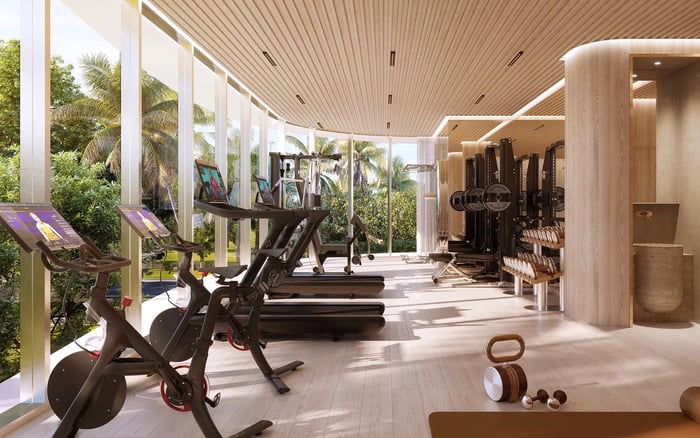
A buyer-focused look at whether a private fitness room or a full building wellness floor better serves luxury residential life in South Florida.
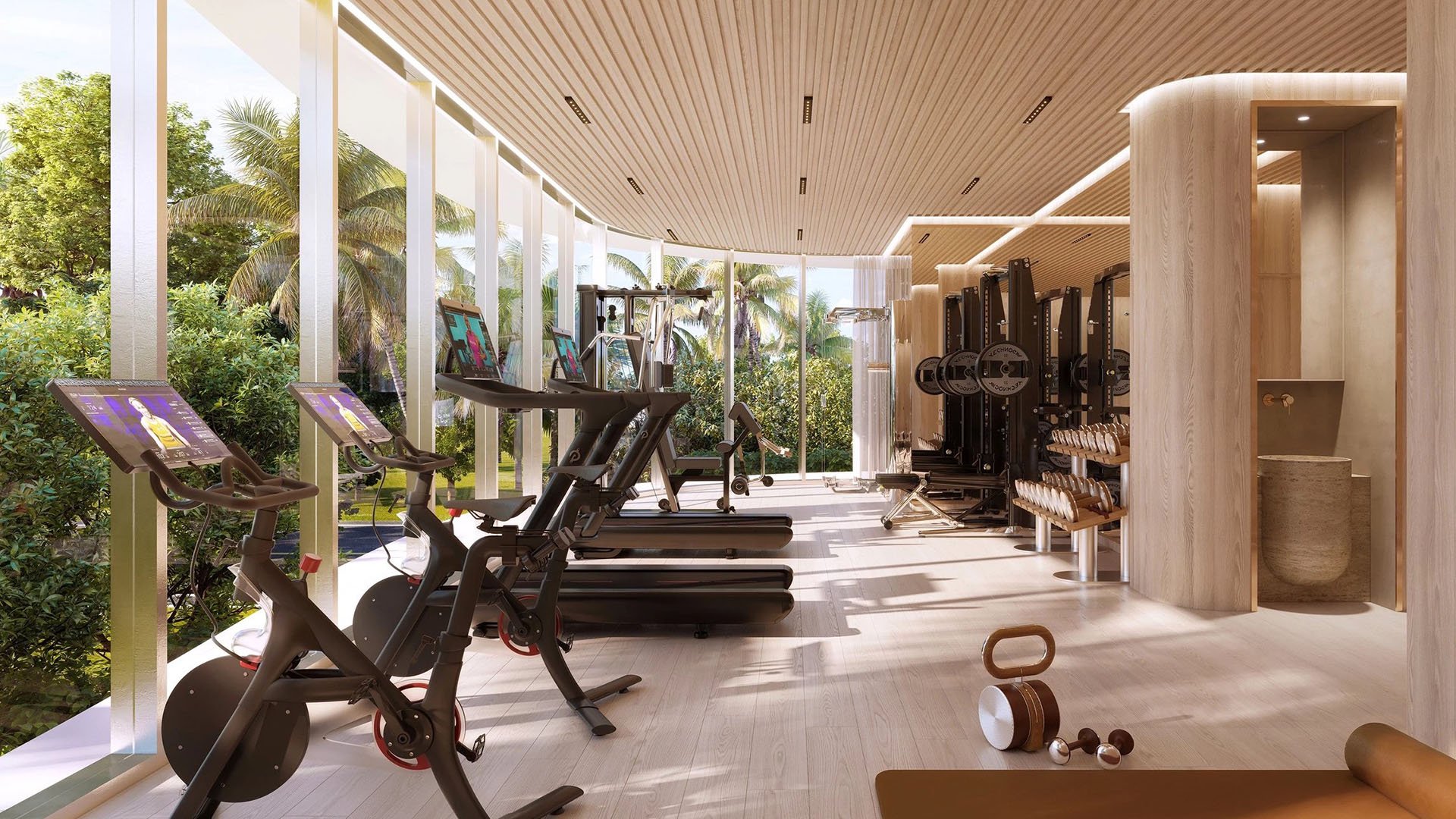
For the South Florida buyer, fitness is no longer a secondary amenity. It now sits alongside views, privacy, parking, staff flow, and outdoor living as part of a residence’s daily architecture. The question is not simply whether a building has a gym. It is whether the buyer should dedicate valuable private square footage to a personal fitness room, rely on the building’s wellness floor, or design a life that uses both with intention.
This decision is especially relevant in markets such as Brickell, Miami Beach, Coconut Grove, Bay Harbor Islands, Sunny Isles, Fort Lauderdale, and Palm Beach, where luxury buyers often expect hotel-level service without surrendering the intimacy of home. A private gym can feel like the ultimate expression of control. A building wellness floor can feel like a private club just an elevator ride away. The better choice depends on how one trains, how much privacy one needs, and how the residence will be used over time.
A private gym is primarily about certainty. The room is always available, the temperature is yours to set, the music is yours to choose, and the equipment can be selected around your body, routine, and goals. For buyers who train early, travel often, or keep a disciplined schedule, this level of control is difficult to replace.
It also solves the question of discretion. A private fitness room allows a resident to train without casual encounters, cameras, scheduling conflicts, or the mild performance of a shared space. For public figures, executives, collectors, and families with staff, that privacy can matter as much as the workout itself.
The tradeoff is space. A private gym competes with a den, media room, guest suite, office, art wall, wine room, or children’s lounge. It also requires ongoing curation. Equipment ages. Flooring matters. Mirrors, ventilation, acoustics, storage, and ceiling heights become design considerations rather than afterthoughts. The most successful private gyms are not spare bedrooms filled with machines; they are purpose-built rooms that feel visually consistent with the rest of the home.
Building wellness floors offer a different kind of value. They provide scale, variety, and separation from the residence. For many buyers, that separation is healthy. Leaving the private home, even for an elevator ride, creates a mental threshold between rest and performance.
A well-conceived wellness floor can support multiple modalities: strength, cardio, stretching, recovery, movement, and quiet decompression. It can also remove maintenance from the owner’s life. Equipment selection, replacement, cleaning, climate control, and spatial planning become part of the building experience rather than the homeowner’s personal operations.
This is where newer South Florida residences have sharpened the conversation. Buyers comparing projects such as The Well Bay Harbor Islands are often thinking beyond the conventional fitness room and asking how a building supports rhythm, restoration, and daily wellness without requiring them to build every function inside the unit.
For many high-end buyers, the strongest answer is not either-or. It is a hybrid. The private residence handles the nonnegotiable daily ritual. The building wellness floor handles breadth, equipment variety, and occasional programming. This is the most resilient model because it allows the home to feel complete without forcing every wellness function into private square footage.
A compact in-residence gym may include only the essentials: a mat zone, a few preferred strength pieces, a mirror, discreet storage, and enough floor area for mobility work. The building then supplies the larger experience. This avoids overbuilding a room that may feel dated in five years, while still protecting the owner’s morning routine.
In vertical neighborhoods, this hybrid logic is especially relevant. At The Residences at 1428 Brickell, for instance, the broader Brickell lifestyle conversation often centers on efficiency, privacy, services, and the ability to compress a full day into a highly designed residential environment. A private workout zone inside the home can complement, rather than duplicate, the building’s shared offering.
The private gym is usually most compelling when more than one person in the household uses it. A couple with different schedules, teenagers with athletic routines, or a household that hosts long-stay guests may find that the room becomes part of the home’s daily utility rather than a luxury flourish.
It also changes the way wellness fits into family life. A parent can train while remaining close to children. A guest can use the room without navigating the building. A trainer can arrive directly, if the property and household protocols allow it. The experience becomes more residential, less public, and more adaptable.
A building wellness floor, by contrast, can bring a useful sense of community. Some buyers value seeing neighbors, joining a class, or using a space that feels active beyond the family circle. This is less about socializing and more about atmosphere. Energy can be motivating, especially in buildings where the wellness environment has the polish of a private club.
The decision should be made during floor-plan evaluation, not after closing. A room that looks large on paper may fail as a gym if it has low ceilings, poor ventilation, awkward columns, fragile flooring, or no logical storage. A room that looks modest may work beautifully if it has the right proportions and a calm relationship to the rest of the home.
Terrace adjacency can be desirable when it supports light, air, and post-workout recovery, but it is not always necessary. Pool proximity within the building can be valuable if the buyer uses swimming or water recovery as part of a broader routine. A lap pool, where available, may serve a very different buyer than a lounge-oriented deck, so the distinction should be understood before assigning value.
In oceanfront contexts, the wellness calculation often becomes more atmospheric. A buyer considering 57 Ocean Miami Beach may think about fitness in relation to morning beach walks, light, views, and the sensory calm of the shoreline. For some residents, the most luxurious gym is not the largest one; it is the one that fits seamlessly into the day.
A buyer should walk the wellness floor with the same seriousness used for the primary bedroom or kitchen. Consider circulation, privacy, noise, natural light, equipment spacing, locker convenience, and whether the room feels calm at peak times. The best wellness spaces do not feel like basement obligations. They feel deliberate, well maintained, and aligned with the building’s overall design language.
Ask how the space supports different routines. Is it useful for strength training, mobility, stretching, and recovery, or is it weighted heavily toward one use? Does it feel comfortable for a solo workout? Would a private trainer be practical? Does the environment feel refined enough to use daily, or only impressive during a tour?
This is also where wellness-branded and lifestyle-forward addresses such as The Well Coconut Grove can enter the buyer’s shortlist. In a Coconut Grove search, the wellness decision may be less about a single gym room and more about how the entire building experience supports a composed, health-oriented way of living.
From a resale perspective, flexibility matters. A private gym that can easily become a den, office, massage room, nursery, or staff-adjacent utility space will appeal to a wider future audience. Highly specialized rooms can be wonderful for the current owner, but they should be designed so they do not narrow the next buyer pool.
Building wellness floors can also influence perception, especially when the amenity feels current, maintained, and proportional to the building. Buyers may not assign value to every individual feature, but they do respond to an overall sense of ease. If the wellness floor reduces friction in daily life, it strengthens the residential proposition.
The ideal outcome is layered: a home with enough private wellness capacity to support the owner’s essential routine, paired with a building that offers a larger canvas for movement, recovery, and social energy. That layered approach is increasingly persuasive in South Florida because it respects both privacy and lifestyle.
Before choosing, map a real week. Not an aspirational week, but the one you actually live. If you train before sunrise, between calls, or after children are asleep, a private gym may be essential. If you prefer variety, coaching, or the atmosphere of a shared environment, the wellness floor may carry more weight. If you travel frequently and want the residence to feel ready the moment you return, a hybrid approach may be the most durable.
The home gym question is ultimately a question of behavior. Luxury is not having every possible amenity. Luxury is removing the obstacles between intention and daily life.
Is a private home gym worth the square footage? It is worth it when fitness is part of the owner’s daily routine and privacy is a priority. If use will be occasional, flexible space may be smarter.
Does a building wellness floor replace a private gym? It can for some buyers, especially those who value equipment variety and maintenance-free access. Others still prefer a private room for routine workouts.
What is the best setup for frequent travelers? A small private gym paired with a strong building wellness floor is often ideal. It offers immediate convenience without sacrificing broader options.
Should families prioritize a private gym? Families may benefit from private space because schedules overlap and children or guests can use it easily. The room should remain adaptable.
What should I look for in a wellness floor? Look for light, spacing, privacy, equipment quality, cleanliness, and whether the space supports your actual routine. Atmosphere matters as much as scale.
Can a private gym hurt resale? It can if it is too specialized or difficult to convert. Designing it as a flexible wellness room protects long-term appeal.
Is oceanfront living a substitute for fitness amenities? No, but it can complement them. Walks, light, and outdoor routines can reduce dependence on a large private gym.
How important is a pool to the wellness decision? A pool can be meaningful if swimming, recovery, or low-impact movement is part of the routine. Otherwise, it is a lifestyle bonus rather than a gym replacement.
Should I choose the unit first or the amenities first? Choose the residence first, then test whether the amenities improve daily life. A superb amenity package cannot fix an unsuitable floor plan.
What is the most luxurious answer overall? The most luxurious answer is a tailored hybrid: private space for consistency and shared wellness floors for variety, service, and scale.
If you'd like a private walkthrough and a curated shortlist, connect with MILLION.
If branded residences are on your mind — as a home or as an allocation — we would be glad to share what we are seeing, privately.
Begin a quiet conversation