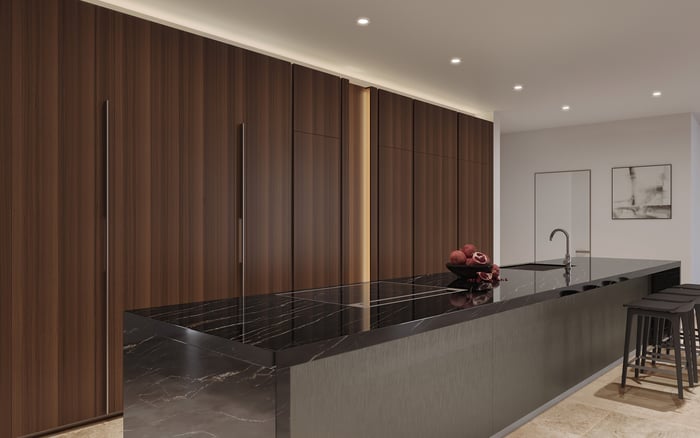
A discreet buyer guide to evaluating whether a Grove Isle condo can function elegantly with live-in help, from floor plan privacy to building rules and daily service logistics.

For a Grove Isle buyer who expects a condominium to function with live-in help, the first question is not simply how many bedrooms appear on the floor plan. It is whether the residence can support a private household rhythm without forcing owners, guests and staff into constant overlap. In the luxury market, that distinction is often decisive.
A bedroom labeled as a den, staff room or secondary suite may look adequate in a listing presentation, but the true test is the daily sequence that follows. Can someone enter, store personal belongings, rest, prepare for work and move through the home without crossing the principal entertaining spaces at the wrong moment? Can the family host dinner while household support continues quietly in the background? Can morning routines unfold without turning the kitchen corridor into the center of the home?
This is where Grove Isle ownership becomes a lifestyle audit. The setting may be serene, but the purchase should be evaluated with the discipline of a private residence. Buyers should think less like visitors and more like household operators.
The strongest layouts for live-in help create separation without making staff accommodations feel improvised. Ideally, the staff sleeping area sits near the kitchen, laundry, service entry or secondary circulation, rather than beside the primary suite or in the middle of a guest wing. A small but legitimate bath matters. So does acoustic separation, especially in residences where stone floors, open kitchens and glass walls can amplify movement.
Flow-through units can be appealing when they provide light, air and a graceful separation of public and private rooms. Yet a broad plan only works if circulation is intelligent. A long walk from the staff room to the laundry may be inconvenient. A staff room opening directly into a formal entertaining area may be worse. Buyers should walk the residence at the hours when help would actually be active, not only during a polished showing.
The same applies to terrace access. A terrace is a privilege, but it should not become the only place where off-duty staff can step away from the household. In a truly workable plan, every person in the residence has a place to be without feeling exposed.
For buyers who need live-in help, association rules are not paperwork to review after the emotional decision. They are part of the asset. Before committing, counsel should review whether live-in domestic employees are permitted, how residents must register them, what identification or access credentials are required, and whether there are restrictions on overnight occupancy for non-family members.
This is not a minor administrative point. A residence can be physically perfect and still fail the ownership test if the building treats daily household staffing as an exception rather than a normal pattern of life. The best outcome is clarity: who may stay, how long they may stay, how they enter, where they park, how deliveries are handled and what happens when schedules change.
Gated-community expectations can also affect the experience. Controlled access may enhance privacy, but it may also add layers of approval for staff, vendors, dog walkers, drivers and visiting nurses. That is manageable when the building is accustomed to staffed households. It becomes frustrating when the procedures are unclear or inconsistently applied.
A live-in arrangement depends on logistics that many buyers underestimate. Parking is one of them. If staff will keep a car on site, the buyer must understand whether an assigned, valet or additional space is available and whether the building allows it. If not, the staff member's daily mobility may become a household problem.
Elevators are equally important. A building with service elevators, sensible delivery policies and clear move-in procedures may preserve the sense of calm that owners expect. Without that infrastructure, ordinary tasks can feel intrusive. Groceries, dry cleaning, luggage, flowers, pet supplies and maintenance visits all need a path through the building.
Pets add another layer. If the household includes animals, live-in help may be central to their care. The buyer should consider how pet rules, walking routes, elevator etiquette and staff credentials interact. A property can be pet-friendly in spirit yet complicated in practice if the staff member responsible for daily walks has limited access or unclear authorization.
The buyer drawn to Grove Isle often wants privacy without abandoning city convenience, and that mindset is especially relevant for households with live-in support. Even when the search is filed under Coconut Grove, the decision is less about a neighborhood label than about whether the residence behaves like a private home in vertical form.
For some buyers, the comparison may include established condominium residences, newer construction, or a name such as Vita at Grove Isle. The right question is consistent across options: does the building understand the daily mechanics of a staffed household, and does the floor plan allow service to remain discreet?
A graceful answer usually appears in small details. There is a place for uniforms or luggage. There is a way to receive deliveries without disrupting breakfast. There is a sleeping area that does not require apologizing to guests. There is a bathroom arrangement that respects everyone. There is enough storage to keep the residence from becoming visibly operational.
A serious buyer should tour twice: once for beauty, once for function. The first visit can be emotional. The second should be almost clinical. Open every door. Trace the route from the entry to the kitchen, laundry, staff room and guest areas. Ask how a late arrival would be handled. Ask where a staff member would wait for a rideshare, receive a package, or enter after walking a dog.
Do not rely only on staging. A room with a daybed may not be a true live-in solution. A flexible den may lack privacy. A maid's room may be too close to mechanical noise. A beautiful powder room does not replace a usable bath. Luxury is not proven by finishes alone; it is proven by whether the home performs under pressure and still feels composed.
What is the first thing to check if I need live-in help? Start with the condominium documents and building rules, then compare those rules with the actual floor plan and daily access needs.
Can any extra bedroom work as staff quarters? Not always. The room should offer privacy, a practical bath arrangement and reasonable access to service areas.
Why does elevator access matter? Staff, deliveries and vendors need predictable circulation so the household can operate without disturbing owners or guests.
Should parking be reviewed before an offer? Yes. If live-in help will keep a car, parking rights and building policies can affect the viability of the purchase.
Are association rules more important than the layout? They are equally important. A workable layout is not enough if the building does not permit or properly manage live-in occupancy.
How should buyers evaluate privacy during a showing? Walk the routes staff would use each day and note whether those paths cross primary entertaining or bedroom areas.
Can a luxury condo replace a single-family home for staffed living? It can, but only when the plan, rules, access, storage and service culture support that way of living.
Do pet rules affect live-in help? Yes. If staff will handle walks or care, their access credentials and the building's pet procedures should be clear.
Is a larger condo automatically better for live-in help? No. Intelligent separation and circulation often matter more than raw square footage.
What should a buyer ask before signing a contract? Ask how live-in staff are registered, where they may park, how they access the building and whether overnight stays are permitted.
To compare the best-fit options with clarity, connect with MILLION.
If branded residences are on your mind — as a home or as an allocation — we would be glad to share what we are seeing, privately.
Begin a quiet conversation