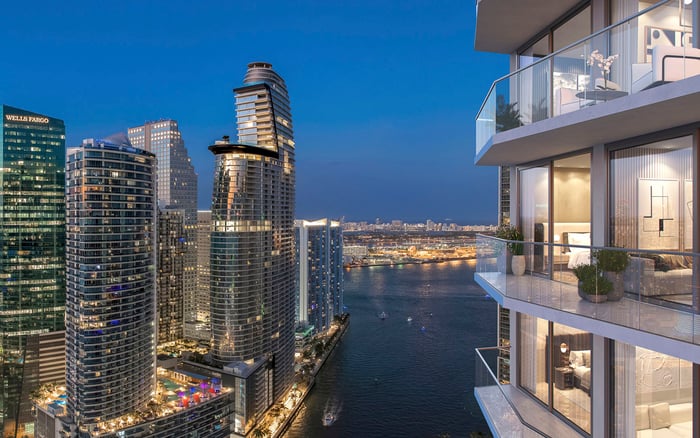
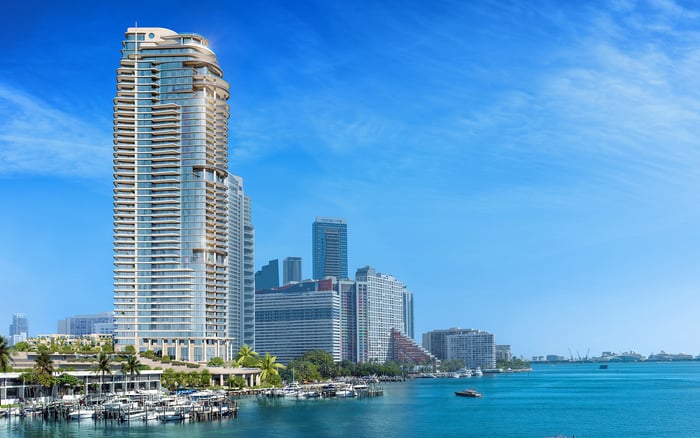
A discreet buyer’s guide to evaluating The Cove Residences Edgewater as a more intentional alternative for waterfront estate owners seeking simplicity, service, and Miami access.

For a certain South Florida buyer, the waterfront estate has long represented the fullest expression of privacy: land, arrival sequence, staff circulation, outdoor space, and control. Yet the same qualities that make an estate desirable can also make it demanding. A large property requires constant attention. A dock, garden, pool, gate, roof, systems, and security all become part of the owner’s calendar, even when others manage the details.
That is why Edgewater has become a serious conversation for buyers who are not downsizing in taste, but editing the way they want to live. The move is less about leaving the water than choosing a different relationship to it. Instead of a single-family compound, the buyer considers a lock-and-leave residence with views, services, proximity, and a more curated daily rhythm.
For those studying The Cove Residences Edgewater, the essential question is not whether a condominium can replicate an estate. It cannot, and it should not try. The better question is whether a residence in Edgewater can deliver a more intentional version of the waterfront lifestyle, with less friction and a sharper connection to Miami.
Estate buyers tend to evaluate homes through a lens of control. They ask how a guest arrives, where service providers enter, how morning light moves through living spaces, how the home behaves during travel, and whether the property feels calm when Miami is busy. Those same questions still matter in Edgewater, but the answers take a different form.
In a condominium setting, control is expressed through planning, privacy, building culture, and the way the residence sits within its broader environment. An elevator landing, parking experience, service protocol, amenity location, and acoustic separation may matter as much as a gate once did. The buyer is not simply purchasing square footage. The buyer is selecting a lifestyle system.
This is where the phrase Cove Miami can be useful as shorthand for a broader aspiration: protected waterfront living inside an urban district, with the city close enough to be useful and the water close enough to be restorative. Edgewater’s value proposition is not suburban quiet. It is composed access.
The most successful estate-to-condo transitions begin with clarity. What parts of estate living are truly used, and what parts are mostly maintained? A formal lawn may photograph beautifully but rarely shape daily life. A large motor court may be necessary for entertaining but irrelevant for a couple that travels often. Guest suites may sit empty for most of the year, while a generous primary suite, proper storage, and a well-scaled terrace shape every day.
Buyers considering EDITION Edgewater alongside The Cove Residences Edgewater should think less in terms of which name is louder and more in terms of which environment best supports their routines. Morning coffee, fitness, privacy after dinner, package handling, pet movement, chef access, visiting family, and weekend departures all deserve attention.
Lifestyle is the operative word, but not in the vague marketing sense. It means the sequence from bed to bay view, from car to residence, from work call to dinner reservation, from airport arrival to a quiet evening at home. The right purchase should reduce decisions without reducing pleasure.
Waterfront is not a single category. A private estate may offer direct grounds and a personal sense of horizon. A condominium may offer elevation, long views, and a reduced maintenance burden. The buyer should compare the emotional experience of each, not simply the address category.
First, study privacy. In an estate, privacy often comes from land and landscape. In Edgewater, it comes from planning, orientation, glass, setbacks, elevator configuration, and the culture of the building. Second, study arrival. A great condominium arrival should feel dignified, efficient, and predictable, especially for owners accustomed to controlling every approach to the home.
Third, study service. Estate owners often have personal staff or long-standing vendors. A vertical residence requires coordination with building systems and protocols. The goal is not to give up service quality, but to place it inside a more organized structure. Fourth, study storage. The estate owner has room for art crates, seasonal items, sports equipment, and entertaining inventory. A move to Edgewater requires a disciplined plan for what remains close, what is stored elsewhere, and what is no longer needed.
Edgewater should not be evaluated in isolation. It belongs on a larger map of Miami choices, each with a distinct personality. Brickell is more corporate and financial in tone. Miami Beach carries a resort and cultural rhythm. Coconut Grove offers a softer village character. Surfside and Bal Harbour speak to beachfront discretion. Edgewater’s position is more transitional and contemporary: bay-facing, design-aware, and close to the urban core without being defined entirely by office life.
That distinction matters for estate owners who want access without constant exposure. Aria Reserve Miami and Villa Miami can enter the same conversation because they help frame the neighborhood as a serious residential alternative rather than a compromise. The comparison should be practical: which building culture feels most aligned, which residence plan lives most naturally, and which location best supports the owner’s actual week.
This is also why buyer guides for Edgewater should be more personal than statistical. The right answer for a collector, a frequent traveler, a couple leaving a bayfront house, or a family keeping a second residence elsewhere may be entirely different.
The hardest part of leaving a waterfront estate is often not the physical move. It is the identity shift. Land carries symbolic weight in South Florida. It suggests permanence, independence, and a certain level of command. A condominium asks the buyer to trust a shared environment, even at the highest end of the market.
That shift can be liberating when handled correctly. The buyer gives up some autonomy in exchange for efficiency, security, and continuity. Travel becomes easier. Seasonal use becomes simpler. The home can be enjoyed without the constant background hum of property management. For many, the greatest luxury becomes the absence of obligation.
Still, this is not a decision to romanticize. A buyer who loves gardening, private outdoor entertaining, boat access, or the feeling of driving through a gate may miss those rituals. The right Edgewater residence should be chosen only after those attachments are named honestly.
A serious tour should be structured like a day in the life, not a parade of finishes. Arrive as you would from the airport. Notice the parking sequence. Walk the path a guest would take. Stand where you would take a morning call. Imagine two people getting ready at the same time. Ask how deliveries, service providers, pets, and visitors move through the building.
New-construction buyers should be especially disciplined about what is promised, what is documented, and what is essential to their decision. The more refined the buyer, the less useful generic luxury language becomes. Ask for clarity around residence layout, outdoor space, privacy conditions, building operations, and the lived experience at different times of day.
The best decision is rarely made by chasing the largest residence or the most dramatic amenity. It is made by identifying the property that removes the greatest number of small frictions while preserving the emotional qualities that made waterfront living compelling in the first place.
Is The Cove Residences Edgewater a replacement for a waterfront estate? It is better understood as an alternative lifestyle model. Buyers should compare privacy, service, views, and ease rather than expecting an estate replica.
Who is the ideal buyer for this type of move? The strongest fit is often a buyer who still values water, design, and discretion, but wants less property management and a more efficient Miami base.
What should estate owners evaluate first in Edgewater? Arrival, privacy, storage, building culture, and daily circulation should come before finishes. These factors determine whether the residence will live comfortably.
Does waterfront living feel different in a condominium? Yes. A condominium may trade private grounds for elevation, views, services, and reduced maintenance responsibility.
Should buyers compare multiple Edgewater projects? Yes. Even within the same neighborhood, each project can express a different balance of privacy, service, design, and daily convenience.
Is Edgewater suited to frequent travelers? It can be, especially for buyers who want a residence that is easier to leave and return to than a large estate.
What is the biggest adjustment after leaving an estate? The largest adjustment is often psychological. Owners move from total property control to a shared residential environment with coordinated services.
How should a buyer think about lifestyle in this decision? Lifestyle should mean daily function, not decoration. The right residence should improve mornings, evenings, travel days, entertaining, and privacy.
Why does Cove Miami appear in buyer searches? The phrase often reflects interest in The Cove Residences Edgewater and the broader idea of a more protected Edgewater waterfront setting.
Is Edgewater a good fit for buyer guides focused on new-construction? Yes. Edgewater is a useful case study for buyers comparing new residential formats, urban access, and a lower-maintenance waterfront life.
If you'd like a private walkthrough and a curated shortlist, connect with MILLION.
If branded residences are on your mind — as a home or as an allocation — we would be glad to share what we are seeing, privately.
Begin a quiet conversation