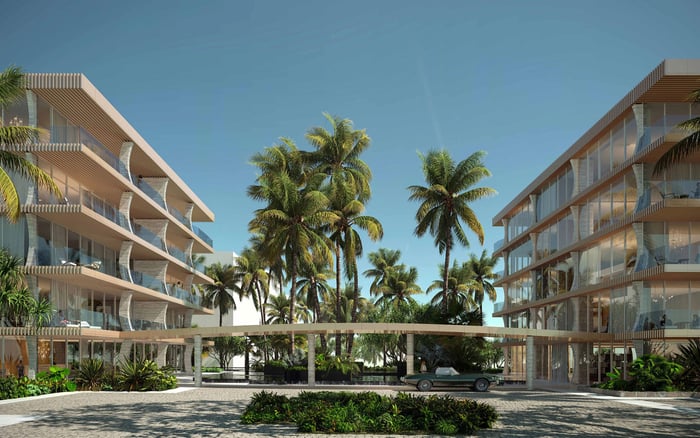
A buyer-oriented analysis of how three South Florida luxury residential settings frame parking control, EV charging review, and private-driver coordination.

In South Florida’s upper tier, parking is no longer a utility tucked away in the garage. It is part of the ownership experience, the guest experience, and, increasingly, the resale conversation. A buyer who owns several cars, employs a private driver, charges an electric vehicle, or receives frequent guests is not simply purchasing square footage. That buyer is purchasing control.
The Bristol Palm Beach, The Surf Club Four Seasons Surfside, and Nora House West Palm Beach each frame that control differently. One begins with the legal architecture of condominium parking rights. One relies on a hospitality-style operating system for arrivals and departures. One asks buyers to focus early on urban logistics, especially before making assumptions about future charging or chauffeur routines.
In owner shorthand, Palm Beach, Surfside, and West Palm Beach represent three distinct mobility cultures: estate-like control, resort-managed service, and walkable city living. The essential question is not which model is universally better. It is which model matches how an owner actually lives.
The Bristol is best understood as the parking-rights case study. In a condominium ownership model, the first question is not whether the garage feels convenient during a tour. The first question is what the owner legally controls.
For a buyer at The Bristol, diligence should begin with the condominium declaration and related parking exhibits. Are spaces deeded to the unit? Are they assigned as limited common elements? Are they leased, licensed, or controlled by the association? Each answer carries a different implication for resale value, transferability, owner discretion, and day-to-day certainty.
That distinction becomes even more important when electric charging enters the conversation. A buyer should not assume that a space can be modified simply because it is used by the owner. EV-charger rules, electrical capacity, architectural review, insurance requirements, and association approval can all shape what is allowed. The practical sequence is clear: confirm the parking right first, then evaluate whether that right supports the desired charging solution.
Private-driver logistics at this level are also tied to control. If a chauffeur must stage, wait, charge, or access the building repeatedly, the owner needs to understand the rules for entry, guest management, and garage use. The most elegant arrival is often the one that has been legally and operationally resolved before closing.
For resale buyers, this documentation can be as meaningful as a view line or terrace depth. Parking rights are not merely conveniences. They can define how clearly a future purchaser understands and values the residence.
The Surf Club Four Seasons Surfside represents a different philosophy. Here, the central mobility value is not solely the owner’s individual control over every operational detail. It is the ability of a branded, hospitality-driven environment to coordinate movement with discretion.
In a service-led setting, the experience depends on the orchestration of arrivals, valet flow, guest access, private drivers, and the relationship between residential and hotel-style operations. A resident may care less about personally managing each friction point and more about whether the property can absorb those frictions gracefully.
That distinction matters. In many luxury condominiums, an owner wants to know exactly what is deeded, assigned, or transferable. At a hospitality-managed property, those questions still matter, but they sit alongside another question: how well does the operation perform under pressure? Weekend arrivals, dinner-hour departures, visiting family, security protocols, and private-driver coordination all test the building’s rhythm.
For an owner who travels often, entertains frequently, or prefers a turnkey lifestyle, this can be powerful. The perceived luxury is not the act of parking. It is the absence of visible strain. A successful arrival sequence feels calm because many small decisions have already been absorbed by staff and protocol.
This model is especially relevant in Surfside, where oceanfront living, resort expectations, and private residential ownership often intersect. Buyers should still review their own parking rights, EV rules, and charging permissions, but they should also test the service promise. Ask how private drivers are handled, where guests are received, how valet volume is managed, and how residential priorities are separated from broader hospitality activity.
Nora House West Palm Beach enters the discussion from a different angle. Rather than assuming a fixed set of parking or charging features, buyers should treat it as a reminder that urban luxury requires early logistical clarity.
In West Palm Beach, a residence may appeal because of dining, culture, offices, waterfront access, and a more walkable daily pattern. That can reduce reliance on multiple cars, but it does not eliminate the need to understand parking rights. In fact, it can make those rights more important, because urban settings often balance resident parking, guest access, rideshare flow, deliveries, service vehicles, and private-driver movement within a tighter footprint.
New-construction buyers should ask early questions before lifestyle assumptions harden. What parking rights are expected to convey with a residence? How are guest arrivals handled? Is EV charging subject to association rules, building infrastructure, or future approval? Where would a private driver wait during dinner, a school run, or an airport departure? These are not secondary questions for a luxury buyer. They are part of the residence’s real usability.
The most sophisticated approach is to separate aspiration from documentation. A sales presentation may describe a polished lifestyle, but the purchase file should answer the functional questions. If the owner plans to charge an EV, employ a driver, host family often, or keep a collector vehicle nearby, those intentions should be tested against the building’s governing documents and operating procedures.
Across these three examples, the framework is simple. First, establish the legal right. Second, understand the charging pathway. Third, pressure-test the private-driver experience.
The legal-right question is the foundation. A parking space can feel private, but the governing documents determine whether it is owned, assigned, shared, transferable, or subject to association discretion. The EV question follows because charging depends on both physical infrastructure and permission. The chauffeur question comes last because it is operational, and operations work best when the underlying rights and rules are clear.
This is where luxury buyers can protect themselves from ambiguity. A beautiful garage entrance, polished valet stand, or calm porte cochere can be persuasive. Still, the value lies in enforceable rights and repeatable service. The best buildings make both feel effortless.
A serious buyer should ask for the condominium declaration, parking exhibits, EV-charging rules, architectural or association approval procedures, and any written policies that govern valet, guest parking, private drivers, and service access. If the residence is being purchased for long-term use, these details should be reviewed with the same care as floor plan, exposure, and monthly carrying costs.
The right questions are specific. Can the parking right be transferred with the unit? Can the association reassign or regulate use? Is charging already permitted, or must it be approved later? Are there restrictions on charger installation, vendor access, or electrical upgrades? How are drivers credentialed, staged, and released during peak hours?
In South Florida’s luxury market, the answer is rarely one-size-fits-all. The Bristol emphasizes certainty through ownership review. The Surf Club emphasizes managed ease through hospitality operations. Nora House West Palm Beach emphasizes the need to clarify urban logistics before assuming they will solve themselves.
Why do parking rights matter in luxury condominiums? Parking rights can affect owner control, daily convenience, and future resale perception. Buyers should know whether spaces are deeded, assigned, leased, or association-controlled.
Is an assigned parking space the same as a deeded space? No. An assigned space may provide use, while a deeded space generally indicates a stronger ownership interest that should be verified in the governing documents.
Can an owner always install an EV charger in a condominium garage? Not always. Charger installation may require association approval, infrastructure review, insurance compliance, and adherence to building rules.
Why is The Bristol treated as the parking-rights example? Its most relevant buyer issue is the confirmation of legal parking control before evaluating EV charging or chauffeur logistics.
Why is The Surf Club Four Seasons Surfside treated as service-led? Its mobility appeal is tied to managed arrivals, valet flow, guest access, and coordinated private-driver service in a hospitality-style environment.
How should buyers evaluate Nora House West Palm Beach? Buyers should use an urban-living lens and clarify parking, charging, guest access, and private-driver procedures before relying on assumptions.
What should a private-driver household ask first? Ask where drivers may wait, how they are credentialed, how guest access works, and whether peak-hour arrival flow is managed consistently.
Do EV rules affect resale value? They can. Buyers increasingly view charging access and approval certainty as practical components of long-term residence usability.
Should parking be reviewed before the contract is signed? Yes. Parking exhibits, association rules, and EV policies should be reviewed during diligence, not after closing.
What is the best way to shortlist comparable options for touring? Start with location fit, delivery status, and daily lifestyle priorities, then compare stacks and elevations to validate views and privacy.
When you're ready to tour or underwrite the options, connect with MILLION.
If branded residences are on your mind — as a home or as an allocation — we would be glad to share what we are seeing, privately.
Begin a quiet conversation