For private households leaving high-tax states, Miami real estate often serves two purposes at once: a lifestyle upgrade and a practical component of a Florida domicile strategy. The appeal begins with Florida’s lack of personal state income tax, estate tax, and inheritance tax, then extends into homestead benefits, long-term property-tax protections, and a housing market built to accommodate fast, sophisticated moves. In this framework, luxury property is not merely a trophy asset. It can be part of the factual pattern that supports physical presence and intent to reside in Florida, provided the move is documented properly and coordinated with legal and tax advisors.
For founders, investors, executives, and family offices, a move to Miami is rarely driven by a single variable. It is a layered decision in which tax efficiency, business access, lifestyle quality, and real estate intersect. The Florida Constitution limits state taxation of the income of natural persons, and the Florida Department of Revenue confirms that Florida’s estate tax was eliminated for decedents dying after December 31, 2004. For households coming from high-tax jurisdictions, that difference can materially reshape long-term planning.
Yet sophisticated buyers understand that relocation is not accomplished by aspiration alone. It is established by facts. A Miami residence, whether owned or leased, can be an important part of the relocation framework because it helps demonstrate physical presence and intent to reside in Florida. That distinction matters. Buying a residence may strengthen a domicile case, but it does not by itself guarantee tax residency.
This is where luxury real estate fits the strategy with unusual precision. In Miami, the home often serves as both a personal refuge and a documentable anchor for a new pattern of life.
A well-chosen residence can support the practical side of a move. Advisors typically focus on objective ties such as a Florida driver’s license, voter registration where applicable, mailing address, primary-home records, local professionals, actual days spent in Florida, and a consistent reduction of ties to the prior state. Real estate becomes relevant because it can align those administrative steps with everyday reality.
For some households, renting first is the more elegant move. A lease allows a family or principal to begin spending meaningful time in Florida, establish routines, and test neighborhood fit before making a major acquisition. For others, an immediate purchase makes sense, especially when the buyer wants privacy, permanence, and a clear operational base for family and work.
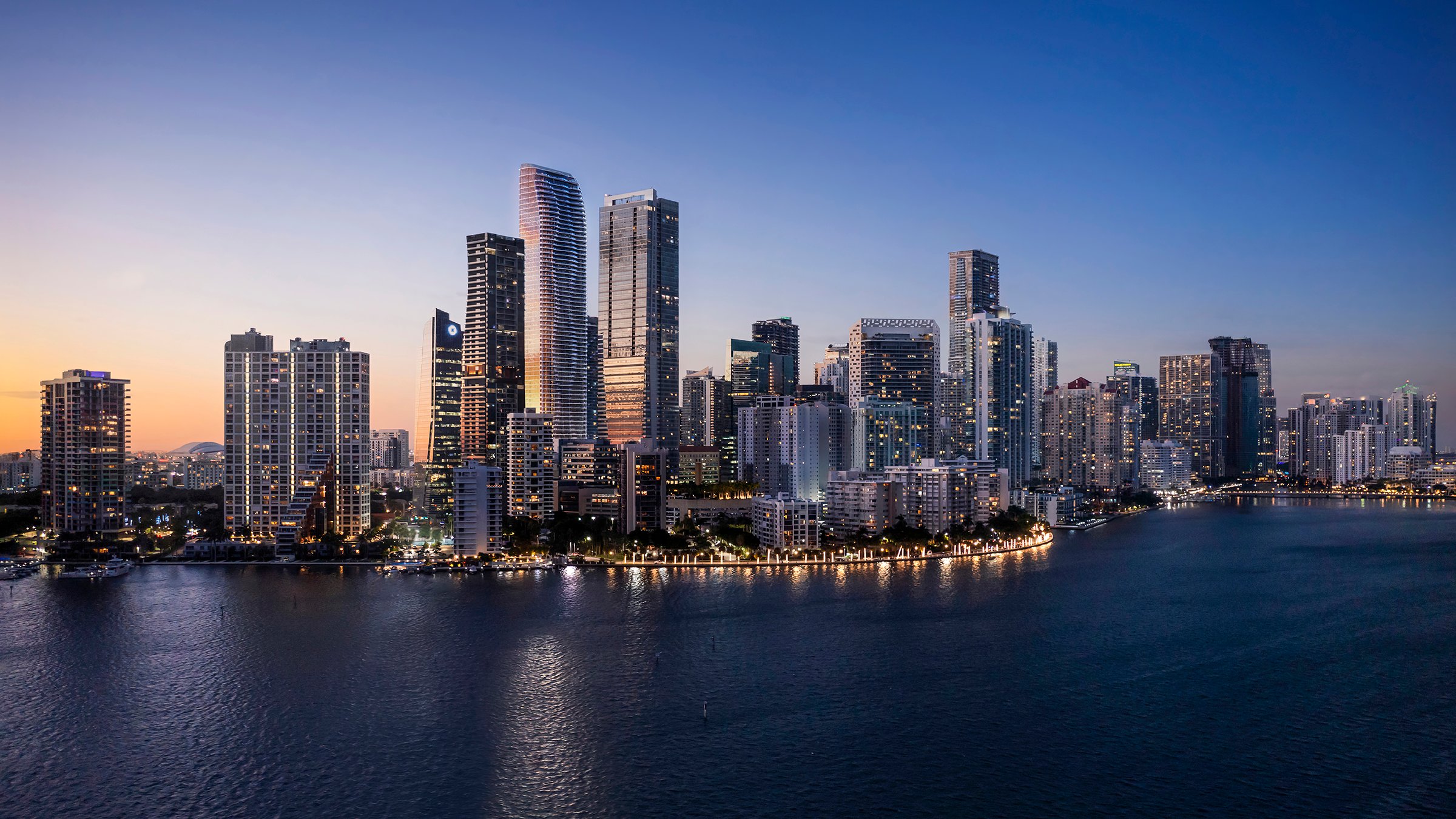
In Miami, that choice is supported by deep luxury inventory. New development has been a major force in the city’s premium market, offering turnkey residences that suit relocators seeking speed and discretion. In Brickell, projects such as The Residences at 1428 Brickell and St. Regis® Residences Brickell reflect why the district is often the first stop for executives and finance professionals seeking a seamless entry into the city.
Miami does not present a single luxury market. It offers several, each suited to a different version of relocation.
Brickell is often the most tactical choice. It combines walkability, office proximity, a refined service culture, and a concentration of high-end condominiums. For a principal still traveling frequently or building a Miami-centered business routine, Brickell offers immediacy. The neighborhood’s appeal is not simply aesthetic. It makes day-to-day residency feel plausible from the moment of arrival. That practicality helps explain continued interest in addresses like 888 Brickell by Dolce & Gabbana, where branded living and centrality align with a polished relocation profile.
Miami Beach serves a different buyer. Here, the purchase is often about a more expressive form of permanence: waterfront exposure, branded residences, and a distinctly international social setting. Waterfront properties can command a premium, reinforcing their role as both lifestyle assets and concentrated stores of value. For buyers who want their relocation to culminate in a statement address, Miami Beach remains compelling, with projects such as The Perigon Miami Beach fitting naturally into that conversation.
Coral Gables attracts executives and families who want larger homes, established streetscapes, and easier access to schools, clubs, and major business districts. The tone is more settled and residential, often better suited to buyers who want the move to feel multigenerational rather than transitional. In that setting, projects like Ponce Park Coral Gables speak to a buyer who values permanence, discretion, and a traditional neighborhood framework.
Wynwood, meanwhile, represents Miami’s newer luxury instinct. Design-led buyers and entrepreneurial households are drawn to its energy, art adjacency, and boutique residential feel. Wynwood is less about legacy formality and more about immediacy, culture, and urban identity. That distinction matters for relocators whose businesses and social networks are already oriented toward creative and growth sectors.
A relocation search should support the tax plan without pretending to create it. MILLION helps buyers identify South Florida luxury residences that fit the practical realities of a Miami move: privacy, daily use, airport access, school or office proximity, building quality, and long-term ownership flexibility. For those seeking a discreet path into scarce trophy inventory, MILLION can curate on-market, new-development, and select off-market opportunities while the buyer’s legal and tax advisors handle domicile and residency planning.
Florida’s tax appeal is not limited to income. According to the Florida Department of Revenue, a qualifying permanent residence may receive a homestead exemption that decreases taxable value by as much as $50,000 and qualifies the home for Save Our Homes assessment limitations. The Department’s January 2026 Save Our Homes publication lists the 2026 cap at 2.7%, reflecting the lower of 3% or the relevant CPI measure.
Those features can help qualifying full-time residents moderate property-tax growth over time. They should not be assumed by nonresident buyers, investment buyers, or owners whose use does not support permanent-residence status. Portability may also be available in certain Florida-to-Florida moves, but it is a technical rule and should be reviewed before relying on it.
The luxury buyer’s math is always broader than a single line item. Mortgage interest and property taxes can still matter at the federal level, and the overall relocation outcome depends on timing, income type, entity structure, days in state, and the household’s broader balance sheet. An all-cash buyer may assess the move differently from an executive using financing, and a founder with liquidity events ahead will approach the calendar differently from a principal living on investment income.
The core point is simple: the residence should fit the tax plan, not outrun it.
South Florida’s luxury market has sustained demand even in a higher-rate environment, in part because many buyers transact with substantial cash. According to MIAMI Realtors, cash sales represented 38.1% of Miami closed sales in March 2026, including 49.8% of existing condo sales. MIAMI Realtors’ 2025 International Report also reported that 51% of South Florida international residential transactions were all-cash.
Miami benefits from multiple layers of demand at once. International buyers still view the city as a globally legible wealth market. MIAMI Realtors reported that foreign buyers purchased $4.4 billion of South Florida residential property in 2025, up from $3.1 billion in 2024. The organization’s November 2025 New Construction Global Report also found that global buyers represented 52% of new South Florida construction, pre-construction, and condo-conversion sales over a recent 22-month period.
Still, the domestic migration narrative should be precise. The U.S. Census Bureau reported in January 2026 that Florida’s net domestic migration slowed sharply in 2025 from the levels seen in 2022 and 2023. Miami remains relevant for relocation, but the most reliable thesis is not broad population momentum; it is the combination of tax structure, lifestyle, global access, business infrastructure, and asset quality.
The most successful relocations tend to begin before the moving trucks arrive. Timing is critical, especially for buyers leaving states that may scrutinize a departure closely. There is no single bright-line rule that automatically creates Florida residency for state-tax purposes. Prior jurisdictions may examine a broad set of facts, and the strength of a move often depends on whether personal, administrative, and residential ties were shifted in a coherent way.
For that reason, the real estate decision should be treated as one component of a larger choreography. Choose the home that supports actual use. Spend time there consistently. Move the formal records that define daily life. If the household needs flexibility, rent first. If the family is ready for permanence, buy with conviction and align the purchase with the broader legal and tax timetable.
Buyers should also underwrite physical and carrying-cost risk before using a property as the anchor of a relocation plan. Florida DBPR’s condominium inspection and structural-integrity reserve-study requirements, insurance pricing, flood-zone status, and Miami-Dade’s sea-level-rise planning materials all belong in the diligence file.
Luxury real estate works best in this strategy when it is not forced into a symbolic role. The property should function naturally as the place where life is now centered. This article is general editorial information, not legal, tax, or residency advice.
Does buying a Miami home automatically make me a Florida tax resident? No. A home can support a domicile case, but residency usually depends on a broader pattern of facts showing intent and actual presence.
Why is Florida so attractive for tax relocation? Florida does not levy a personal state income tax on natural persons and has no active state estate tax for decedents dying after December 31, 2004.
Can renting help with a relocation plan? Yes. Renting can be a practical interim step that helps establish Florida presence before committing to a purchase.
What records usually matter in a domicile shift? Common examples include a Florida driver’s license, voter registration where applicable, mailing address, local professional relationships, primary-home documentation, and actual time spent in Florida.
Is Brickell a good fit for relocators? Often, yes. Brickell appeals to buyers who want walkability, office access, luxury towers, and a highly efficient urban routine.
Why do some buyers choose Miami Beach instead of Brickell? Miami Beach often suits those prioritizing waterfront prestige, branded residences, and a more resort-like daily setting.
How does Coral Gables differ from other luxury submarkets? Coral Gables typically appeals to buyers seeking larger homes, established neighborhoods, and a more family-oriented environment.
Are there property-tax benefits for full-time Florida residents? Qualified owner-occupants may benefit from the homestead exemption and Save Our Homes protections on assessed-value growth.
Does higher interest-rate pressure weaken Miami’s top market? The upper tier has remained comparatively resilient because many buyers use significant cash and focus on long-term positioning, but every asset still needs pricing and liquidity analysis.
What is the best way to shortlist comparable options for touring? Start with location fit, delivery status, daily lifestyle priorities, tax-planning needs, and risk profile, then compare stacks and elevations to validate views and privacy.
For a Miami relocation search that respects privacy, timing, and scarcity, connect with MILLION for tailored access to South Florida’s luxury and trophy inventory, including select investment options not broadly circulated.
If branded residences are on your mind — as a home or as an allocation — we would be glad to share what we are seeing, privately.
Begin a quiet conversation