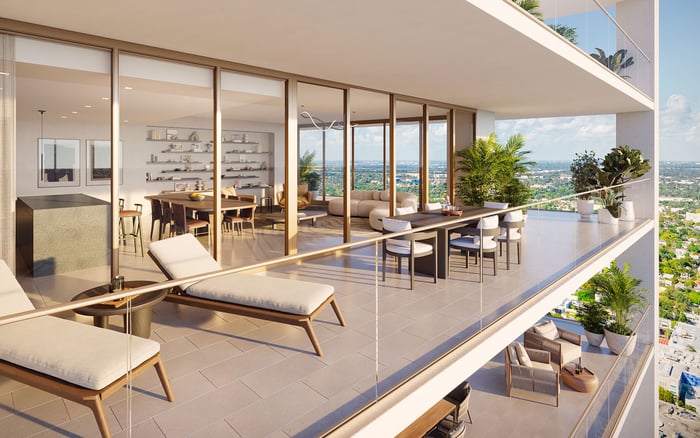
A buyer-focused guide to evaluating privacy, light, view depth, and long-term livability when considering neighbor-tower exposure at Sixth & Rio Fort Lauderdale.
For affluent households considering Sixth & Rio Fort Lauderdale, neighbor-tower exposure is not a minor detail to reserve for a final walkthrough. It is central to how a residence feels at breakfast, during a quiet work call, at sunset, and when guests gather on the balcony. In a market where architecture, location, and lifestyle often command the spotlight, exposure is the quieter variable that can define daily satisfaction.
Neighbor-tower exposure is the relationship between a residence and the buildings around it. It includes distance to adjacent structures, window angles, view depth, visible sky, and the likelihood that another household can see into the home. It is not automatically negative. Some buyers prefer a more urban, layered outlook, especially when the floor plan, ceiling height, terrace depth, and interior design create a sense of calm. Others want more openness and separation, even if that means compromising on a preferred stack or floor.
At Sixth & Rio Fort Lauderdale, the most sophisticated approach is to treat exposure as a decision framework, not a simple yes or no. A household should ask how the view performs at different times of day, how close neighboring massing feels from the primary suite, and whether the residence delivers enough privacy for the way the owners actually live.
Many buyers begin with distance, but privacy is rarely measured by distance alone. A neighboring building set at an angle may feel less intrusive than one farther away but directly aligned with the living room. A side-facing window can create more comfort than a broad glass wall looking straight into another elevation. The question is not simply, “How close is the next tower?” The better question is, “Where do eyes meet?”
For a household that entertains frequently, privacy in the living area may matter most. For a second-home buyer, the primary suite and terrace may take priority. For a family, the exposure of secondary bedrooms and study areas can be just as relevant. Broward buyers accustomed to waterfront living may be especially sensitive to the difference between a framed water view and a view interrupted by neighboring massing.
A careful buyer should stand in each major room and evaluate the eye line from multiple positions. Sit where the sofa would be. Stand near the kitchen. Step onto the terrace. Look from the bed wall, not only the bedroom window. Exposure changes materially when assessed from lived-in positions rather than from the center of an empty room.
Neighbor-tower exposure also affects light. A residence can have extensive glass and still feel visually compressed if the outlook is dominated by a nearby facade. Conversely, a residence with some adjacent exposure can feel serene if the plan captures lateral light, open sky, or a diagonal corridor between buildings.
Morning light, afternoon glare, and evening reflections all matter. A neighboring tower can bounce light into a room in a pleasing way, or it can create a mirror-like effect after dark. That evening condition is easy to overlook, yet it is often when owners become most aware of privacy. If a household expects to use the residence as a calm retreat, the nighttime relationship to surrounding windows belongs in the evaluation.
New-construction buyers often focus on finishes, amenities, and delivery expectations, but exposure is one of the least reversible attributes of a home. Window treatments, furniture placement, and landscape elements on a terrace can soften the condition. They cannot fundamentally change the spatial relationship between buildings.
Higher floors often reduce the intensity of neighbor-tower exposure, but they do not solve every condition. A high floor can still face another tall building. A lower floor can still feel excellent if the view corridor is open, the orientation is favorable, or the residence looks toward a more layered urban scene that suits the buyer’s taste.
Orientation matters because not all exposure is frontal. Some of the most desirable residences in urban coastal markets succeed by offering angled view corridors, side light, and a sense of movement beyond the glass. A direct, head-on view into another structure generally deserves more scrutiny than a diagonal relationship. The latter can preserve privacy while still creating architectural depth.
Corner residences may offer an advantage when they provide multiple outlooks. If one side is more urban and the other has greater openness, the home can feel balanced. Still, the buyer should avoid assuming that a corner automatically means superior privacy. Exact sightlines, room placement, and terrace orientation carry more weight than the label.
Exposure should be priced in relation to the whole residence. A household should not isolate it from floor plan, ceiling character, terrace usability, parking convenience, building services, or the broader appeal of Sixth & Rio Fort Lauderdale. A less open outlook may be acceptable if the plan is exceptional, the interior lives larger than expected, or the price reflects the condition with discipline.
The reverse is also true. A compelling view can be diluted if the layout is awkward, the terrace is shallow for the intended use, or the main living area does not support the household’s rhythm. Buyers sometimes overpay for a single visual attribute while underestimating how they will use the residence over years.
A refined offer strategy compares exposure against likely resale perception. Future buyers may react quickly to privacy and view depth, especially in a competitive Fort Lauderdale condominium market. If an exposure condition requires explanation, it should be reflected in the acquisition logic. If it is mitigated by thoughtful orientation, strong natural light, or a superior plan, the buyer can value it with more confidence.
Before making a decision, households should ask whether the exposure supports their daily rituals. Can the terrace be used comfortably in the morning and evening? Does the primary bedroom feel private with lights on? Is there enough sky to create emotional openness? Do neighboring facades dominate the living area, or do they sit at the edge of the experience?
Buyers should also consider furnishing. A room with direct exposure may become more private with a shifted seating arrangement, a layered window treatment plan, or a dining layout that faces away from the neighboring building. Yet the most elegant design response is the one that feels intentional, not defensive.
For investors and future sellers, exposure should be described plainly and priced cleanly. Luxury buyers appreciate honesty. If the residence offers urban energy rather than sweeping openness, position it that way. If it has a meaningful water view from one angle and neighboring massing from another, both realities should shape expectations.
The right residence is not always the one with the least exposure. It is the one where exposure, privacy, light, and plan align with the household’s priorities. Some owners want quiet separation above all else. Others want proximity to the city, visual texture, and the convenience of a refined Fort Lauderdale setting. The best purchase decisions begin with that self-knowledge.
Sixth & Rio Fort Lauderdale should be evaluated through that lens. Neighbor-tower exposure is not a flaw by default. It is a condition to be understood, negotiated, designed around, and lived with. When assessed with precision, it can clarify which residence is merely attractive and which one truly fits.
What is neighbor-tower exposure? It is the visual and privacy relationship between a residence and nearby buildings, including sightlines, distance, angle, and view depth.
Is neighbor-tower exposure always a negative? No. Some buyers enjoy an urban outlook, especially when the plan, light, and privacy conditions feel balanced.
What should buyers evaluate first at Sixth & Rio Fort Lauderdale? Start with the rooms used most often, especially the living area, primary suite, terrace, and any work-from-home space.
Do higher floors always solve exposure concerns? Not always. Height can help, but orientation and the position of neighboring buildings may matter even more.
How should a balcony be assessed? Evaluate whether it feels usable, private, and comfortable during the times of day the household expects to enjoy it.
Can interiors reduce the impact of exposure? Yes. Furniture placement, lighting, and window treatments can soften exposure, though they cannot change the building relationship.
Why does nighttime matter? Evening conditions can make privacy more noticeable because interior lights may increase visibility between neighboring residences.
Should exposure affect offer strategy? Yes. If exposure may influence resale perception or daily comfort, it should be reflected in the buyer’s valuation.
Is a water view enough to offset neighboring towers? It can be, if the view feels meaningful from the main living spaces and the neighboring massing does not dominate the experience.
How should buyers compare residences with different exposures? Compare privacy, natural light, view depth, terrace usability, and plan quality together rather than focusing on one attribute alone.
For a confidential assessment and a building-by-building shortlist, connect with MILLION.
If branded residences are on your mind — as a home or as an allocation — we would be glad to share what we are seeing, privately.
Begin a quiet conversation