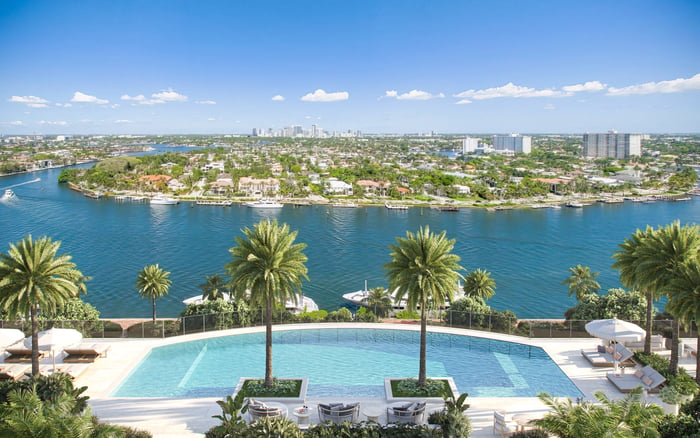
A collector-focused due-diligence guide for evaluating art installation, freight access, delivery routing, climate control, storage, insurance, and operating rules at Shell Bay by Auberge Hallandale and St. Regis® Residences Bahia Mar Fort Lauderdale.

For buyers considering Shell Bay by Auberge Hallandale or St. Regis® Residences Bahia Mar Fort Lauderdale, the question is not simply whether a residence offers the right walls for art. It is whether significant works, collectible objects, design pieces, and lifestyle storage can be received, moved, installed, conditioned, insured, and maintained without avoidable friction.
That distinction matters in South Florida. Coastal air, seasonal humidity, storm planning, association protocols, elevator scheduling, and privacy expectations all converge at the ultra-luxury level. A residence may be exquisite, but a serious collector still needs to understand the full operational path behind the scenes.
This is especially relevant in Broward, where buyers often balance waterfront living, branded hospitality, and a sophisticated ownership profile. Hallandale and Fort Lauderdale buyers may be comparing lifestyle, service culture, and access, yet for art owners the decisive questions can be more technical: clearances, turns, cab dimensions, storage conditions, and installation rules.
Shell Bay by Auberge Hallandale is positioned as a branded luxury residential offering in Hallandale Beach for high-net-worth buyers whose lifestyle may include art, collectibles, and specialized storage needs. St. Regis® Residences Bahia Mar Fort Lauderdale occupies a parallel role in Fort Lauderdale, with a similarly elevated audience likely to care about discretion, service, and logistics.
Neither should be evaluated through décor alone. Art installation capability belongs in core due diligence. A collector purchasing at this level should ask whether a large-format painting, sculptural work, collectible design piece, or fragile crate can move from vehicle arrival to residence without conflict at the loading area, corridor, elevator cab, turn radius, or entry door.
The goal is not to declare one address superior for art logistics. Exact freight-elevator sizes, loading clearances, storage-room specifications, HVAC tolerances, and operating rules should not be assumed. The right approach is disciplined verification before contract, closing, or major installation planning.
The most elegant residence can become complicated if the delivery route is not studied in advance. Buyers should request the practical path: where the truck stops, how crates enter the building, whether designated loading access exists, which elevator is used, how protective coverings are handled, and whether the elevator opens into a corridor with sufficient turning room.
For Shell Bay, that means confirming service-elevator dimensions, delivery routing, loading access, and installation procedures directly with the relevant project or building representatives. For St. Regis® Residences Bahia Mar Fort Lauderdale, the same questions apply. A buyer’s art advisor, designer, or fine-art handler should not rely on assumptions formed from renderings or model residences.
A useful test is to map the route for the largest anticipated object, not the average one. If a collector owns oversized canvases, framed photography, stone pieces, vitrines, wine cabinets, or large design objects, the due-diligence package should include dimensions, turning points, elevator capacity, door widths, and any restrictions on timing.
Installation is more than hanging art. It can involve third-party handlers, wall reinforcement review, specialty lighting coordination, lift equipment, insurance certificates, after-hours access, security supervision, and noise controls. These rules affect cost, scheduling, and risk.
A sophisticated buyer should ask whether third-party art handlers are permitted, what insurance limits they must carry, how elevator reservations are made, whether after-hours work is allowed, and who approves protective measures for common areas. If installation requires building staff presence, that should be identified early.
In a new-construction context, some answers may evolve as association documents, operating policies, and property-management procedures are finalized. That makes early written confirmation valuable. For a pre-construction buyer or an early purchaser, the right questions can be incorporated into the closing file, designer brief, or collection-management plan.
Art does not only need space. It needs stability. Climate-control diligence at both Shell Bay by Auberge Hallandale and St. Regis® Residences Bahia Mar Fort Lauderdale should focus on HVAC reliability, humidity management, temperature stability, and storage conditions suited to valuable works in a South Florida coastal environment.
Collectors should ask how residential HVAC systems are specified, how humidity is managed, and what happens during service interruptions. They should also examine whether storage areas are conditioned, whether any private storage is suitable for sensitive items, and whether building protocols address storm preparation, extended travel, or prolonged absence.
Climate stability is especially relevant for works on paper, photography, textiles, wood, mixed media, and objects with organic materials. Even when a residence is beautifully appointed, a collector should understand whether the environment can be maintained consistently enough for the collection’s needs.
Climate-controlled storage is not a generic amenity when valuable objects are involved. Buyers should distinguish between ordinary owner storage and storage that may be appropriate for art, archival materials, seasonal design pieces, or collectibles. The questions should include conditioning, access control, camera coverage, fire protection, pest management, and whether storage is private, assigned, or separately licensed.
Security and insurance are intertwined with logistics. If a crate is staged in a loading zone, who is responsible? If a handler damages a common area, what documentation is required? If an installation extends into evening hours, who has access? A high-value collection deserves a written chain of responsibility, not informal reassurance.
Buyers should also coordinate with insurance advisors before installation. The policy should contemplate transit, temporary storage, installation, wall mounting, building restrictions, and named third-party vendors. The strongest due diligence brings the owner’s art advisor, interior designer, insurance specialist, and legal counsel into the conversation before the residence is fitted out.
Before proceeding, buyers should request technical drawings, back-of-house circulation information, elevator specifications, loading procedures, rules for third-party handlers, insurance requirements, elevator reservation protocols, and any restrictions on after-hours installation. These materials should be reviewed against the actual collection or the type of collection the buyer expects to build.
The essential questions are direct. Can the largest work enter the building and residence without a pinch point? Are elevator dimensions and weight capacities adequate? Is the delivery route protected from weather exposure? Are storage spaces conditioned and secure? Are association rules compatible with professional art handling? Are there limitations that might affect sculpture, oversized works, or fragile objects?
For both Shell Bay and St. Regis® Residences Bahia Mar Fort Lauderdale, the most prudent framing is verification, not assumption. These are branded luxury offerings serving discerning buyers, but museum-grade logistics should never be presumed without project-specific confirmation.
Why should art installation be part of real estate due diligence? Because valuable works require a verified path for delivery, handling, installation, climate stability, insurance, and ongoing care.
What should Shell Bay buyers confirm before planning major art installation? They should confirm service-elevator dimensions, loading access, delivery routing, third-party handler rules, insurance requirements, and installation scheduling.
What should St. Regis® Residences Bahia Mar Fort Lauderdale buyers verify? They should review the same operational details, including freight access, elevator reservation protocols, after-hours restrictions, and storage conditions.
Can buyers assume either building has museum-grade logistics? No. Exact back-of-house specifications and operating rules should be confirmed directly before purchase or installation planning.
Why does the delivery route matter for large-format works? Oversized pieces can encounter pinch points at loading areas, corridors, elevator cabs, turns, or residence doorways.
What climate issues matter most in South Florida? HVAC reliability, humidity management, temperature stability, and conditioned storage are central concerns for valuable art and collectibles.
Should art advisors join the purchase review? Yes. Art advisors and professional handlers can compare the collection’s dimensions and sensitivities against the building’s technical realities.
Are ordinary storage rooms suitable for art? Not necessarily. Buyers should verify conditioning, security, access control, fire protection, and suitability for specific objects.
Do association rules affect art installation? Yes. Rules may address elevator reservations, work hours, insurance certificates, common-area protection, vendor access, and staff supervision.
What is the best way to shortlist comparable options for touring? Start with location fit, delivery status, and daily lifestyle priorities, then compare stacks and elevations to validate views and privacy.
To compare the best-fit options with clarity, connect with MILLION.
If branded residences are on your mind — as a home or as an allocation — we would be glad to share what we are seeing, privately.
Begin a quiet conversation