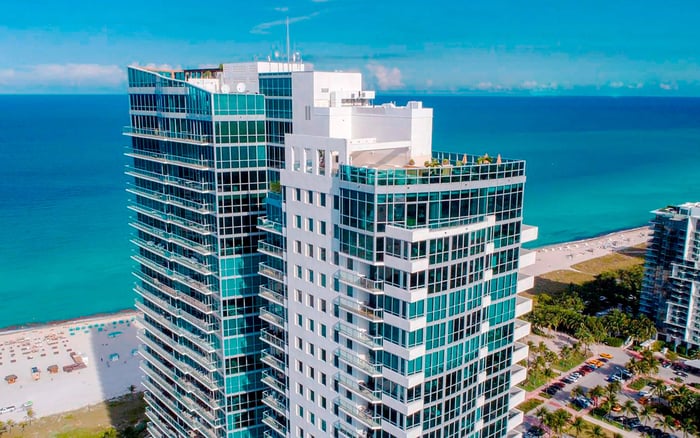
For South Florida buyers balancing lifestyle, flexibility, and cost transparency, hotel-serviced residences and traditional condos solve different problems. This guide breaks down what is typically included, what is variable, and the due diligence that matters most when the lines between hospitality and home blur.

In ultra-prime South Florida, the decision is rarely “hotel versus home.” The more useful question is operational: should your Miami-beach base function purely as a private residence, or should it be able to perform like a well-run hotel when you want service, support, or rental-style flexibility?
Serviced apartments, often framed as hotel-serviced residences, were built for longer stays with the infrastructure of daily life: a kitchen, a separate living area, and a layout that reads as residential rather than a single-room hotel plan. Many are fully furnished, and they are typically supported by hospitality operations that may include housekeeping and front-desk style assistance.
A traditional condominium, by contrast, is an ownership structure. You hold title to an individual unit and share ownership, costs, and governance of common areas. That shared ecosystem is managed by a condo association that sets rules, hires vendors, funds reserves, and charges recurring fees to maintain the building.
For a Second-home buyer, the best choice depends on what you are optimizing: ease, predictability, privacy, control, or the freedom to leave for weeks without a second thought.
The appeal of serviced living is not just polish. It is operational simplicity. Many serviced-apartment offerings bundle utilities and Wi‑Fi, reducing the number of moving parts in your monthly total. The goal is home-like function with hospitality backup.
The advantage becomes obvious once you stay long enough for routines to matter. A serviced residence typically gives you the space to work, host quietly, and keep your own cadence, with the option to add services as needed. The kitchen is not a decorative detail; it changes how you spend, how you entertain, and how often you need to leave the property.
The cost structure is often the second driver. Serviced apartments are commonly positioned as a way to reduce total trip cost on longer stays because you can self-cater and do laundry in-unit rather than paying hotel markups for meals and laundry. Over extended stays, those “extras” are where budgets tend to drift.
This is why hybrid hospitality is now a meaningful category, not just a marketing phrase. Real estate and hospitality are converging, blending hotel operations with longer-stay residential expectations such as more space, kitchens, and a rhythm that feels closer to living than visiting.
Even sophisticated travelers underestimate how variable a hotel total can be.
Hotels commonly use revenue-management strategies that adjust prices based on demand, seasonality, and customer willingness to pay. In plain terms, the same room can cost dramatically different amounts depending on the week.
A practical comparison from Sydney’s CBD illustrates the mechanism. A hotel “superior king room” of roughly 23 m² was shown around $335 per night in standard periods, while a larger corporate apartment of roughly 60 m² was around $311 per night. In peak periods, the hotel rate in that example rose to about $769 per night while the corporate apartment rate stayed around $311 per night. The numbers are market-specific, but the exposure to demand spikes is universal.
Fees compound the issue. Many hotels add mandatory or semi-mandatory amenity or resort fees, framed as covering on-site facilities or services. Whatever the label, these charges can materially raise the nightly total and blur the comparison between a headline rate and the true cost.
For owners considering Short-term-rentals, that volatility is a double-edged sword. Demand spikes can be lucrative, but they also make planning less predictable, particularly if you value the ability to use the residence on short notice during high-demand weeks.
A condo purchase offers permanence and a stronger sense of “mine,” but it also enrolls you in shared governance.
Condo buildings are typically governed by a homeowners association or condo association that enforces rules and manages shared spaces on behalf of owners. Those rules can shape both lifestyle and economics, including leasing limitations and rental rules. For owners who want flexibility, that governance layer is not a footnote; it is the operating system.
Condo fees are the quiet line item that deserves the most scrutiny. HOA or condo fees fund shared expenses like common-area upkeep and repairs, building services, and long-term reserve contributions. The exact scope varies by building, as does the seriousness of its planning for future capital needs.
Amenities can be genuinely valuable, but they are not free. Luxury amenity packages increase the all-in cost, and the value hinges on whether you will actually use them and whether they improve daily life enough to justify the premium. You are paying for the building’s lifestyle infrastructure whether or not you swim laps.
Insurance differs from single-family norms as well. Condo insurance is typically an HO‑6 policy that covers the unit’s interior and personal property, while the condo association’s master policy generally covers the building and shared structures. The precise split depends on the master policy type, which is why the building’s insurance posture belongs on every serious due diligence list.
In Miami-beach, many high-net-worth buyers are not choosing a primary home. They are choosing a pattern of use.
If you stay for longer stretches, day-to-day functionality becomes more important than the optics of a lobby. This is where serviced living can feel unusually efficient: more space, a kitchen, and bundled basics that reduce the friction of arriving and settling in.
If you prefer owner control, customization, and a stronger degree of privacy, a traditional condo can deliver a more personal sense of residence. The tradeoff is that you must engage with association economics, rules, and long-term building planning.
If your ownership thesis includes Long-term-rentals, the central questions are governance and predictability. Condo associations can impose restrictions that affect leasing flexibility, and owners should weigh those constraints alongside monthly fees and reserves.
If your lifestyle leans toward a hospitality-forward building, a Condo-hotel style model can make sense, but you should expect operational rules and fee structures that feel closer to hospitality than to a classic condominium.
When you tour, look past finishes and ask one operational question: does this place behave well when you are not here?
Branded residences, homes tied to hospitality brands, emphasize hotel-style service and amenities and are commonly priced at a premium versus comparable non-branded properties. That premium often reflects the promise of service consistency, brand stewardship, and an experience that is intentionally curated.
Miami Beach offers multiple interpretations of this idea, from art-driven lifestyle ecosystems to quieter, service-first residential environments. In that conversation, it is natural to benchmark buildings that have shaped buyer expectations for service, discretion, and arrival experience such as Faena House Miami Beach.
For buyers who value an established hospitality cadence and a strong sense of place, Setai Residences Miami Beach is frequently discussed in the same breath as other service-oriented addresses. Mentioning Setai Residences Miami Beach here is less about any single feature and more about the market’s preference for residences that feel effortlessly managed.
If your ideal is a residential environment that still reads as hotel-grade in service expectations, The Ritz-Carlton Residences® Miami Beach is another reference point buyers often use when comparing “live like an owner” versus “arrive like a guest.”
And for those who prioritize a quieter, more residential oceanfront rhythm, boutique scale can be part of the appeal, which is why projects like 57 Ocean Miami Beach tend to surface in conversations about privacy and daily livability.
Luxury buyers do not fear paying for quality. They fear ambiguity.
Start with an all-in lens. Comparing a serviced residence to a traditional condo is often an exercise in all-in monthly cost versus ownership or lease plus separately billed costs. Ask, in writing, what is typically included and what is not: utilities, internet, parking, housekeeping cadence, gym access, storage, and any fees that are mandatory.
For traditional condos, request the association’s budget, fee history, and reserve posture. Fees often cover shared upkeep, services, and reserve funding, but the way a building plans for long-term repairs can shape future cost more than any current line item.
Confirm rules that affect flexibility. Leasing restrictions, guest policies, and operational constraints can change the true value proposition, especially if your calendar shifts from year to year.
Finally, align insurance responsibilities early. Understand what the master policy covers versus what an HO‑6 policy must cover for interiors and personal property. It is less glamorous than a showroom kitchen, and far more decisive.
1) What is a serviced apartment in luxury real estate terms?
A fully furnished residence designed for longer stays, typically with a kitchen and living space, plus hospitality support.
2) Why can serviced apartments cost less than hotels on long stays?
They can reduce total trip cost because you can self-cater and do laundry in-unit instead of paying hotel markups.
3) What makes hotel pricing feel unpredictable?
Hotels often use dynamic pricing based on demand, seasonality, and willingness to pay, so rates can spike.
4) Are resort or amenity fees really a big deal?
They can be, because they are often mandatory and raise the true nightly total beyond the headline rate.
5) What exactly is a condominium?
An ownership structure where you own your unit while sharing ownership and governance of common areas.
For discreet guidance on selecting a Miami-beach residence that fits your calendar, explore MILLION Luxury.
If branded residences are on your mind — as a home or as an allocation — we would be glad to share what we are seeing, privately.
Begin a quiet conversation