Palm and Hibiscus Islands sit like two quiet commas in Biscayne Bay, minutes from both Downtown Miami and the energy of South Beach. Created in the early 1920s through dredging and fill, these man-made islands have evolved into among Miami Beach’s most private addresses: low inventory, high discretion, and a waterfront lifestyle that remains difficult to replicate. For buyers, the appeal is less about flash and more about geography and scarcity. The islands are gated and guarded, their streets largely residential, and their market is often defined by trophy-level listings that can set national headlines. What follows is a buyer-oriented look at why Palm and Hibiscus Islands endure as long-term luxury holds, and what to watch when you decide to compete for a water-edge parcel in the heart of Miami Beach.
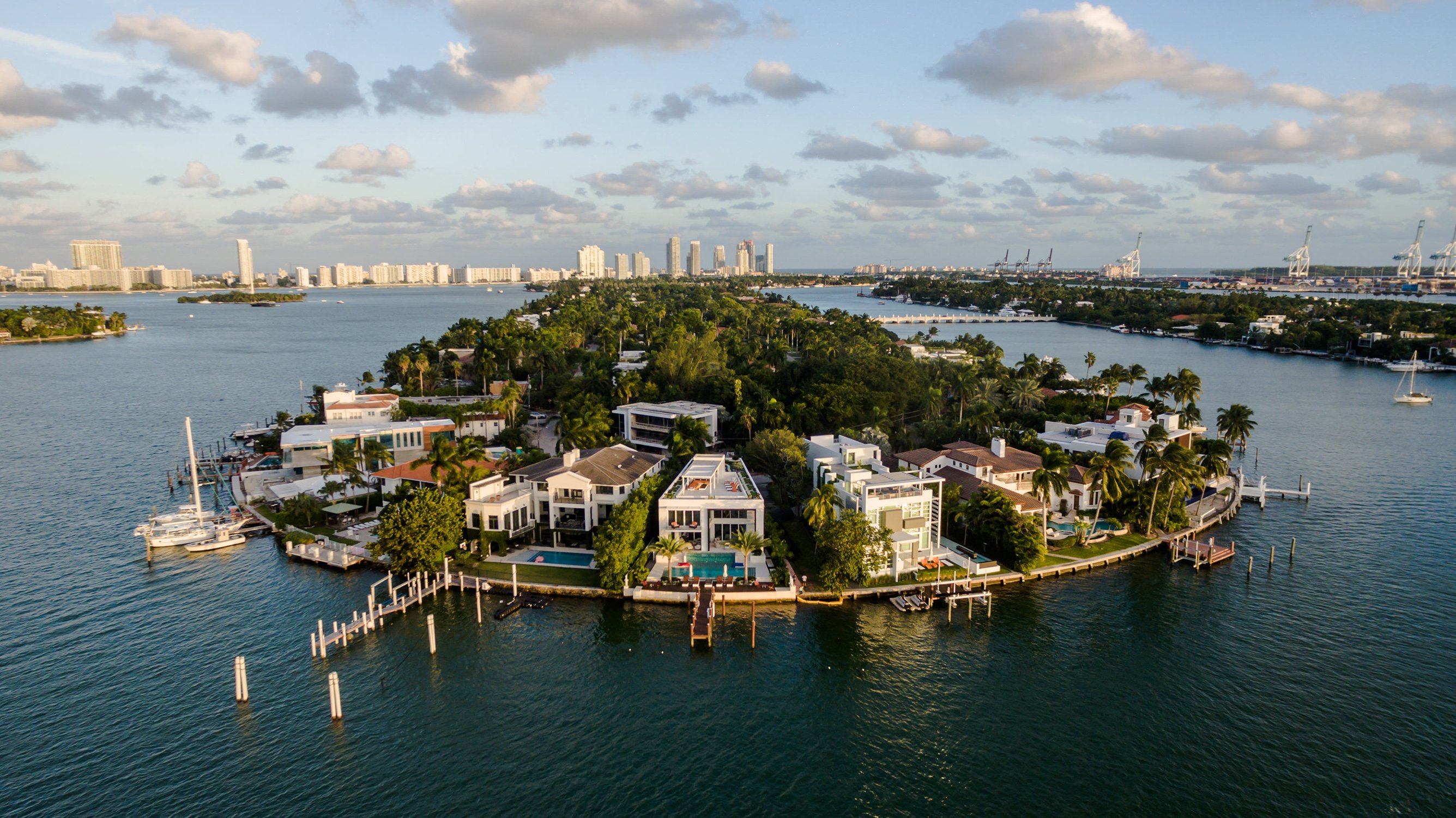
Palm Island and Hibiscus Island are man-made islands in Biscayne Bay within the City of Miami Beach. They are often discussed as a single destination because, for residents and buyers, they operate like one tightly held micro-neighborhood with the same core promise: a guarded residential setting that feels insulated from the city, while remaining genuinely close to it.
Location does the heavy lifting. The islands sit just off the MacArthur Causeway, positioned between Miami on the mainland and South Beach and the broader Miami Beach barrier island. That placement creates a form of convenience that is easy to underestimate until you live it. You are not committing to a long bridge routine just to come home. You can move in either direction, quickly, without turning daily logistics into a project.
For buyers, that is the defining difference between Palm and Hibiscus and other waterfront enclaves. In many luxury neighborhoods, discretion comes with distance. Here, discretion comes with access. You can step away from the pace of Miami, but you do not have to step far.
That combination is also why these islands continue to matter in a market where new luxury options appear every year. A guarded island setting in the middle of Miami’s center of gravity is not easy to replicate, and scarcity only compounds its appeal.
Palm and Hibiscus Islands were created in the early 1920s through dredging and fill during the “Biscayne Bay Islands” development era, the same broader chapter that includes nearby Star Island. That origin is not a historical footnote. It explains the fundamental asset you are buying: engineered land that has become deeply embedded in Miami Beach’s luxury map, socially and financially.
Palm Island is the larger of the two at about 82 acres. Hibiscus Island measures about 69 acres. These numbers matter because they set the physical ceiling on what can exist here. In practice, the acreage translates into a limited residential footprint and a constrained inventory cycle. Palm Island is commonly described as having about 136 homes and residences, a scale that helps explain why listings can feel intermittent and why serious buyers often track the islands long before they plan to move.
The market tends to move in chapters rather than seasons. There can be stretches where the inventory feels quiet, then a wave of meaningful properties appears and the conversation shifts quickly. When a true waterfront estate hits the market, the audience is not just local. Coverage and attention can widen fast, and that visibility becomes part of the submarket’s pricing psychology.
For a buyer, this history reinforces a practical reality: you are competing for one of a finite number of addresses on two small islands with fixed edges. That limitation is structural, not cyclical.
Palm and Hibiscus are gated and guarded residential enclaves, and that is not a secondary amenity. It is the framework for how the neighborhood lives. In Miami Beach, “security” is sometimes reduced to marketing language. On these islands, it functions as an everyday condition of the streetscape and the rhythm of the community.
The atmosphere is notably residential. Streets are quiet, activity feels local, and the tone is more neighborhood than nightlife. That is part of why the islands draw a buyer profile that values privacy in a lived-in way, not just as a headline feature.
The lifestyle is also more practical than outsiders expect. Community amenities commonly cited include a neighborhood park and sports courts, including tennis and basketball. They are not resort amenities, and they do not try to compete with the full-service experience of a branded tower. Instead, they support day-to-day routines that signal permanence: morning walks, time outdoors, and the simple ability to stay on the island without needing to “go somewhere” for every small need.
That practicality is one reason the buyer pool can be end-user heavy even at ultra-luxury price points. A gated community that supports a normal cadence, while still giving you fast departures toward either Downtown Miami or South Beach, creates a type of ease that is difficult to reproduce elsewhere in Miami Beach.
Buyers should also understand that the islands’ calm does not mean they feel isolated. The sense of separation is real, but it is created through controlled access and residential continuity, not through distance from the city’s core.
Palm Island is frequently defined by waterfront scarcity and ultra-luxury price points, with listings and sales that are covered as “trophy” Miami real estate. This is not a neighborhood where comparable sales always read cleanly. Even within the same island, two waterfront homes can carry very different value profiles based on site lines, seawall conditions, dock configuration, and parcel orientation.
That is why headline listings matter. In trophy markets, the most visible properties can anchor buyer expectations and seller confidence, even when actual terms and final pricing are opaque. A trio of adjacent Palm Island waterfront properties has been marketed together for $150 million and widely publicized as among the priciest U.S. home listings. National coverage has identified 190 Palm Ave as the compound-style offering associated with that $150 million figure.
Other high-profile Palm Island listings often referenced in public portals and brokerage marketing include 198 Palm Ave, cited around $99 million; 130 Palm Ave, cited around $60 million; and 210 Palm Ave, marketed around $49.5 million. Prices in trophy environments can move, and the public record may not tell the full story. Still, the takeaway is consistent: when Palm Island enters the market conversation, it often does so at a national level.
For buyers, the trophy effect cuts both ways. It can reinforce long-term narrative premium, which is a real component of value in global luxury markets. It can also introduce noise, because attention can distort expectations or encourage oversimplified underwriting. Palm Island demands granular analysis. “Miami is hot” is not a strategy. You are buying a specific waterfront asset, in a scarce, high-attention submarket, where details like exposure and dock setup can matter as much as square footage.
The right approach is disciplined. Understand the physical waterfront realities, the constraints of inventory, and the ways that high-visibility listings shape psychology even beyond their own parcel lines.
Hibiscus Island also trades at ultra-luxury levels, with “luxury homes” inventory tracked across major portals and in mainstream market commentary. Public discussion has characterized Hibiscus as a high-price submarket where deals can require patience, with longer days on market and negotiated discounts that are consistent with trophy environments.
In other words, Hibiscus can present a different rhythm than Palm. Not necessarily less expensive and not necessarily easier, but sometimes less performative. Some buyers prefer a negotiation defined by a property’s singularity rather than by an active bidding landscape. For that temperament, Hibiscus can align well.
The island’s inventory also reflects a range of architectural and lifestyle profiles within a compact, guarded setting. Representative listings that have appeared in mainstream luxury coverage include 375 N Hibiscus Dr, marketed as a luxury and newer-construction opportunity, and 271 N Hibiscus Dr, positioned across major listing aggregators as an estate home. The point is not the individual marketing language. The point is that, within the same small island, buyers can encounter both contemporary builds and more traditional estate presentations.
For underwriting, that range reinforces the need to compare like with like. Construction era, waterfront interface, and the way a home uses its site can create meaningful separation even at similar price levels.
In Miami, history can be surprisingly liquid. Palm Island’s celebrity and cultural associations form part of its long-standing brand, and they continue to resurface in national conversation. One widely covered example is the well-known Palm Island home once owned by Al Capone, which later drew attention related to preservation, demolition debate, and resale.
This kind of legacy adds a layer that newer neighborhoods cannot manufacture quickly. Buyers at the top end are not only acquiring square footage and a water view. They are buying into an established story that has repeated, with new owners and new architecture, for a century.
The islands also sit close to Miami Beach’s broader entertainment and social history. The historic Latin Quarter nightclub era, a major mid-century Miami Beach entertainment venue, is part of the surrounding tapestry that helps explain why close-in addresses can retain a sense of timelessness. Even when the city’s style shifts, these islands remain legible as classic Miami Beach: discreet, waterfront, and central.
This legacy factor also helps explain continued resonance with international second-home buyers. For many global buyers, an address that “reads” immediately has value. Palm and Hibiscus do not require long explanations. They carry recognition, and recognition can support confidence.
Even buyers committed to a single-family estate should understand the nearby condo market, because it shapes lifestyle options and future exit logic. In Miami Beach, the definition of ultra-luxury has expanded. The island estate is no longer the only status symbol. Branded and design-forward towers have become credible alternatives for buyers who prioritize security, services, and lock-and-leave simplicity.
For example, Five Park Miami Beach is often part of the conversation for buyers who want new construction and a tower lifestyle in Miami Beach, particularly when they value design, views, and a more vertical sense of privacy.
Similarly, Setai Residences Miami Beach represents a hospitality-driven model that appeals to owners who want an established service experience tied to a globally recognized hotel standard.
And for buyers whose definition of luxury includes brand heritage and a curated residential program, The Ritz-Carlton Residences® Miami Beach offers another way to stay close to the water and the city’s core while delegating daily friction to a staff.
The comparison is not about better or worse. It is about what you want to manage personally. On Palm and Hibiscus, you own the full stack: the home, the grounds, the waterfront interface, and the decisions that come with them. In a high-service building, you are buying time, predictability, and a different kind of privacy.
This framework also clarifies buyer intent. Some clients want the autonomy of a standalone estate, a gate, and a dock environment that feels entirely theirs. Others want to arrive, turn a key, and let a professional operation handle the details. Palm and Hibiscus attract the first profile, but the towers nearby provide a relevant benchmark.
Because Palm and Hibiscus are defined by waterfront scarcity, due diligence should begin with waterfront realities rather than end there.
First, treat each property as a bespoke asset. Two homes on the same street can live very differently depending on orientation, water exposure, and how the structure interfaces with the bay. The value is not only in the address. It is in the way the parcel performs as a waterfront site.
Second, underwrite the trophy-market dynamic. These islands are not purely momentum markets. They can behave like collectible markets, where value is a function of rarity, narrative, and timing. That means you should plan for fewer clean comps, more nuance in negotiations, and greater importance placed on specifics that might be secondary elsewhere.
Third, be honest about use. If your Miami-beach pattern is seasonal and you prioritize minimal responsibility, a tower alternative may fit your life better. If your pattern is frequent and you want control, privacy, and the feel of a standalone estate, the islands remain difficult to displace.
For buyers who want ocean proximity rather than bayfront living, it can also be useful to benchmark against boutique oceanfront options like 57 Ocean Miami Beach. That comparison highlights a real trade: direct ocean adjacency versus the protected-water lifestyle of Biscayne Bay.
The goal is not to find a universally “best” option. The goal is to match your priorities to the asset type, then evaluate the specific property with a waterfront-first lens.
Palm and Hibiscus Islands also benefit from their position inside a broader South Florida luxury frame often discussed as a “Golden Triangle” spanning Miami, Palm Beach, and Naples. Within that geography, close-in Miami waterfront neighborhoods function as international calling cards. They are recognizable, they are scarce, and they communicate a particular kind of lifestyle without needing explanation.
From that perspective, the islands’ value proposition is not only local. It is portable. For a global buyer comparing Florida to other wealth hubs, the combination of gated-community security, immediate access to Miami’s commercial core, and a legacy luxury address can feel unusually complete.
That is why single-family-homes on Palm and Hibiscus remain in the conversation even as the region introduces new projects and new neighborhoods. Scarcity is not a marketing claim here. It is a physical fact of two small engineered islands with finite edges, in a city where proximity is one of the most expensive commodities.
For buyers who view real estate as both lifestyle and long-term hold, that structural scarcity can matter as much as the home itself.
Are Palm and Hibiscus Islands part of Miami Beach? Yes. They are man-made islands in Biscayne Bay within the City of Miami Beach.
How close are the islands to Miami and South Beach? They sit just off the MacArthur Causeway between the mainland and Miami Beach, which supports quick access in both directions.
What kind of security and privacy do buyers typically expect? The islands are gated and guarded, a core reason they are favored by buyers prioritizing discretion.
Do the islands have neighborhood amenities, or is it only residential? They are primarily residential, but community amenities commonly cited include a neighborhood park and sports courts such as tennis and basketball.
For confidential guidance on Miami-beach trophy real estate, connect with MILLION Luxury.
If branded residences are on your mind — as a home or as an allocation — we would be glad to share what we are seeing, privately.
Begin a quiet conversation