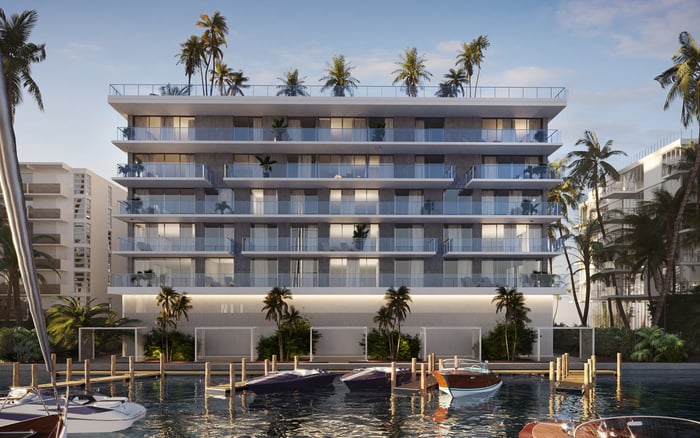
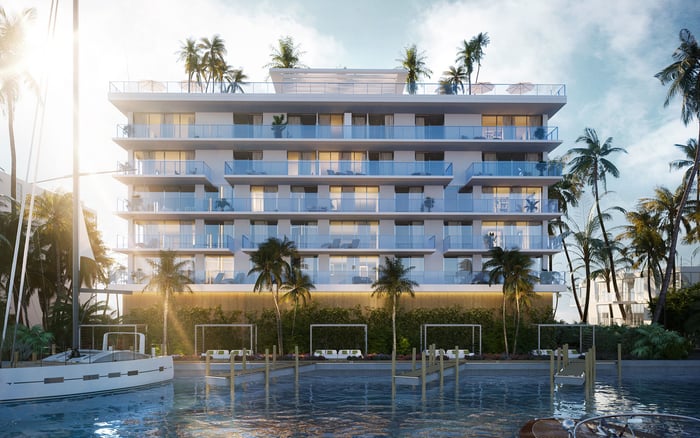
A discreet buyer-diligence guide to evaluating private and semi-private elevator openings at Origin Bay Harbor Islands, with focus on plans, access control, legal status, acoustics, service routing, association costs, emergency operation, and resale clarity.
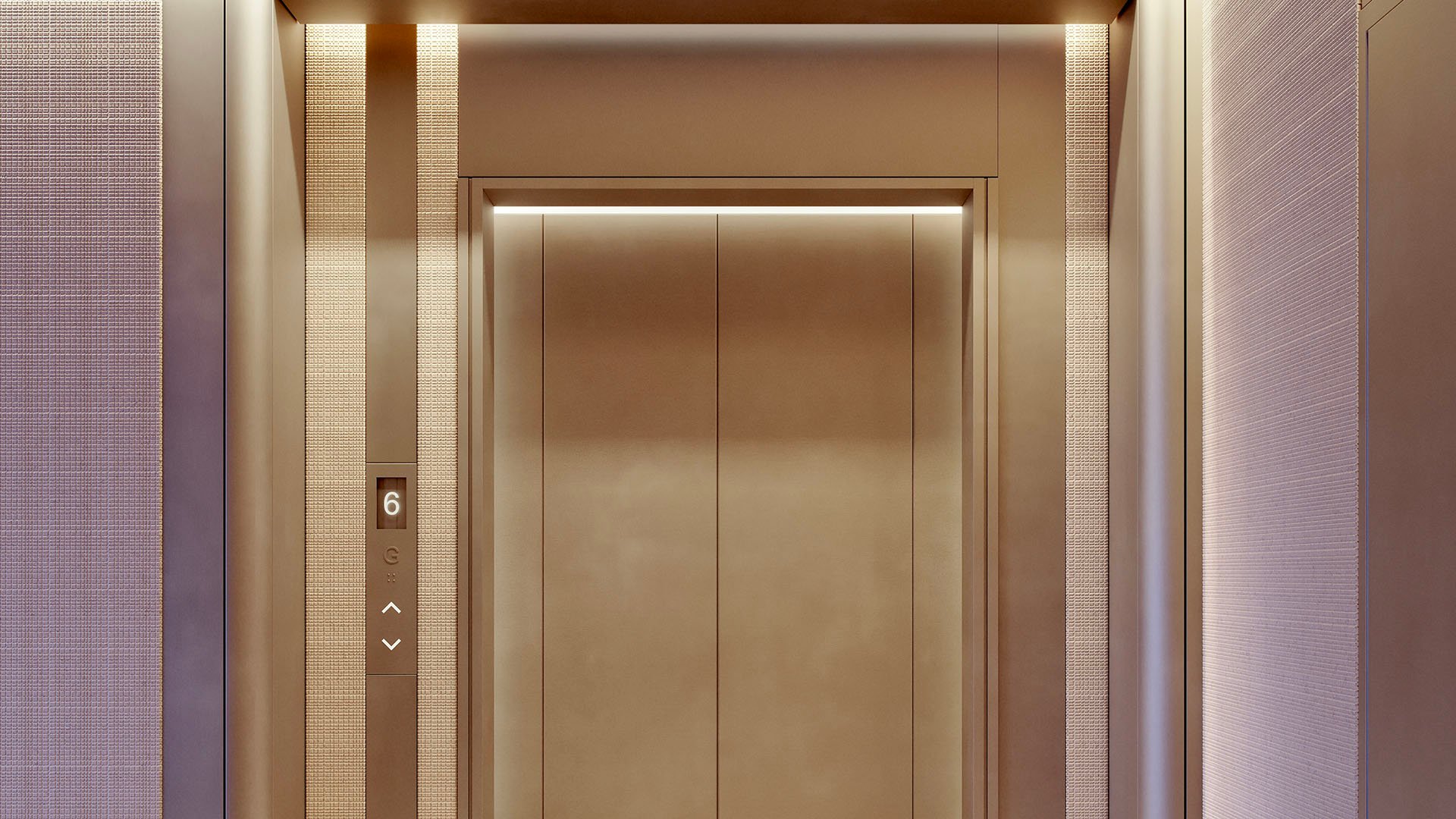
At the upper end of South Florida condominium buying, the arrival sequence matters. A private or semi-private elevator opening can make a residence feel less like an apartment and more like a discreet vertical estate, with a first impression that is controlled, quiet, and intentionally personal. At Origin Bay Harbor Islands, that promise should be evaluated with the same discipline buyers apply to views, terraces, floor plans, and association costs.
A rendering may show a gallery-like foyer, handsome finishes, and an effortless transition from elevator to residence. But a rendering is not a legal description, an access-control protocol, an acoustic test, or a maintenance obligation. The essential buyer question is not simply whether the elevator appears private. It is whether the elevator experience will operate privately, securely, quietly, and predictably once the building is lived in.
For Origin Bay Harbor Islands, the conversation should begin with the official project materials and continue through the architectural plans, condominium documents, and operational rules. The goal is to understand exactly what opens where, who controls it, who pays for it, and how it performs under real-life conditions.
In luxury marketing, “private elevator” can be used loosely. For a buyer, the distinction is material. A true private elevator condition generally means the elevator opens directly into a residence or into a foyer functionally controlled by that residence. A semi-private condition may involve an elevator opening into a shared foyer, a limited-access vestibule, or a space governed differently by the condominium association.
That distinction affects privacy, security, daily convenience, and future resale language. If another residence, staff route, guest path, or service access point interacts with the same landing, the lived experience may differ from what the marketing imagery implies. The issue is not that semi-private access is undesirable. In many boutique buildings, it can be elegant and efficient. The issue is whether the buyer understands the condition before assigning value to it.
A Bay Harbor buyer should ask to see the elevator-to-residence condition on the architectural plans. The plan should make clear whether the elevator opens into the unit, a private vestibule, a limited common element, or a common area. That single distinction can shape everything from furnishing rights to insurance responsibility.
The most overlooked question is often the most consequential: what is the elevator foyer, legally? If the foyer is part of the unit, the owner may have a different set of rights and obligations than if it is a limited common element assigned to the unit or a common area controlled by the association.
This affects maintenance, insurance, repairs, finish changes, lighting, security hardware, and liability. A buyer drawn to the idea of a private arrival may assume the space is theirs to use, decorate, and control. That may or may not be accurate. The condominium declaration, survey exhibits, unit boundaries, and rules should be reviewed carefully.
New-construction buyers often focus on visible elements such as stone, millwork, lighting, and ceiling height. Yet the invisible legal boundary may matter more. If a lockable vestibule, elevator landing, or controlled-access component requires association approval for changes or repairs, the owner’s practical control may be more limited than the sales language suggests.
A private elevator is only private if access is controlled intelligently. Buyers should ask how the system will work day to day. Will residents use key fobs, coded access, destination dispatch, staff authorization, or another security protocol? Can guests be sent directly to the residence? Can access be restricted by floor, unit, time of day, or staff role?
The details matter because luxury living includes more than the owner’s arrival. It includes dinner guests, domestic staff, deliveries, vendors, maintenance personnel, movers, and emergency responders. If the elevator opens close to the residence without a secondary lockable vestibule or door, the security design becomes especially important.
The best question is practical: what happens when the elevator arrives and the doors open? Is there another controlled threshold before the living space? Can an unintended arrival occur? How are permissions revoked after a guest visit, vendor appointment, or temporary staff assignment? These are not abstract concerns. They define whether the residence feels serene or exposed.
Private access can be diluted if building functions rely on the same elevator banks. Buyers should verify whether Origin Bay Harbor Islands provides a separate service elevator condition or whether residents, guests, movers, deliveries, and building staff share the same vertical circulation.
Even in a refined pre-construction setting, service logistics become visible after move-in. Furniture deliveries, dog walkers, housekeeping, catering, repairs, and package flow all place pressure on elevator systems. If the private elevator is also the practical route for service access, the feeling of exclusivity may be interrupted more often than expected.
Wait times should also be considered. A private opening is appealing, but the number of users, elevator programming, staffing model, and guest-management procedures all influence the experience. Privacy is not merely the absence of a public hallway. It is the smooth management of every arrival and departure.
Sound can quietly define whether a private elevator feels luxurious. Buyers should investigate elevator shaft noise, mechanical movement, door operation, chimes, and sound transfer between the foyer and adjacent living areas. A glamorous foyer loses some of its appeal if the primary bedroom, den, or living room hears repeated elevator activity.
Architectural plans can reveal adjacency, but buyers should also ask what acoustic assemblies separate the elevator, shaft, foyer, and residence. Door seals, wall assemblies, flooring transitions, and vestibule depth may all influence the result. The concern is especially relevant when an elevator opens directly into or immediately beside the residence.
Acoustic privacy is also part of social privacy. If conversations from the residence carry into the foyer, or if voices in the landing are audible inside, the emotional benefit of private arrival can be compromised. In a luxury condominium, silence is not a decorative feature. It is part of the asset.
The private-elevator experience may carry costs beyond the initial premium. Monthly association expenses should be reviewed for elevator maintenance, inspections, security systems, modernization reserves, and any infrastructure related to controlled access. If the foyer or access component serves only one unit or a limited group of units, the documents should clarify how costs are allocated.
Buyers should also ask how the elevator works during power outages, fire alarms, hurricanes, maintenance downtime, and emergency response scenarios. Does the system default to a safe floor? How do first responders gain access? What happens if the elevator serving a private opening is temporarily out of service? How will residents, guests, and staff move through the building during interruptions?
These questions do not diminish the appeal of the feature. They protect it. The most compelling luxury amenities are those that remain elegant under pressure, not only in a brochure.
For resale value, clarity is essential. Future buyers, appraisers, and brokers may interpret “private elevator” differently across South Florida projects. A seller who can document the exact elevator condition, legal status of the foyer, access-control protocol, and maintenance responsibilities will be better positioned to explain the premium with confidence.
At Origin Bay Harbor Islands, the most sophisticated approach is to separate image from operation. The rendering introduces the aspiration. The plans, documents, rules, and systems reveal the reality. When those elements align, a private elevator opening can be one of the most graceful conveniences in condominium living. When they are vague, the buyer should slow down.
What should buyers verify first about a private elevator opening? Confirm exactly where the elevator opens on the architectural plans and whether the condition is private or semi-private.
Is a semi-private elevator foyer necessarily a drawback? No. It can work beautifully if access, sharing, security, and maintenance obligations are clearly understood.
Why does the legal status of the foyer matter? It determines whether the space is part of the unit, a limited common element, or common area controlled by the association.
Can renderings prove that an elevator foyer is private? No. Renderings communicate design intent, but plans and condominium documents define the actual condition.
What access-control questions should be asked? Ask whether access uses fobs, codes, destination dispatch, staff control, or another protocol, and how permissions are managed.
Should buyers ask about service elevators? Yes. Service routing affects privacy, wait times, deliveries, move-ins, and the daily rhythm of the building.
How can acoustic privacy be evaluated before completion? Review adjacency on plans and ask about shaft separation, door-operation noise, wall assemblies, and sound transfer.
What emergency scenarios should be reviewed? Ask how access works during outages, fire alarms, hurricanes, maintenance downtime, and emergency response.
Can private elevator infrastructure affect monthly costs? Yes. Maintenance, inspections, security systems, and reserves may influence association expenses.
Why is elevator documentation useful for resale? It helps future buyers understand what “private elevator” actually means and supports clearer value positioning.
For a confidential assessment and a building-by-building shortlist, connect with MILLION.
If branded residences are on your mind — as a home or as an allocation — we would be glad to share what we are seeing, privately.
Begin a quiet conversation