For buyers planning around medical equipment or ongoing care, Cora Merrick Park warrants a precise operational review. Verify in-residence backup power, caregiver parking rights, patient-transfer routes, and responder access before relying on lifestyle amenities or verbal assurances.

For a household managing medical equipment or recurring care, residential luxury includes a less visible quality: dependable daily operations. At Cora Merrick Park, the purchase review should examine three systems together: power inside the residence, caregiver access, and the route emergency responders would use to reach the occupant.
The planned 74-residence condominium offers one- to three-bedroom homes at 4241 Aurora Street, Coral Gables, FL 33146, across from Shops at Merrick Park. Its advertised air and water purification systems and noise-reducing acoustic design address residential comfort. They do not establish clinical services, medical-equipment support, or uninterrupted electricity.
Begin with a written household brief covering equipment requiring power, caregiver schedules, mobility needs, and assistance needed during an outage. Have the occupant’s care team identify equipment-specific requirements, then ask appropriate technical advisers to assess whether the proposed residence can accommodate them. The objective is not a general assurance of preparedness, but a documented match between the home and its intended use.
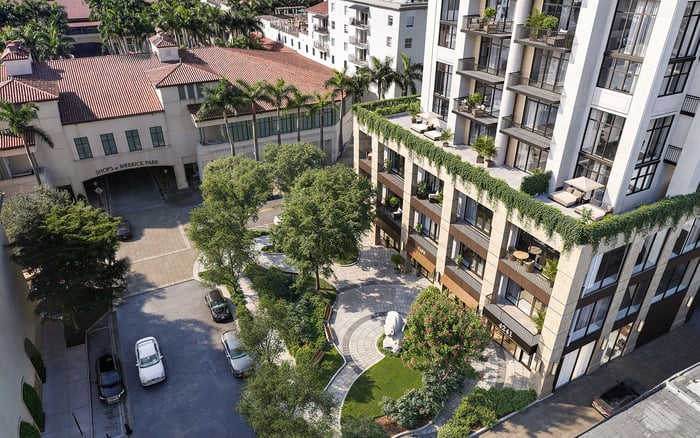
Cora’s planned 13-story building combines residences with more than 8,000 square feet of ground-floor retail and 13,000 square feet of offices on the second and third floors. Plans also include a 5,000-square-foot public park. These public-facing uses make the separation of residential, visitor, service, and emergency routes a relevant purchase question-not evidence of a problem.
An April 2025 completion forecast pointed to 2027. Treat that date as a dated projection, not a confirmed delivery commitment, particularly when coordinating a care transition.
Medical-equipment electrical provisions, caregiver privileges, and dedicated emergency staging facilities are not publicly established. Unverified does not mean absent. It means the buyer should request the applicable drawings, schedules, and written policies before treating an operational capability as part of the purchase.
A dedicated medical-equipment electrical package and generator-backed residential receptacles are not publicly established for Cora. Neither wellness amenities nor a general reference to backup power would resolve the central question: which outlets in the selected residence remain powered, under what conditions, and for how long?
Request the electrical one-line diagram, emergency-power schedule, unit-panel schedules, and written identification of any backed-up in-unit circuits. An electrical adviser should reconcile those documents with the household’s equipment requirements. Ask specifically about available residential load, the backup source, runtime, refueling arrangements, testing procedures, and the elevator emergency-power sequence.
The review should also address the interval between utility failure and backup availability. Ask the equipment supplier and care team what device-specific continuity arrangements are necessary; do not assume a building system can substitute for them.
Separately, obtain written guidance on critical-load subpanels, approved battery backups, oxygen equipment, medication refrigeration, and installation approvals. Establish who reviews a proposed modification and whether approval can be obtained before purchase commitments are finalized. The acceptance standard should allow an adviser to identify the proposed equipment, its intended circuit, and any unresolved dependency.
Dedicated private parking in a covered garage is advertised. Final per-residence allocations, guest capacity, accessible-space counts, and loading-bay dimensions are not publicly established. An individual residence’s parking description should not be read as a building-wide entitlement.
Caregiver parking privileges, recurring credentials, and access to short-term or valet areas also remain unconfirmed. A household employing rotating or overnight caregivers should request rules that address its actual schedule rather than rely on ordinary guest access.
Ask whether credentials attach to an individual caregiver, a vehicle, or the residence. Clarify overnight permissions, shift-change overlap, guest-permit limits, any available valet arrangements, after-hours entry, and enforcement. If a caregiver arrives unexpectedly or replaces another worker, who authorizes access-and how is that handled outside normal management hours?
For buyers also considering Ponce Park Coral Gables, use the same written questions without assuming equivalent policies. Compare the practical permissions a household needs, not simply whether parking appears among the advertised features.
A covered garage is only one part of the journey between vehicle and residence. Request dimensions and plans showing garage clearance, wheelchair-van maneuvering space, accessible routes, protected drop-off areas, and elevator dimensions. Confirm where a vehicle may pause for a patient transfer and which loading dwell-time rules would apply.
Review the route from end to end: vehicle position, unloading space, doors, thresholds, corridors, elevator entry, and the residence entrance. Have the household’s mobility equipment dimensions available so technical advisers can evaluate the actual route rather than an abstract accessibility description.
Ask how that journey changes during an elevator outage or loss of electrical power. Any proposed assisted-transfer or evacuation procedure should be assessed with appropriate professionals, not improvised from a floor plan. An elegant arrival sequence still needs to function when conditions are least favorable for the household.
A dedicated ambulance bay, fire-department staging area, or emergency loading zone is not publicly established for Cora. Request approved site and fire-rescue access plans showing intended staging locations and unobstructed routes to the residential entrance and elevators.
The access review should cover gates, controlled doors, overrides, and entry during power or communications failures. Ask who keeps the response route clear and how responders reach the correct residence if normal communications are unavailable. Do not assume that a concierge or security presence guarantees a particular response capability.
Obtain written notification, evacuation-assistance, emergency-contact, and elevator-outage protocols. Ask whether a voluntary special-assistance registry exists, who maintains it, and what assistance, if any, registration actually provides. None of those arrangements should be presumed from the building’s wellness positioning.
A household comparing Cora with The Village at Coral Gables should carry the same operational brief into both conversations. This is a framework for comparison, not a claim that either project offers verified medical support.
Before relying on an operational representation, have appropriate legal and technical advisers assess the supporting documents. Identify which provisions concern the specific residence, which are building-wide, and which remain proposed policies. Ask who is responsible for each commitment and how future management or rule changes could affect it.
Where answers remain unresolved, keep that uncertainty explicit in the purchase review. The strongest outcome is neither reassurance nor rejection by default, but a clear understanding of what is documented, what requires approval, and what the household must arrange independently.
For a discreet conversation about aligning a South Florida residence with your household’s priorities, connect with MILLION.
If branded residences are on your mind — as a home or as an allocation — we would be glad to share what we are seeing, privately.
Begin a quiet conversationThe project address is 4241 Aurora Street, Coral Gables, FL 33146, across from Shops at Merrick Park. The planned condominium has 74 residences with one- to three-bedroom homes.
A dedicated medical-equipment electrical package and generator-backed residential receptacles are not publicly established. That means these capabilities are unverified, not necessarily absent.
Request the electrical one-line diagram, emergency-power schedule, unit-panel schedules, and written identification of backed-up in-unit circuits. Have a qualified adviser compare them with the household’s equipment requirements.
Clarify the power source, available residential load, runtime, refueling arrangements, testing procedures, and elevator emergency-power sequence. Ask the care team and equipment supplier about device-specific continuity needs.
Caregiver parking privileges and recurring access credentials are not publicly confirmed. Obtain written rules addressing overnight parking, shift changes, guest permits, and after-hours entry.
Dedicated private parking in a covered garage is advertised. Final per-residence allocations, guest capacity, accessible-space counts, and loading-bay dimensions are not publicly established.
Request garage clearance, maneuvering space, loading dwell-time rules, accessible-route details, and elevator dimensions. Evaluate the full journey from the vehicle to the residence using the household’s mobility requirements.
A dedicated ambulance bay, fire-department staging area, or emergency loading zone is not publicly established. Request approved site and fire-rescue access plans to clarify responder routes and staging.
No. Advertised air and water purification systems and noise-reducing acoustic design do not establish clinical services or medical-equipment support.
No confirmed delivery commitment is established by the April 2025 forecast projecting completion in 2027. Treat that date as a dated projection when planning a move or care transition.