A 59-residence waterfront address at 1300 Monad Terrace, Monad Terrace translates Jean Nouvel’s signature play of light, privacy, and reflection into a climate-aware Miami Beach statement.

There are luxury condos that simply sit on the water, and then there are buildings that interpret it. Monad Terrace, at 1300 Monad Terrace in Miami Beach, belongs to the second category. Developed by JDS Development Group, the 14-story tower contains just 59 condominium residences, placing it firmly in the boutique tier where scarcity is part of the value.
The authorship is equally intentional. The project was designed by Ateliers Jean Nouvel, led by Jean Nouvel, an architect known for treating light as a material and context as a discipline. Nouvel received the Pritzker Architecture Prize in 2008, a distinction that matters in a city where the gap between “new” and “enduring” is often decided by design intent.
Set on Biscayne Bay, Monad Terrace is often positioned as a contemporary Miami Beach benchmark for buyers who want a waterview without the usual glass-box exposure. The premise is not only to frame the bay, but to edit it, balancing view, privacy, and shade so the experience feels considered rather than generic.
Monad Terrace is widely described as Nouvel’s “reflection machine,” a phrase that becomes practical once you understand what it implies: geometry is doing work that many buildings outsource to tint, drapery, or heavy landscaping.
The façade is articulated with a sawtooth or honeycomb-style logic. This is not surface decoration. The form is intended to preserve water views while limiting direct sightlines between neighboring units, a subtle advantage in a condominium where the luxury buyer expects openness without feeling on display. It reads as a more architectural response to privacy than the familiar Miami approach of darker glass and deeper setbacks.
Just as important, the façade’s reflective effects amplify changing daylight and shifting water conditions. In a market saturated with smooth curtain wall, that variation registers as craft and restraint, a quiet signature that suits buyers who value discretion over spectacle.
In Miami Beach, “waterfront” is inseparable from resilience. One of the most discussed moves at Monad Terrace is its elevation: the building was designed to be raised roughly 11.5 feet (3.5 meters) above grade as a climate-adaptation strategy. The idea is direct and unusually integrated. Rather than treating sea-level concerns as an engineering afterthought, the project builds elevation into the architectural concept.
That decision also shapes the experience of arrival. When a building lifts itself from the ground plane, the choreography of entry changes. It alters perceived security and gives the landscape real presence as a foreground, not a leftover strip of planting.
At the heart of the environment is a central water garden or lagoon, reinforcing the project’s theme of reflection and light. It serves as a composed counterpoint to the open bay, offering residents a more intimate watery interior that complements the larger horizon.
Vertical greenery is another defining element. Official materials emphasize vegetated “hanging gardens” and climbing plantings integrated into the architecture, and published coverage has described these hanging gardens as central to shade, privacy, and façade softening in Miami’s climate.
Technically, the vertical planting relies on Jakob Webnet stainless-steel cable trellis systems designed for trained climbing plants in a marine environment. That level of specificity matters in coastal South Florida, where the difference between greenery as a rendering and greenery that endures often comes down to systems, corrosion resistance, and long-term maintenance realities.
For buyers, the takeaway is both lifestyle and performance. Greenery on the façade can reduce glare, add a layer of privacy, and temper the perceived heat of large expanses of glass. It also changes how the terraces feel over time, as planting matures and the building’s edges become softer and more habitable.
Monad Terrace residences are marketed with floor-to-ceiling glass and expansive terraces, underscoring a classic Miami priority: indoor-outdoor living with Biscayne Bay as the primary view corridor.
What differentiates the building is how those elements are composed. The façade geometry works in tandem with the glazing to shape privacy and angles of view. Instead of a simple “big glass equals big view” equation, the design aims to deliver usable exterior space that feels protected. At the upper end of the market, that sense of refuge is often what separates a beautiful unit from a truly livable one.
For second-home buyers in particular, the question is rarely about a first impression. It is about how the apartment feels after months away, when you want calm with minimal effort. Deep terraces, filtered sightlines, and greenery tend to age well because they support everyday rhythm without demanding constant staging. The goal is not to win a tour; it is to deliver ease on an ordinary morning.
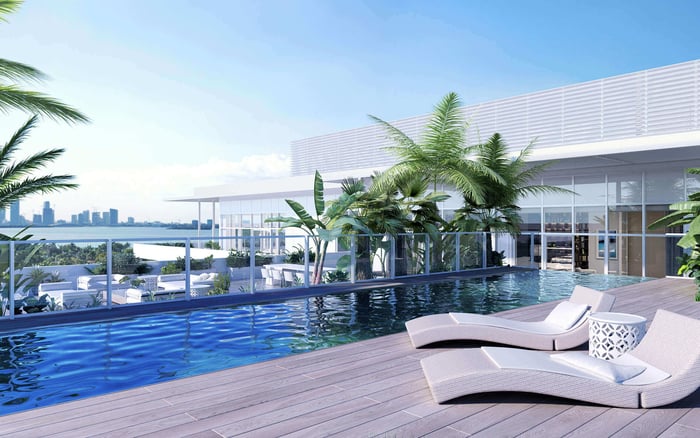
Amenities at Monad Terrace are framed to complement the setting rather than compete with it. A frequently cited highlight is the 116-foot-long Pool overlooking Biscayne Bay, a dimension that suggests lap-friendly utility while still reading as resort-grade.
The larger point is what the bayfront location enables. The sense of open sky and shifting water color can feel more expansive than many oceanfront conditions, where dunes and public activity compress the foreground. For buyers who prioritize view and quiet, the bay can be the more elegant answer.
And because the building is limited in residence count, amenity spaces tend to be experienced with a different cadence. “Private” in a condominium is rarely absolute, but a 59-residence building can feel materially different from a tower with hundreds of keys.
Miami Beach is not short on trophy addresses. The question is less “what is luxurious?” and more “what kind of luxury is being offered?” Monad Terrace makes its case through architectural authorship, privacy, and a measured scale.
For buyers comparing lifestyles, it helps to look at the range of service models across the island. Setai Residences Miami Beach represents a hotel-anchored, amenity-rich experience where brand and hospitality sit at the center of value. By contrast, Monad Terrace is defined less by buzz and more by concept, form, and reduced density.
Elsewhere, The Ritz-Carlton Residences® Miami Beach reflects a different proposition: a globally recognized service culture translated into a residential format. In that context, Monad Terrace can appeal to buyers who want their “signature” to be architectural rather than branded.
A similar contrast applies to private-club-inflected living. Casa Cipriani Miami Beach is often discussed in terms of membership aura and social capital. Monad Terrace, in comparison, leans toward discretion, a building where the strongest signal is the façade itself.
And for those weighing coastal exposure and a more overt oceanfront atmosphere, 57 Ocean Miami Beach offers a separate, ocean-facing narrative. Monad Terrace’s bayfront orientation, paired with its reflective geometry, can feel more inwardly composed.
Public listing data moves, but it can still provide a useful snapshot of positioning. As illustrative examples, a residence such as Unit 7C has been publicly listed around $2.7M, while a penthouse listing such as 1300 Monad Ter PH-E has been publicly listed around $14.15M. Treat these figures as time-stamped signals, not fixed benchmarks.
More important than any single number is the buyer profile this building tends to reward. Monad Terrace suits someone who values architectural authorship, wants privacy without giving up glass and view, and prefers a smaller residential community. It also fits a buyer who wants Miami Beach without the constant performance of Miami Beach: a home that reads as composed even when the island can feel like a scene.
As a long-term hold, its differentiators are not trend-driven finishes, but structural ideas: elevation, façade geometry, and integrated landscape. In a market where the supply of “new” is constant, the supply of truly distinct is not.
Is Monad Terrace a large high-rise? It is a 14-story residential building with 59 condominium residences, placing it on the smaller, more boutique side of Miami Beach’s luxury inventory.
Who designed Monad Terrace? The project was designed by Ateliers Jean Nouvel, led by Jean Nouvel, a Pritzker Architecture Prize laureate (2008).
What does “reflection machine” mean in this context? It refers to the building’s façade geometry and reflective effects, designed to shape light, preserve water views, and reduce direct sightlines between neighbors.
What are the standout outdoor features? A central water garden or lagoon is integral to the concept, and the project incorporates “hanging gardens” and climbing greenery supported by stainless-steel trellis systems.
What is one signature amenity? A 116-foot-long Pool overlooking Biscayne Bay is among the most cited amenities.
Explore more South Florida trophy residences with MILLION Luxury.
If branded residences are on your mind — as a home or as an allocation — we would be glad to share what we are seeing, privately.
Begin a quiet conversation