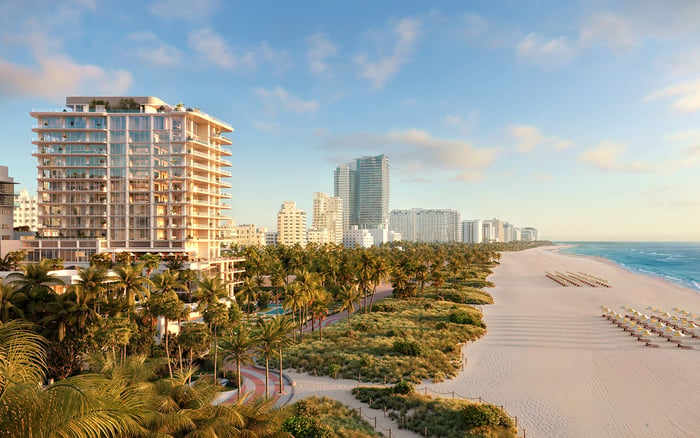
For South Florida’s oceanfront buyers, flood risk is less about alarm and more about precision. This guide explains where to verify a property’s FEMA flood zone, why Elevation Certificates matter, how to read storm-surge and sea-level layers, and what Florida’s new flood disclosure rules mean at contract time.

In Miami Beach and across South Florida’s barrier islands, flood risk is not theoretical. It shows up in lender requirements, insurance availability, renovation strategy, and, increasingly, the exact language used at contract. For ultra-prime buyers, the objective is rarely to eliminate risk entirely. The objective is precision: understanding what is mapped, what is modeled, and what is documented so an ownership plan stays composed under pressure.
Oceanfront living commands a premium because it delivers immediate value: light, air, horizon, and walkability. Sophisticated owners pair that lifestyle with discreet, address-specific due diligence. The clean sequence is consistent: confirm the legal flood zone, review elevation documentation, then add local layers that speak to storm surge, tidal flooding, and sea level rise planning scenarios.
If you are evaluating residences such as Setai Residences Miami Beach or any other coastal condominium, this structure keeps the conversation grounded and efficient: map, certificate, context, then contract.
When people refer to “the flood zone,” they typically mean the designation shown on FEMA Flood Insurance Rate Maps (FIRMs). In South Florida, counties commonly point owners and buyers to FEMA mapping and related digital products as the baseline reference for flood hazards and flood insurance rating implications.
The most direct way to confirm a property’s mapped zone is FEMA’s Flood Map Service Center, the federal portal for viewing and downloading flood hazard products. Its address-based search lets you verify the currently mapped flood zone for a specific property.
For buyers, the takeaway is straightforward: treat the FEMA zone as the legal starting point for lender conversations and insurance discussions. It is also the baseline for determining whether a property lies in a Special Flood Hazard Area (SFHA). In general, higher-risk mapped areas are commonly associated with FEMA “A” and “V” zones.
At the luxury end, it is easy to assume that a newer building or a well-managed association automatically means a cleaner flood profile. Sometimes it does. The map, however, cannot confirm the building-specific details that can influence insurance rating or compliance. That is where elevation documentation becomes decisive.
Miami-Dade County has required FEMA Elevation Certificates for permitted construction since 1995 as part of its building permitting process. That matters because an Elevation Certificate is not marketing collateral. It is a standardized record of a building’s elevation details, including the lowest floor elevation relative to the Base Flood Elevation (BFE), and it is used in floodplain management and flood insurance rating.
If an Elevation Certificate exists for a building or structure, it can shift the analysis in two practical ways.
First, it improves accuracy. Insurance pricing and risk discussions are more precise when elevation details are documented rather than assumed.
Second, it supports compliance clarity. After a storm, or during major renovation planning, floodplain rules can hinge on whether improvements are considered “substantial.” A commonly referenced concept in flood regulation is the 50 percent rule, which relates to substantial improvement or substantial damage thresholds that can trigger requirements to bring a structure into compliance with current flood standards.
The efficient move is to ask early whether an Elevation Certificate is already on file. FEMA-recommended due diligence includes checking with the local floodplain manager first, because a certificate may already exist for the property.
Florida has also modernized certificate availability. A state law effective January 1, 2023 requires surveyors and mappers to submit a digital copy of each Elevation Certificate they complete to the Florida Division of Emergency Management within 30 days. Owners and buyers can look up whether a certificate has been submitted using the state’s Elevation Certificate search tool.
If you are considering a trophy address such as The Ritz-Carlton Residences® Miami Beach, requesting the right documentation is not a sign of anxiety. It is a mark of sophistication. Excellent buildings still benefit from excellent paperwork.
FEMA maps are essential, but they are not designed to answer every long-horizon question an owner may ask. In South Florida, hurricane storm surge is a major flood driver. Local emergency management guidance commonly recommends using FIRMs alongside local evacuation and surge tools to better understand personal risk.
Miami-Dade County also maintains sea level rise and flooding resources that include a Flooding Vulnerability Viewer. These tools can layer elevation, storm surge, sea level rise scenarios, and FEMA flood zones. For buyers, that context can be especially relevant for ground-floor amenities, garage access points, and the day-to-day experience of a neighborhood.
Miami-Dade’s planning reference aligns with the Southeast Florida Regional Climate Change Compact’s Unified Sea Level Rise Projection, which estimates that by 2040 sea level could be about 10 to 17 inches higher than year-2000 levels. Planning projections are not the same as an insurance map. They can, however, inform long-term decisions, particularly if you expect to hold an asset through multiple building cycles.
King tides, sometimes described as perigean spring tides, can cause nuisance flooding in low-lying coastal areas, and sea level rise can worsen these impacts over time. For owners who value seamless arrivals, private driver access, and predictable routines, these are not academic details. They influence how you evaluate street elevation, ingress points, and the resilience of surrounding infrastructure.
This is where a calm, layered approach pays off. A residence like 57 Ocean Miami Beach can be evaluated first through official mapping, then through elevation documentation, and then through neighborhood-level context such as surge and tidal patterns. The goal is not perfect prediction. The goal is to reduce uncertainty where it is reducible.
Two realities shape the insurance conversation in South Florida.
First, mapped risk can create lender requirements. If a property is in a higher-risk FEMA zone and has a federally backed mortgage, lenders typically require flood insurance.
Second, standard homeowners insurance typically does not cover flood damage. Florida’s flood disclosure language now puts that statement directly in front of buyers, but the underlying point has long mattered in responsible ownership. If you want flood coverage, you typically explore a separate flood policy.
Sophisticated buyers treat insurance as part of the design of ownership. The “right” structure varies by use case. A full-time resident may prioritize continuity and claims handling. A second-home owner may prioritize protection of finishes and predictable annual costs.
Where available, community-level programs can also matter. Miami-Dade notes that participation in FEMA’s Community Rating System (CRS) can reduce NFIP flood insurance premiums for eligible policies depending on the community’s CRS class. This is not a detail you negotiate at the closing table. It is a structural market feature that can reward communities investing in floodplain management practices.
Starting October 1, 2024, Florida law created mandatory flood-risk disclosures for many residential real estate sales. The disclosure form requires sellers to provide key flood-related statements before contract execution, including whether the property is in a FEMA Special Flood Hazard Area.
The disclosure language also emphasizes a point luxury buyers sometimes overlook when assuming comprehensive coverage: homeowners insurance typically does not cover flood damage, and buyers are encouraged to discuss separate flood insurance with an insurance agent.
In practice, this new disclosure era raises the baseline for the conversation. It does not replace due diligence. A seller disclosure is not a flood map. A flood map is not an Elevation Certificate. None of these documents substitute for an insurance professional reviewing a specific address and a specific building.
If you are evaluating lifestyle-forward membership concepts and branded residences such as Casa Cipriani Miami Beach, the most discreet approach is to align legal review, insurance review, and building-document review early. The purchase should be driven by clarity, not by calendar.
Luxury due diligence works best when it is systematic and quiet. A disciplined sequence helps you move quickly without skipping essentials.
First, confirm the FEMA flood zone by address and retain the current map panel for your records.
Second, ask whether an Elevation Certificate exists and where it can be obtained. If needed, check with local channels and the state’s digital search tool to see whether a certificate is on file.
Third, review local resilience and flooding viewers that layer elevation, storm surge, sea level rise scenarios, and FEMA zones. Use this step to understand access points, garage levels, and neighborhood friction points during king tide periods.
Fourth, have your lender and insurance advisor evaluate the property profile early, particularly if you are financing the purchase or structuring ownership through entities that may carry underwriting requirements.
Finally, treat renovations with respect. If you anticipate a future reconfiguration, ask qualified professionals to discuss how substantial improvement concepts can affect compliance obligations over time. This is not about fear. It is about avoiding expensive surprises.
How do I verify a property’s official flood zone in South Florida? Use the FEMA Flood Map Service Center and confirm the mapped zone by address.
What is an SFHA, and why does it matter? A Special Flood Hazard Area is generally associated with higher-risk mapped zones and can affect insurance and lending requirements.
Are “A” and “V” zones considered higher-risk zones? Yes. They are commonly associated with higher-risk mapped areas in FEMA flood mapping.
If I buy in a high-risk zone, will I be required to carry flood insurance? If you have a federally backed mortgage, lenders typically require flood insurance in high-risk zones.
Does homeowners insurance cover flood damage? Typically, no. Flood damage is generally addressed through separate flood insurance.
What is an Elevation Certificate, in plain terms? It documents a building’s elevation details relative to the Base Flood Elevation and is used for floodplain management and insurance rating.
Why might an Elevation Certificate already exist? In Miami-Dade, Elevation Certificates have been required for permitted construction since 1995, so many properties may have one on file.
Where can I look for an Elevation Certificate in Florida? Start with the local floodplain manager, and also check the Florida Division of Emergency Management’s Elevation Certificate search tool.
What is the “50 percent rule” I keep hearing about? It is a commonly referenced substantial improvement or substantial damage threshold that can trigger requirements to bring a structure into compliance with current flood standards.
What changed with Florida’s new flood disclosures? Starting October 1, 2024, many residential sales require sellers to provide flood-risk disclosures before contract execution, including SFHA status and a reminder that flood is typically not covered by homeowners insurance.
For confidential, property-specific guidance, work with MILLION Luxury.
If branded residences are on your mind — as a home or as an allocation — we would be glad to share what we are seeing, privately.
Begin a quiet conversation