A discreet guide for Mexico City buyers evaluating Coral Gables and nearby South Florida luxury markets, with emphasis on lifestyle fit, acquisition discipline, legal coordination, and long-term ownership strategy.

For Mexico City families evaluating South Florida, Coral Gables often enters the conversation for reasons quieter than the broader Miami narrative. The appeal is not only water, weather, or a recognizable international address. It is the possibility of establishing a stable residential base in a city that feels composed, established, and legible to families accustomed to privacy, cultural fluency, and layered urban life.
This is not a simple relocation story. Many buyers are not leaving one life for another. They are creating a second center of gravity: a residence that can serve school visits, seasonal stays, business travel, family gatherings, and long-term optionality. That distinction matters because the strongest purchase is rarely the most visually dramatic. It is the one that fits how the family intends to live.
Coral Gables, Coconut Grove, Brickell, Miami Beach, and select waterfront enclaves each answer a different question. A buyer moving from Mexico City should begin not with a floor plan, but with a hierarchy: privacy, commute pattern, school proximity, entertaining style, lock-and-leave convenience, building services, parking, staff access, and resale depth.
Coral Gables appeals to buyers who want South Florida without surrendering a sense of civic order. The neighborhood offers a quieter residential cadence than Miami’s most visible districts, while keeping buyers close to the city’s broader cultural and commercial orbit. For families arriving from Mexico City, that balance can feel especially relevant: close enough to participate, but not constantly exposed to the pace of the center.
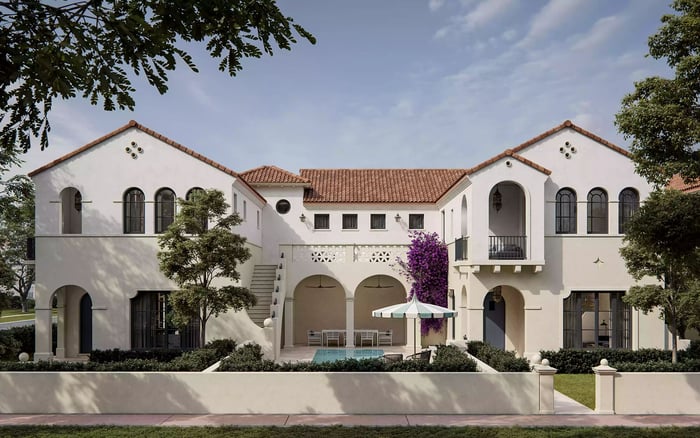
The area also supports buyers who value architecture, streetscape, and continuity. In a market where branded towers and waterfront statements receive much of the attention, Coral Gables offers another language of luxury: shade, proportion, discretion, and a more residential rhythm. That is why projects such as The Village at Coral Gables can belong in a serious conversation for families seeking neighborhood identity rather than a purely vertical lifestyle.
A Coral Gables search should be precise. Some buyers will prefer a single-family home with greater autonomy. Others will want new-construction ease, concierge structure, and reduced maintenance responsibility. There is no universal answer, only a better match between property type and family pattern.
The phrase wealth migration can suggest a one-way movement. In practice, many sophisticated buyers are building optionality across borders. A residence may function as a second home today, a family base later, and a legacy asset over time. That calls for a different acquisition standard than a purely emotional purchase.
Begin with the calendar. Will the residence be used during school breaks, long weekends, extended seasonal stays, or as a full-time home? Will multiple generations use it at once? Is the property expected to accommodate household staff, visiting relatives, or business guests? The answers shape everything from bedroom count and storage to elevator privacy and outdoor space.
Buyers should also be candid about management. A beautiful home that requires constant supervision may not suit a family whose primary operating life remains in Mexico City. Conversely, a highly serviced condominium may feel too structured for buyers who prize independence. The correct property is the one that reduces friction, not the one that simply photographs well.
Coral Gables is not the only relevant option. Coconut Grove can appeal to buyers who want a softer, more tropical atmosphere while remaining close to the urban core. In that conversation, Four Seasons Residences Coconut Grove may be considered by buyers who want a service-oriented residential environment in a neighborhood known for a more relaxed daily rhythm.
Brickell, by contrast, speaks to buyers who want a denser, more vertical, business-adjacent lifestyle. It may suit an owner who values dining access, building amenities, and a lock-and-leave format over garden privacy. A buyer comparing Coral Gables with Brickell should consider whether the residence is meant to feel like a retreat or a city apartment. Projects such as 2200 Brickell belong in that discussion when the priority is urban convenience rather than suburban quiet.
Miami Beach and the barrier islands introduce another variable: waterfront identity. Some Mexico City buyers will want the symbolic clarity of ocean or bay living. Others will find that the maintenance, exposure, and lifestyle profile are less aligned with daily needs. The point is not to choose the most famous location. It is to choose the one that will still feel correct after the first season of ownership.
Cross-border buyers should organize the search around structure as much as aesthetics. Legal ownership, tax planning, estate considerations, financing or cash movement, insurance, and privacy preferences should be discussed before a contract becomes urgent. None of these topics should be treated as an afterthought.
The same applies to education. For families with children, private-school planning can become one of the strongest forces in the search. The best residence may be the one that simplifies the morning routine, supports extracurricular life, and keeps the household operating calmly. A property that is exceptional in isolation may be less compelling if it complicates daily family logistics.
Security and discretion are also central. Buyers should evaluate building access, staff protocols, guest management, parking circulation, and how visible the residence feels from public spaces. For many international families, privacy is not a luxury feature. It is a baseline requirement.
New construction can be attractive for international buyers because it often offers contemporary layouts, updated systems, amenity depth, and a more predictable lock-and-leave experience. It can also reduce the burden of immediate renovation, which matters when a family is managing decisions from another country.
Established residences, however, may offer mature settings, larger lots, or a sense of permanence that cannot be replicated quickly. In Coral Gables, the distinction is especially important. A buyer may compare the ease of a new condominium with the character of an older single-family property. Neither is inherently superior. The better choice depends on whether the owner values control or convenience more.
Within Coral Gables, Ponce Park Coral Gables and Cora Merrick Park can help frame the condominium side of the discussion for buyers who want to remain in the Gables orbit while considering a more managed ownership format.
Investment should not be reduced to expected appreciation. For a cross-border family, the more relevant questions are liquidity, carrying cost, replaceability, and the depth of the future buyer pool. A rare property can be powerful, but rarity alone is not a strategy if the next buyer is too narrow.
Liquidity often follows clarity. A well-located residence with a coherent lifestyle proposition is easier to understand. A property with too many compromises may require a highly specific future buyer. That matters when the owner is balancing personal use with long-term flexibility.
Buyers should also separate personal prestige from market resilience. The most recognizable address is not always the most useful asset. The strongest purchase is often the residence that aligns with family life while remaining comprehensible to the next qualified buyer.
For Mexico City buyers, the first step is to define the operating model. Is South Florida a second home, a future primary residence, a school-year base, or a portfolio asset with personal use? The second step is to select the neighborhood that supports that model. The third is to compare property types only after the first two questions are resolved.
A strong search also requires patience. The best opportunities may not be the loudest. In Coral Gables especially, the ideal property may be quiet, well-positioned, and easy to underestimate at first glance. That is often the point. True luxury in this corridor is less about spectacle and more about living well without unnecessary exposure.
For readers using MILLION Buyer’s Guides as a starting point, the essential discipline is simple: define the life first, then let the real estate follow. Lifestyle, investment, Coral Gables, private-school planning, and new-construction considerations should be weighed together, not treated as separate decisions.
Is Coral Gables a natural fit for Mexico City buyers? It can be, particularly for families seeking privacy, residential order, and proximity to Miami without choosing the most intense urban setting.
Should buyers start with Coral Gables or compare several neighborhoods first? Compare several neighborhoods first, then narrow quickly once the family’s use case and daily routine become clear.
Is a condominium or single-family home better for cross-border ownership? A condominium may simplify management, while a single-family home may offer more autonomy. The right choice depends on how often the family will be in residence.
How important is school planning in the purchase decision? For families with children, it can be central. The residence should support the school routine rather than complicate it.
Should legal and tax planning happen before making an offer? Yes. Cross-border ownership structure, estate planning, and tax considerations should be reviewed early with qualified advisers.
Is Brickell a substitute for Coral Gables? Not exactly. Brickell offers a denser urban lifestyle, while Coral Gables generally suits buyers seeking a more residential rhythm.
Why consider new construction? New construction may offer contemporary systems, amenities, and easier lock-and-leave ownership, which can be useful for international families.
What makes a property more resilient over time? Clear location logic, functional design, privacy, and a broad future buyer audience can all support long-term resilience.
How should buyers think about lifestyle versus investment? The best purchase should satisfy both, but the family’s actual use pattern should guide the final decision.
What is the best way to shortlist comparable options for touring? Start with location fit, delivery status, and daily lifestyle priorities, then compare stacks and elevations to validate views and privacy.
When you're ready to tour or underwrite the options, connect with MILLION.
If branded residences are on your mind — as a home or as an allocation — we would be glad to share what we are seeing, privately.
Begin a quiet conversation