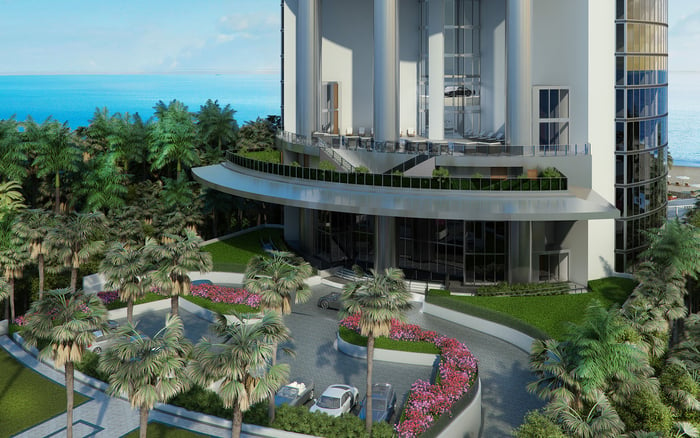
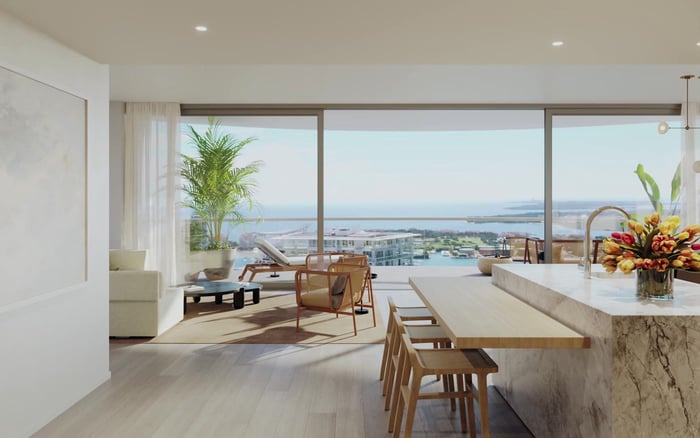
Across South Florida’s most coveted towers, ultra-luxury buyers are quietly assembling adjacent residences into single, estate-scale homes in the sky. From merged penthouses in Miami Beach to multi-level trophy offerings marketed in Bal Harbour, the move is less about novelty than about solving a practical problem: true “large-format” inventory in prime locations is finite. What follows is a buyer-oriented look at why unit combinations are accelerating, how developers are planning for them, and what to underwrite before you decide to stitch two (or more) homes into one.
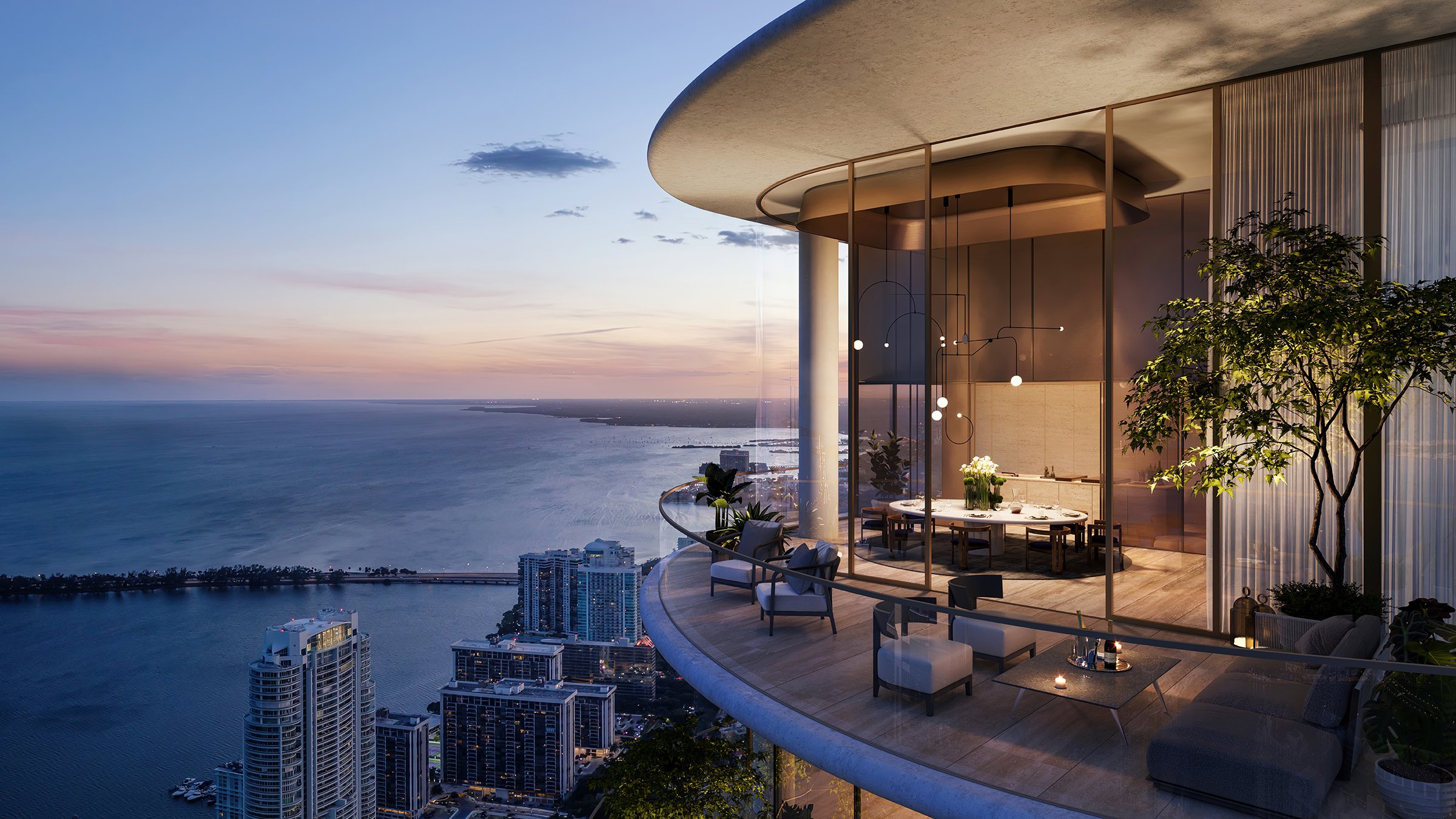
In South Florida’s ultra-premium condo market, “bigger” increasingly means “assembled.” Rather than wait for the rare full-floor residence in the right building, buyers are acquiring adjacent units and combining them into a single mega-residence that lives like a private estate, only elevated. The goal is not novelty. It is function: multiple entertaining zones, real separation between guest and family areas, staff-friendly planning, and outdoor space that reads as a perimeter terrace, not an add-on balcony.
Brokers and developers cite the same catalyst: truly large-format inventory in Miami’s best urban and waterfront towers is finite. When supply is thin, the top of the market does what it always does. It custom-builds. In this case, customization happens through acquisition, with original demising walls treated as an opportunity, not a limit.
It is also a capital allocation decision. The buyer is assembling the right pieces in the right location, then commissioning the home they actually want, instead of compromising on what happens to be listed.
A merged residence can deliver practical advantages that even a premium single listing may not.
First, it restores proportion. Many luxury condos are impeccably finished yet optimized for standard unit counts. Combining units can create grand-scale rooms and longer sight lines that feel closer to single-family living, particularly when the final plan supports a true gallery corridor or a salon sized for serious entertaining.
Second, it improves circulation. The best combinations separate public and private movement. Guests flow toward the view-driven living and dining areas, while family and staff can move between pantry, laundry, and service zones without crossing the main entertaining axis.
Third, it creates outdoor continuity. One terrace is valuable. Multiple terraces stitched into a single wrap can feel like a private park in the sky, especially when the residence captures both sunrise and sunset exposures.
Finally, it can create a psychological buffer. A thoughtful combination can reduce immediate neighbors and shared-wall acoustics. For many ultra-wealthy second-home owners, discretion is part of the amenity set.
Few examples capture the scale of this movement like the publicly reported combined penthouse at The Ritz-Carlton Residences, Miami Beach. After merging two penthouse plans, the combined residence has been priced at $40 million and spans a reported 25,589 square feet of indoor and outdoor space. The disclosed program reads like a private club: seven bedrooms, ten bathrooms, plus lifestyle rooms that signal true primary-residence intent, including a hammam spa, butler kitchen, wine room, screening room, and a game suite.
For buyers comparing trophy options in Miami Beach, the signal is clear. The new benchmark is not only price. It is completeness. Mega-residences compete with waterfront estates by offering similar lifestyle zones, then improve on them with security, services, and elevation.
In that context, The Ritz-Carlton Residences® Miami Beach is best read as a blueprint for what the market rewards when a tower can deliver estate-scale living without leaving the sand.
In Brickell, combinations often center on flexibility and finish as much as raw square footage. Design-forward towers have built reputations for accommodating owner-driven interiors, and there has been widely covered activity of multiple owners combining units in certain buildings.
A vivid, publicly marketed reference point is the Carlos Ott designed penthouse at Echo Brickell, marketed at $42 million for 13,518 square feet, including a 27-foot indoor lap pool overlooking Biscayne Bay. Whether a buyer chooses a single penthouse or assembles a larger plan through combination, the lesson is consistent: top bids are paying for personalization and for a home that is difficult to replicate.
This is also where flow-through exposure becomes strategic. When a combined plan preserves, or creates, true front-to-back light and views, the residence stops reading as “two condos joined together” and starts reading as a coherent waterfront home.
Fisher Island has always operated on a different axis, where access control and privacy are foundational rather than optional. That ethos makes the logic of combinations almost inevitable. Buyers who choose an island lifestyle are rarely optimizing for convenience alone; they are optimizing for separation.
Palazzo del Sol offers a notable illustration. After repeated buyer requests, the project reportedly created a roughly 10,000-square-foot combined residence by merging its two floor-plan options, with the combined home priced at $17.4 million. The message is straightforward: the building responded to demand for larger, more bespoke layouts instead of treating plans as fixed.
For buyers who want a discreet enclave but still value condo services, Palazzo del Sol reflects how Fisher Island product can bridge villa-scale living with turnkey management.
Today’s most discussed offerings are increasingly “penthouse” in spirit even when they are not confined to a single level. Developers are marketing multi-floor, vertically stacked residences and treating customization as a central part of the sales strategy.
In Downtown’s broader orbit, Villa Miami’s “Villa Triplo” triplex penthouse has been marketed at $55 million and spans over 15,000 square feet across multiple upper floors. The takeaway is not only size. It is the reframing of height as an architectural asset: separation of entertaining from sleeping, private elevator logic, and the ability to stage a home with the rhythm of a townhouse, only in the sky.
For buyers who want a new-construction interpretation of a vertical estate, Villa Miami shows how the market is positioning multi-level residences as the next generation of trophy inventory.
At the extreme end, the market is testing what a “mansion in the sky” can cost when it is conceived as a one-off. The Rivage Residences Bal Harbour mega-penthouse has been marketed at $150 million, combining two penthouses into a three-level residence with more than 20,000 square feet of interior space plus about 10,000 square feet outdoors. For buyers who value control, the offering has been publicly framed as customizable during development.
Miami Beach is posting its own headline numbers. The Shore Club Residences in Miami Beach announced a penthouse deal reported “over $120 million,” positioned as a record-setting transaction for the area. The contracted penthouse has been reported at about 10,500 square feet interior with roughly 7,500 square feet of terraces, including a private rooftop pool.
Within that context, Shore Club Private Collections Miami Beach sits in the same conversation as global trophy listings: scale, outdoor living, and branding power, with the market signaling that eight-figure terraces can carry value comparable to interior square footage.
South Florida’s buyer pool has deepened, and it is not only local. Reporting citing Altrata data has described Miami as having 13,211 UHNW second-home owners with net worth of $30 million or more, described as the largest such second-home concentration globally. That matters because second-home buyers often share a single constraint: they want the best location in the building, but they also need a home that functions like a primary residence.
The broader luxury condo market has also shown sustained momentum. CondoBlackBook’s Q3 2025 summary reported a $1.8 million median condo sales price, up 4.3% year-over-year, and a 15.2% year-over-year increase in closed sales in the $2 million-plus segment. When the top of the market is active, scarcity becomes more visible, and combinations become a rational response.
Combining units is simple in concept and complex in execution. That execution is where value is created, or quietly eroded.
Start with governance. Confirm the condominium’s rules on combinations, including approvals, construction hours, insurance requirements, and whether combining changes how assessments are calculated.
Then move to structure and systems. Developers and brokers have noted that some buildings are now planned with combinations in mind. Even so, you must verify what walls can be altered, how plumbing stacks align, and whether HVAC and electrical loads can be rebalanced without sacrificing ceiling heights or introducing noise.
Model the resale thesis. A mega-residence is, by definition, less liquid than a standard unit. That is not a flaw if the home is truly singular. It becomes a risk if the plan reads like an overbuilt compromise.
Finally, underwrite the lifestyle. Many buyers combine units to build amenities that can be hard to find even at the penthouse level: separate butler prep, wine storage, wellness zones, and media rooms. When integrated with discipline, the home can compete with the best private estates while retaining the concierge and security infrastructure that make condos compelling.
This strategy is not limited to new development. It has been widely reported that hedge-fund founder Ken Griffin set a benchmark in Miami by buying multiple units, including a reported $60 million purchase of two penthouses at Faena House in 2015. On a different part of the spectrum, producer Timbaland reportedly bought two units at Aria on the Bay in Edgewater with plans to combine them.
The common thread is not celebrity. It is intent. Buyers at this level treat square footage like a portfolio position, acquiring adjacent space when it appears and building the residence they want rather than accepting what the market happens to offer.
Are combined residences viewed differently by lenders and insurers? Often, yes. The combined home can be underwritten differently depending on how titles are held, whether units remain legally separate, and how the condo documents treat the combination.
Should a combined residence remain two legal units or become one? It depends on the building and your exit strategy. Keeping separate legal units can preserve flexibility, but a full legal combination may simplify operations and monthly billing.
Do combinations typically improve value per square foot? Not automatically. Premiums tend to accrue when the plan feels singular, outdoor space is exceptional, and the end product is rare within the building.
What is the biggest design mistake in a mega-residence? Creating dead corridors and duplicate kitchens that make the home feel like two units. The best outcomes prioritize one “main” experience supported by discreet back-of-house zones.
For private guidance on evaluating large-format condo opportunities across South Florida, connect with MILLION Luxury.
If branded residences are on your mind — as a home or as an allocation — we would be glad to share what we are seeing, privately.
Begin a quiet conversation