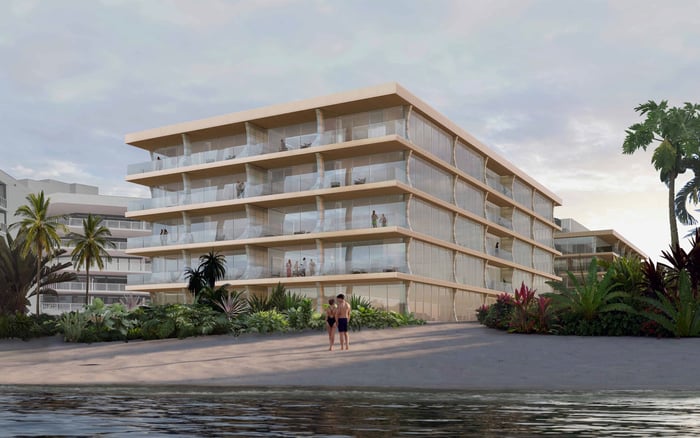
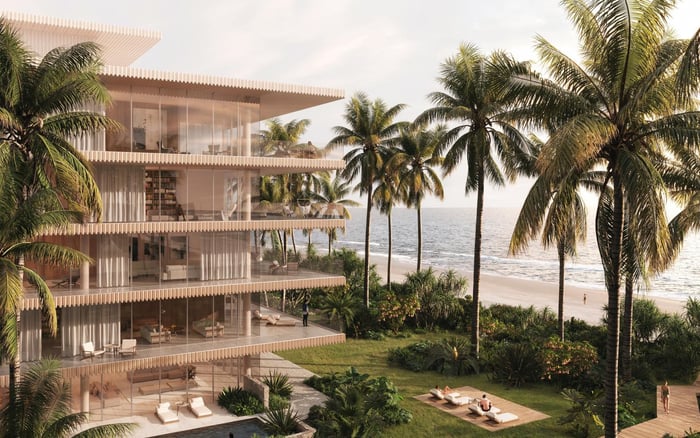
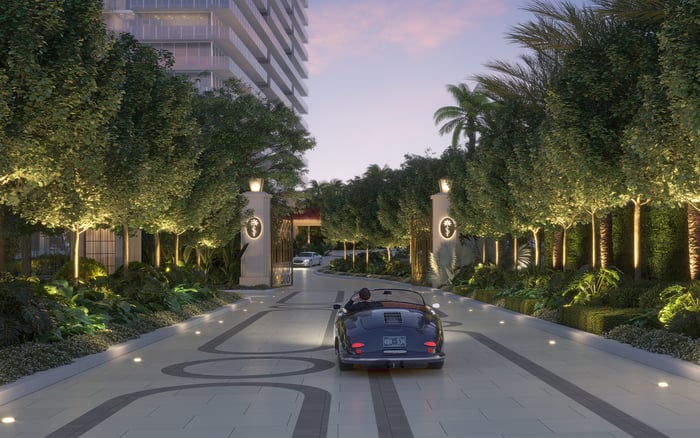
In Manalapan, scarcity is not a slogan. It is geographic math: a tiny barrier-island municipality, a limited number of ocean-to-Intracoastal parcels, and a buyer pool that increasingly treats dual waterfront as a long-term store of lifestyle and leverage. Recent headline transactions and ambitious spec pricing have pushed the town into a rarified conversation alongside Palm Beach, while the broader West Palm Beach luxury condo market offers a lower-maintenance way to stay in the same social and cultural orbit.
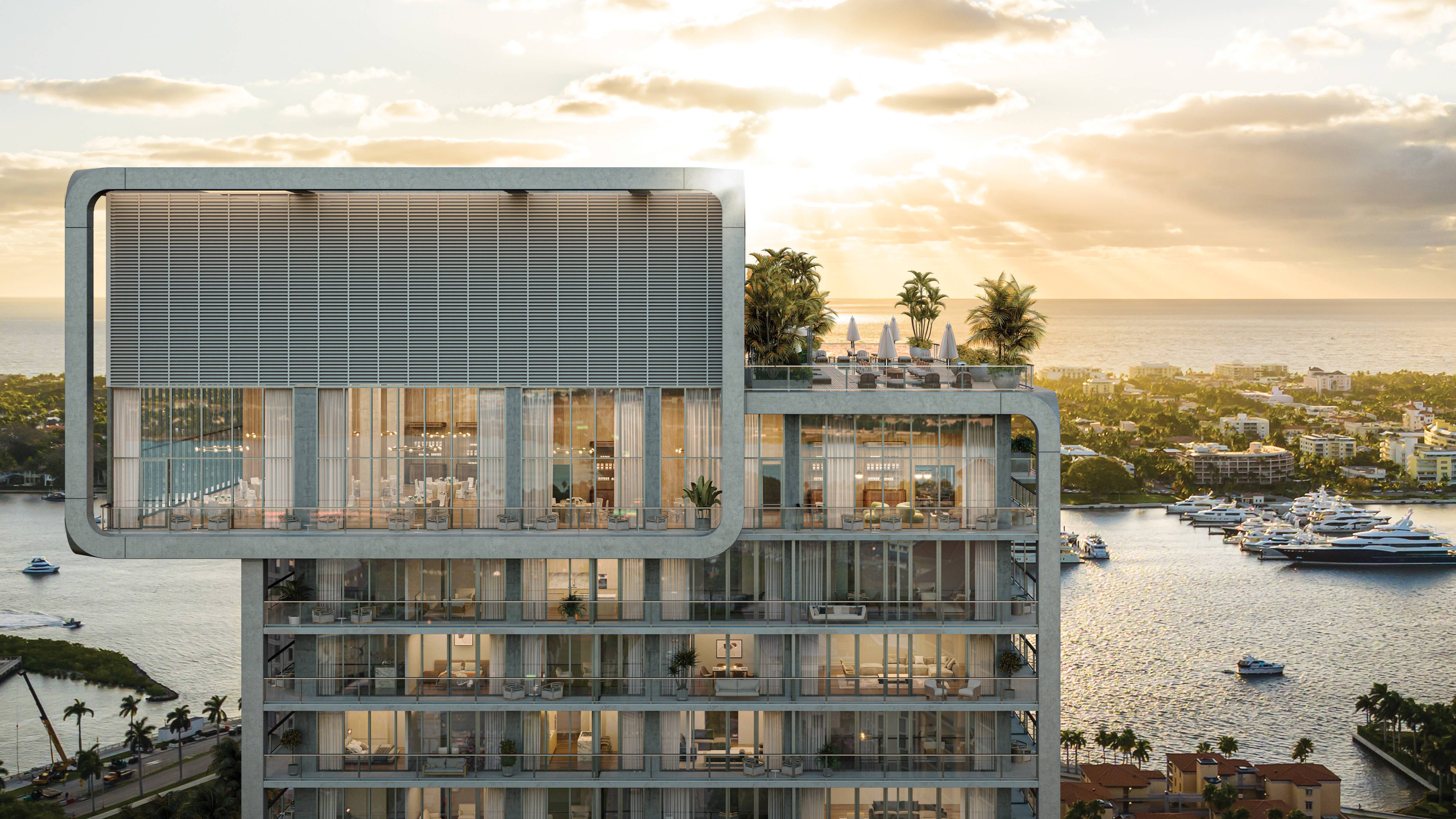
Manalapan is a tiny barrier-island municipality in Palm Beach County, yet it trades like a global address because its signature inventory is both extraordinarily finite and unusually specific: ocean-to-Intracoastal estates that deliver two distinct waterfront experiences on a single holding.
At roughly 2.4 square miles with a population of 419 at the 2020 Census, Manalapan operates at a scale that feels more private than public. Incorporated in 1931 and often linked in local history to a naming story involving Harold Stirling Vanderbilt, it sits quietly between larger, louder neighbors. That quiet is not accidental. It is a defining feature of how the market behaves.
For ultra-premium buyers, the distinction is practical. In places where luxury supply is continuously refreshed by towers, land splits, or rezoning cycles, the conversation is usually about which building, which line, and which view. In Manalapan, the conversation is more fundamental: whether the layout you want exists at all, and whether you will see a comparable opportunity again on a realistic timeline.
Manalapan’s calling card is the ocean-to-Intracoastal configuration, where a parcel extends from the Atlantic Ocean across to the Intracoastal Waterway. This is not merely “waterfront on both sides” as a marketing slogan. It is a functional blueprint for a dual-life estate, with sunrise and surf on the ocean side and protected-water boating, docking, and sunsets on the Intracoastal side.
Realtor.com has reported that only about 60 properties in Manalapan have this ocean-to-Intracoastal setup. In South Florida terms, that is a startlingly small number, especially when paired with the town’s overall low inventory. When demand is driven by a thin, global top-of-market cohort, small numbers do not just create pricing pressure. They create a market where each trade can feel less like a data point and more like a chapter in the town’s price history.
The layout also enables one of Manalapan’s most discreet luxury features: certain estates reportedly use private tunnels under A1A to connect the ocean side and the Intracoastal side without crossing the road at grade. The tunnel is not the luxury by itself. The luxury is continuity, the ability to treat both sides of a holding as one uninterrupted private domain.
This is why Manalapan is frequently framed in “next Palm Beach” terms. It is not about replacing Palm Beach’s legacy. It is about concentrating an exceptionally rare residential geometry into a small, controlled setting where scarcity is easy to understand, and essentially impossible to replicate at scale.
Recent transactions and widely covered pricing narratives have made Manalapan shorthand for Florida’s upper ceiling. The more useful takeaway, however, is what these trades signal about buyer intent, especially in an era when many affluent buyers treat real estate as both lifestyle infrastructure and long-duration positioning.
In June 2022, Oracle co-founder Larry Ellison bought the Gemini estate in Manalapan for $173 million, widely reported at the time as a Florida residential price record. Fortune has also described Ellison’s broader South Florida real-estate activity as totaling roughly $450 million, tying the region’s gravitational pull to proximity and networks around Palm Beach and Mar-a-Lago.
Record trades do two things at once. First, they prove that the buyer pool will pay for singularity, not simply square footage. Second, they compress the time it takes for surrounding owners to recalibrate expectations. In a market with few true substitutes, one benchmark sale can influence pricing posture for years, because owners and brokers begin underwriting listings against the logic of replacement cost plus rarity rather than traditional neighborhood comparables.
The next wave of notable activity reflects that recalibration. The Real Deal reported that Dr. Herbert “Herbie” Wertheim bought an oceanfront Manalapan mansion at 1160 S Ocean Blvd for $61.8 million, one of the town’s biggest post-Ellison trades. Separately, David MacNeil, the WeatherTech founder and CEO, bought 1140 S Ocean Blvd for $55.5 million, reported as an incomplete spec estate transaction.
Manalapan’s celebrity and high-profile owners also add a public narrative layer, even when the town’s fundamental appeal is discretion. Sean Hannity reportedly bought a Manalapan home for $23.5 million in November 2024 and later listed it for roughly $44.9 million, illustrating how quickly some sellers attempt to reprice once new ceilings are established. Musician Billy Joel sold a Manalapan-area Florida mansion for $42.6 million after a long marketing period and prior higher pricing, a reminder that even rare inventory is still subject to timing, buyer alignment, and patience.
Taken together, these are not simply “big numbers.” They describe a market that moves between two impulses: to transact decisively when the right property appears, and to test the upper edge when scarcity suggests the next comp might be higher. In other words, Manalapan’s pricing is not driven solely by the last sale. It is driven by the expectation that the next credible substitute may not arrive for a long time.
The most extreme figure attached to Manalapan is not a closed sale. It is an asking or marketing headline that has shaped perception, and it is valuable precisely because it reveals how the ultra-luxury market uses new construction as a public thesis.
A planned spec project at 1960 S Ocean Blvd has been promoted at around $285 million and has been frequently framed as a contender for America’s most expensive home. Realtor.com’s reporting describes a mega-estate concept of roughly 54,570 square feet across multiple buildings, with amenities that read more like a private resort program than a single residence, including a bowling alley, theater, golf simulator, car museum, and shooting range.
The point is not whether a marketing price is ultimately realized. The point is what a figure like that does to market psychology in a town defined by extremely limited supply. In locations where buyers can always “just build another one,” an outlier ask can be dismissed as theater. In Manalapan, the ask functions as a serious proposition: that dual-water geometry, combined with modern mega-estate programming, deserves a valuation that competes with the best-known global trophy addresses.
The same reporting has associated the project with developer Stewart Satter, architect and design firm Choeff Levy Fischman Architecture + Design, and builder RWB Construction Management. At this level, the team is part of the asset. Sophisticated buyers are underwriting not only design and finishes, but also execution certainty, schedule discipline, and the probability that the finished product will read as a global-standard residence. The risk is not only money. It is time, discretion, and the cost of being wrong when the market expects excellence.
Manalapan’s luxury ecosystem is not purely residential. It also includes hospitality, social access, and the kind of continuity that makes second and third homes feel less like an indulgence and more like a permanent part of life planning.
In August 2024, Ellison’s firm bought the Eau Palm Beach Resort & Spa for $277.4 million, a major commercial deal within the Manalapan and Lantana area luxury landscape. The property has deep local history, originating as the La Coquille Club in the 1950s before evolving through multiple eras.
This matters for two reasons. First, high-end hospitality investment often follows high-end residential demand, and then reinforces it. A strong resort product helps sustain the broader lifestyle layer, from dining and wellness to service culture and the overall perception of the coastline as curated. Second, it protects optionality. Even estate owners who rarely “need” a resort still value the presence of a high-performing property nearby for hosting, overflow, and the simple reassurance that the local experience will remain polished over time.
Finally, there is proximity, the quiet power behind Manalapan’s appeal. The town’s story is frequently linked to the Palm Beach orbit. Even for buyers who do not seek visibility, being near Palm Beach’s institutions, clubs, and philanthropic circuit offers flexibility. In this sense, Palm Beach is less a destination than a baseline assumption of the region’s social infrastructure, with Manalapan positioned as a more secluded residential expression within that same world.
At the top of this market, the decision rarely turns on a single feature. It is a stack of interlocking considerations that collectively justify a long-term hold, especially for buyers who think in decades rather than seasons.
Privacy and control come first. A small municipality with low inventory offers fewer unknowns, fewer “next door” surprises, and fewer opportunities for a buyer to feel exposed by sudden changes in adjacent property use. This is why Manalapan resonates as a second-home choice for executives, founders, and families who want to arrive and disappear, with the confidence that the setting itself supports that intention.
The ocean-to-Intracoastal layout adds functional flexibility that reads like a luxury, but operates like a planning advantage. It can support beach life and protected-water boating within the same property, reduce friction around access, and allow for distinct arrival sequences depending on how an owner uses the estate. For buyers who treat time as their scarcest asset, convenience becomes a form of security, and the ability to move quietly between two waterfront conditions is a meaningful operational benefit.
Then there is the modern risk conversation that accompanies coastal ownership. Sophisticated buyers increasingly approach oceanfront living with clear eyes about operating complexity, insurance realities, and long-term maintenance. Those factors do not diminish the appeal of the Atlantic. They elevate the value of best-in-class construction, thoughtful site planning, and an ownership approach designed to manage the property quietly and predictably. In short, trophy estates increasingly behave like managed assets, with lifestyle as the dividend.
For many buyers, that translates into an investment thesis that is less about short-term appreciation and more about preserving position in a market where the number of true substitutes is extremely small. When you can count the relevant inventory in dozens, not thousands, the logic of ownership changes. You are not simply buying a home. You are securing a scarce format of coastal life.
Not every buyer who wants Manalapan’s orbit wants an estate. Some want the same Palm Beach County access with a modern, service-led lifestyle and fewer operational responsibilities. That is where West Palm Beach has become a serious alternative, especially as the city’s luxury core becomes more legible to high-net-worth buyers who value design, walkability, and airport convenience.
A new generation of waterfront and core-city residences caters to owners who want a refined base without the staffing and upkeep demands of a large single-family property. In practical terms, this is the buyer who wants to spend weekends on the coast, host with ease, travel frequently, and still maintain a strong sense of arrival when they return.
For a tailored, hospitality-influenced lifestyle, Mr. C Residences West Palm Beach speaks to buyers who prefer a branded service ethos and a refined, city-forward point of view.
For those who want the confidence of a globally recognized name in a residential setting, The Ritz-Carlton Residences® West Palm Beach offers a compelling bridge between ultra-luxury expectations and day-to-day ease.
If your priority is contemporary waterfront living with a residential sensibility, Alba West Palm Beach is positioned for buyers who want presence on the water without the scale of an estate.
And for a more established Flagler Drive address, Forté on Flagler West Palm Beach can appeal to owners who prioritize view corridors, privacy, and a finished, move-in-ready lifestyle.
The underlying point is simple: Manalapan represents a rare estate typology, a format defined by dual-water geometry and low turnover. West Palm Beach increasingly represents the refined, urban counterpoint for owners who want the same region, the same airport access, and a more effortless operating model, with services that support frequent travel and a lighter ownership footprint.
Manalapan’s current chapter is shaped by two parallel narratives: closed trades that establish real benchmarks, and ambitious asks that attempt to define the next plateau. Both matter because both influence expectations, and in a scarcity market, expectations are often the lead indicator of pricing.
Realtor.com reported that hedge-fund billionaire Chris Rokos sought $150 million for his Florida mansion after buying it for $40 million in 2017. Even when such a figure proves aspirational, it is instructive. It signals a belief that scarcity, time, and branding can support enormous repricing, especially when the property sits within a small set of holdings that buyers perceive as globally relevant.
The Real Deal has also reported that a Manalapan mansion asking around $45 million helped lead a wave of ultra-luxury contracts, reflecting how $40 million-plus pricing has become part of the town’s new normal. In a market where many buyers are not rate-sensitive and not time-sensitive, the seller’s willingness to wait becomes a strategy in its own right. Patience can function as leverage when there are so few alternatives, and when ownership carries the psychological benefit of “being in” a club of properties that are rarely available.
The likely outlook is continued volatility at the very top, with stability in the underlying premise. Manalapan’s defining assets cannot be manufactured elsewhere at scale. You cannot easily create more ocean-to-Intracoastal parcels, and you cannot reproduce the town’s combination of seclusion and proximity. That is why Manalapan remains a concentrated expression of South Florida’s luxury transformation, and why its story continues to expand beyond the island itself.
Is Manalapan the same as Palm Beach?
No. Manalapan is a separate, much smaller barrier-island town in Palm Beach County. It is often discussed within the Palm Beach luxury orbit, but it is defined by different inventory and a much smaller scale.
What makes an “ocean-to-Intracoastal” property so valuable?
It combines Atlantic Ocean frontage with Intracoastal Waterway frontage on one holding, creating dual waterfront access and, in some cases, private connectivity features such as tunnels.
Are Manalapan prices driven by a few outlier buyers?
High-profile trades have helped reset expectations, but the deeper driver is limited supply, particularly for ocean-to-Intracoastal layouts with few true substitutes.
Is West Palm Beach a realistic alternative for luxury buyers?
Yes, particularly for owners who want a lock-and-leave residence with services and strong regional access rather than the operational demands of an estate.
To explore South Florida’s most in-demand addresses with discretion, visit MILLION Luxury.
If branded residences are on your mind — as a home or as an allocation — we would be glad to share what we are seeing, privately.
Begin a quiet conversation