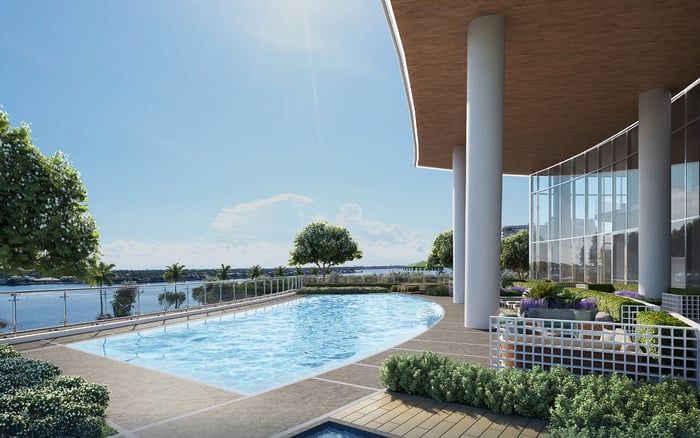
A discreet buyer’s guide to evaluating commercial-tenant noise near Maison D'Or South Flagler, with attention to privacy, service quality, and future resale confidence.

For a luxury buyer, silence is not merely the absence of sound. It is a form of control. At Maison D'Or South Flagler, nearby commercial-tenant noise deserves the same scrutiny as views, floor plan, finish level, and service culture. A residence can be visually refined and still feel compromised if its daily soundtrack is unpredictable.
Commercial adjacency is not inherently negative. In the right configuration, it can add convenience, energy, and a stronger sense of place. The distinction is whether the commercial use supports residential life or intrudes on it. Sophisticated buyers do not simply ask whether there is noise. They ask what kind, when it occurs, where it travels, and how future purchasers are likely to perceive it.
Within the West Palm Beach luxury conversation, this is especially important because buyers are often comparing not only square footage, but discretion. Privacy, arrival sequence, staff coordination, and the ability to entertain quietly all become part of value.
A commercial neighbor should be understood by use pattern, not by name alone. A quiet office tenant behaves differently from a restaurant, lounge, gym, salon, clinic, or service-driven operation. Each has its own rhythm. Morning deliveries, evening departures, music, equipment, staff breaks, waste handling, and customer circulation may matter more than the interior build-out.
During a showing, the environment may feel composed. That is only one data point. A disciplined buyer should visit during early morning, midday, late afternoon, evening, and weekend periods. Sound can shift dramatically with traffic, doors opening, outdoor waiting areas, valet stacking, or mechanical systems cycling on and off.
The goal is not to eliminate every urban sound. The goal is to determine whether the noise is occasional and predictable, or recurring and intrusive. Predictability is crucial. A buyer can adapt to a known rhythm; resale buyers resist surprises.
Privacy is often discussed as if it begins at the front door. In reality, it begins much earlier. Arrival courts, garage entries, lobby glazing, elevator access, amenity circulation, and exterior sightlines all influence whether a residence feels private.
For Maison D'Or buyers, the question is how commercial users move in relation to residents. Do guests or customers share visual proximity with the residential entry? Can anyone look toward a balcony, terrace, or pool deck from a public-facing zone? Does a waterview corridor also expose the residence to pedestrian attention? These questions may sound minor until a buyer imagines daily use: morning coffee outside, an evening dinner, or children moving between amenity spaces.
A high-value home should not require constant self-awareness. The best test is simple: stand in the places where you expect to live casually, then ask who can see or hear you from outside the residential realm.
Luxury service depends on choreography. The fewer conflicts between residents, staff, vendors, visitors, and commercial patrons, the more effortless the property feels. Noise is one symptom, but movement is often the deeper issue.
A buyer should study how deliveries are handled, where ride-share vehicles pause, how after-hours access is controlled, and whether commercial activity competes with resident arrivals. If a commercial tenant has frequent vendor traffic, the building’s loading protocols matter. If customers gather outside, the threshold between public and private space becomes important.
Concierge and security teams can mitigate friction, but they cannot erase a poorly designed circulation pattern. The most resilient luxury buildings separate service flows clearly and maintain a calm residential identity even when the surrounding district is active.
Resale value is shaped by perception before negotiation begins. If a future buyer immediately notices music, truck activity, visible crowds, or a shared arrival condition, the showing becomes defensive. The residence may still be desirable, but the buyer’s focus shifts from aspiration to discount.
This does not mean every residence near commercial activity should be avoided. Some buyers value the convenience and vitality of mixed-use surroundings. The key is to underwrite the condition honestly. A unit with excellent orientation, strong sound separation, discreet access, and limited exposure may perform well. A unit with repeated acoustic or privacy conflict may require more careful pricing.
When evaluating Maison D'Or South Flagler, think like the next buyer. If the concern can be explained in one calm sentence and verified by experience, it is manageable. If it requires a long justification, it may become a future objection.
Begin with the ear, but do not stop there. Listen from the primary bedroom, living room, kitchen, outdoor areas, corridors, elevator lobby, garage path, and amenity spaces. Open and close doors. Step outside, then return inside. Sound transmission is not always linear.
Next, study vibration. Low-frequency mechanical noise can be more intrusive than audible conversation because it is harder to mask. Pay attention near walls, floors, terraces, and rooms intended for sleep.
Then consider time. Ask whether the most active commercial periods overlap with your own use of the home. A restaurant that peaks while you are entertaining may be different from a daytime tenant that quiets before evening.
Finally, review how the building handles rules. Outdoor speakers, trash staging, delivery windows, smoking areas, signage, and queue management can all influence residential serenity. A polished building culture is not defined by amenities alone. It is defined by enforcement.
A serious buyer should ask direct, practical questions before relying on assumptions. What commercial uses are present or contemplated? What hours are permitted? Where do deliveries occur? Are commercial guests separated from resident paths? How are complaints handled? Are there rules for music, outdoor activity, odor control, and waste storage?
The answers matter less as marketing language and more as operating reality. Walk the property after asking. If the lived condition matches the explanation, confidence increases. If not, the issue deserves further negotiation or a more conservative valuation.
For the right buyer, Maison D'Or South Flagler may offer a compelling balance of urban presence and private living. The assignment is to verify that the residence behaves as a sanctuary, not merely that it photographs as one.
Is commercial-tenant noise always a problem for luxury resale? No. It becomes a problem when it is unpredictable, poorly managed, or obvious during showings.
What is the best time to test noise before buying? Visit at multiple times, especially early morning, evening, weekends, and known peak activity periods.
Should I prioritize a higher floor to reduce commercial noise? Higher floors may help, but orientation, glazing, setbacks, and mechanical locations can matter more.
Can soundproof windows solve the issue completely? They can reduce interior sound, but they do not solve terrace noise, arrival friction, or privacy concerns.
Why does privacy matter beyond the unit itself? Luxury buyers value the full experience, including arrival, amenity use, outdoor living, and discretion.
How should I judge a commercial tenant’s impact? Focus on hours, customer flow, deliveries, music, trash handling, odors, and gathering areas.
Can commercial convenience improve value? Yes, when it adds daily ease without compromising quiet, security, or residential identity.
What is the biggest resale risk? The biggest risk is an objection that future buyers notice immediately and cannot comfortably dismiss.
Should noise concerns affect my offer strategy? If the issue is recurring or limits outdoor use, it can justify a more conservative valuation.
What should I do before making a final decision? Experience the residence repeatedly and judge whether the sound profile fits your daily life.
To compare the best-fit options with clarity, connect with MILLION.
If branded residences are on your mind — as a home or as an allocation — we would be glad to share what we are seeing, privately.
Begin a quiet conversation