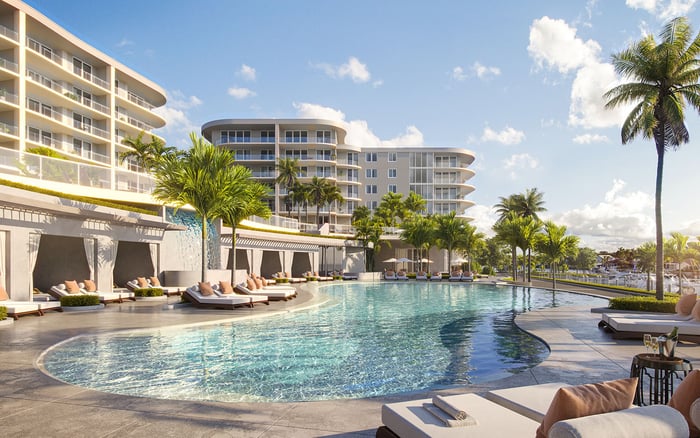
A buyer-focused comparison of Pinecrest and Weston for families weighing elite public-school access against lot size, privacy, proximity, and the differing character of two affluent South Florida communities.

For affluent families searching South Florida with schools and space at the top of the brief, Pinecrest and Weston often surface in the same conversation. Both are firmly established as premium residential choices with strong public-school appeal, yet each delivers a distinct expression of luxury living.
Pinecrest sits in Miami-Dade, about 12 miles south of downtown Miami, and feels rooted in old South Florida privilege: mature canopy streets, established residential fabric, and a closer relationship to the urban core. Weston, in Broward County’s western corridor roughly 25 miles northwest of downtown Miami, presents the more master-planned proposition: newer neighborhoods, expansive community infrastructure, golf-oriented enclaves, and a clearer path to estate-scale parcels.
For readers of MILLION Luxury, the comparison is less about which address is universally better and more about which one aligns with a precise definition of family luxury. If your priority is proximity to Miami, legacy prestige, and a residential environment shaped by deep greenery and older custom homes, Pinecrest carries the stronger pull. If you want more land, more uniform neighborhood planning, and a cleaner suburban framework for privacy and recreation, Weston generally holds the advantage.
This is also not a perfectly symmetrical comparison. The two communities sit in different counties and operate within different school districts, tax structures, and zoning environments. Buyers should view them as separate luxury ecosystems rather than interchangeable substitutes.
Education is often the reason this comparison begins, and it is where the nuance matters most. Pinecrest families commonly feed into Palmetto Middle School and Palmetto Senior High School within Miami-Dade’s public-school system. Palmetto Senior High is widely associated with a selective, STEM-oriented magnet profile, strong advanced-course participation, and a four-year graduation rate above 97%.
That creates a specific kind of draw. Pinecrest’s school appeal is tied not only to strong local expectations, but also to the prestige attached to Palmetto High’s academic reputation. For some buyers, that magnet dimension is part of the allure, suggesting an academically ambitious environment with a long-established identity.
Weston’s school story is compelling in a different way. The city is served by Broward County Public Schools, with Cypress Bay High School and Weston High School as the main secondary campuses. Cypress Bay High is associated with strong college-readiness outcomes, broad AP and IB opportunities, and a four-year graduation rate near 96%.
The distinction, then, is not necessarily quality versus quality. It is structure versus structure. Pinecrest’s school draw has a more selective, magnet-adjacent character around Palmetto, while Weston’s best-known campuses are often seen as strong traditional attendance-based options. Families who value predictability within a master-planned suburban setting may appreciate Weston’s model. Families drawn to Pinecrest often value the established academic prestige and the sense of continuity that comes with its long-favored feeder pattern.
If land is the deciding factor, Weston generally offers the clearer advantage. Typical single-family lots there often range from about 0.5 acres to more than 2 acres, and some premium subdivisions are built around one-acre minimums. That matters for buyers who want true separation from neighbors, room for additions, resort-style outdoor programming, or simply a broader sense of ownership.
In Pinecrest, lot sizes are attractive by Miami standards but usually more moderate. Single-family parcels commonly fall in the 0.25- to 0.75-acre range, with many homes clustering around a median lot size of roughly 0.4 to 0.5 acres. Premium estates can exceed an acre, but the neighborhood pattern is less uniformly oversized.
In practical terms, Pinecrest often gives buyers a more intimate estate feel: mature hedges, older tree cover, and established streetscapes can create privacy even when the parcel is not expansive. Weston, by contrast, more often delivers privacy through scale itself. The backyard brief can become larger, flatter, and easier to customize.
That difference is especially important for buyers deciding between a land-first suburban house and a more managed luxury residence elsewhere in the region. Some households ultimately compare these detached-home markets with turnkey vertical options such as 2200 Brickell, Park Grove Coconut Grove, or The Ritz-Carlton Residences® Fort Lauderdale, where lifestyle programming can replace acreage as the premium. For families committed to lawn, pool, guest house potential, or equestrian flexibility, Weston holds the stronger hand.
Pinecrest is an established suburban community largely shaped from the 1950s through the 1980s. That gives it texture. Homes are often set along leafy streets and within a more organic neighborhood pattern, with prestige derived from maturity rather than master planning. Buyers who want a house that feels anchored in a long-valued residential landscape tend to respond well to Pinecrest.
Weston was developed primarily from the 1990s onward as a master-planned community. Its appeal lies in order, consistency, and newer infrastructure. Many neighborhoods are tied to HOA-managed common areas, and the city’s broader identity includes golf, planned recreation, and a cleaner, more uniform suburban appearance.
Neither atmosphere is inherently superior. Pinecrest feels more classic and closer to Miami’s established family enclaves. Weston feels more calibrated and more suburban in the contemporary sense. A buyer choosing between the two is often deciding not just on a home, but on a rhythm of life.
That same choice appears across South Florida’s luxury map. Buyers who lean toward Pinecrest’s older-tree-canopy elegance often also admire the residential polish of Ponce Park Coral Gables or the village-like refinement of The Village at Coral Gables. Those drawn to Weston’s newer planning logic may appreciate the appeal of a more curated residential environment, even if the product type differs.
Market estimates in both communities place them squarely in affluent territory. Pinecrest single-family pricing has been cited roughly in the $650,000 to $950,000 median range, with luxury estates above $2 million. Weston’s single-family market has been cited around a $700,000 to $1.2 million median range, with luxury properties often above $2.5 million.
Those ranges should be read as broad market indicators rather than fixed promises, because individual streets, subdivisions, and parcel sizes can shift values dramatically. Still, they reveal an important point: buyers are not choosing between inexpensive and expensive. They are choosing between two different ways of paying for luxury.
In Pinecrest, a premium often attaches to proximity, prestige, and mature neighborhood character. In Weston, buyers may feel they are paying for land, newer housing stock, and a highly organized suburban experience. The value question becomes personal. Does your ideal luxury home express access and legacy, or scale and planning?
Choose Pinecrest if your household wants closer access to central Miami, established prestige, and a residential environment defined by mature landscaping and long-standing desirability. It is especially compelling for buyers who prize a classic suburban estate feel without giving up relative proximity to the city.
Choose Weston if your priorities center on acreage, privacy, and a more suburban or exurban atmosphere with newer infrastructure. It is especially persuasive for buyers who want room to customize, a broader sense of retreat, and neighborhoods that align with golf or equestrian lifestyles, including areas associated with Weston Hills.
For some families, the deciding factor is simple: school confidence plus commute points to Pinecrest. For others, school confidence plus land points to Weston. At the highest end, both are credible luxury answers. They simply serve different visions of what family life should look like.
Is Pinecrest closer to Miami than Weston? Yes. Pinecrest is much closer to downtown Miami, while Weston sits farther northwest in Broward County.
Which community generally offers larger lots? Weston typically does. Its residential lots are often larger, with many homes on 0.5 to 2+ acres.
Does Pinecrest still offer estate-scale parcels? Yes. Pinecrest has premium properties on 1+ acre lots, though they are less common than in Weston.
Which area is known for Palmetto Senior High? Pinecrest. Many local students feed into Palmetto Middle School and Palmetto Senior High.
What are Weston’s best-known public high schools? Cypress Bay High School and Weston High School are the main secondary campuses associated with Weston.
Is the school comparison one-to-one? Not exactly. Pinecrest and Weston sit in different counties and districts, so policies and zoning differ.
Which feels more established architecturally? Pinecrest generally does, with neighborhoods shaped over several decades and mature tree-lined streets.
Which feels newer and more planned? Weston. Its identity is closely tied to master-planned neighborhoods, HOAs, and newer infrastructure.
Is Weston better for golf or equestrian lifestyles? In many cases, yes. Weston includes country-club and equestrian-oriented settings that broaden its appeal.
Who should choose Pinecrest over Weston? Buyers who prioritize closeness to Miami, established prestige, and a classic leafy suburban setting often prefer Pinecrest.
To compare the best-fit options with clarity, connect with MILLION Luxury.
If branded residences are on your mind — as a home or as an allocation — we would be glad to share what we are seeing, privately.
Begin a quiet conversation