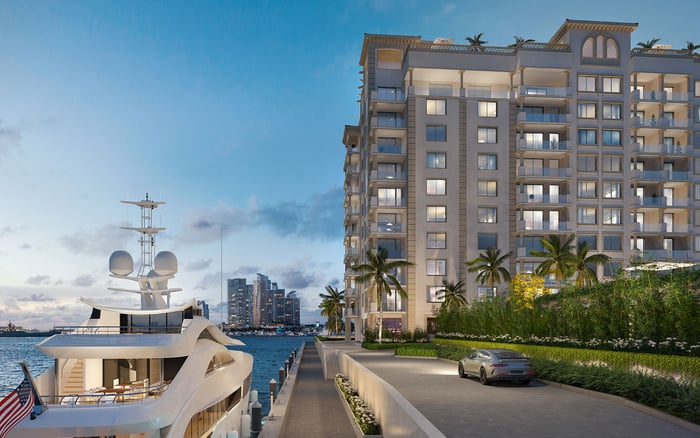
A buyer-focused framework for examining how ownership boundaries, governing documents, reserves, and assessment authority may shape seawall, dredging, and dock costs at The Residences at Mandarin Oriental, Miami.

For a buyer considering The Residences at Mandarin Oriental, Miami, the view is only one element of waterfront ownership. Seawalls, docks, service areas, submerged land, and access routes can sit within different legal boundaries, and each boundary may carry a different maintenance or funding obligation.
The central question is not simply whether waterfront work could occur. A disciplined review asks who owns each component, which party controls repairs, whether reserves anticipate future work, and what authority exists to charge owners when available funds are insufficient.
The durability of a waterfront purchase depends partly on the clarity of the documents beneath it.
A useful review begins with the residence itself. The declaration and related exhibits should define the unit boundaries, identify excluded components, and explain which maintenance duties remain with the owner.
The next level is the condominium association. Its documents should identify the common elements, limited common elements, shared systems, insurance obligations, reserve categories, and procedures for approving or funding major work. Buyers should also determine whether any waterfront component falls outside the condominium property despite appearing physically connected to it.
A separate entity may control additional property or infrastructure. If a master association, neighboring owner, operator, developer affiliate, or public body has rights involving a seawall, walkway, dock, or submerged area, the governing instruments should explain how those rights interact with the condominium. The documents should also reveal whether owners face direct charges, pass-through expenses, or indirect exposure through the condominium budget.
A condition report addresses the physical state of an asset at a particular time. It does not, by itself, establish ownership, maintenance responsibility, reserve treatment, or assessment authority. Those financial questions require a separate reading of the recorded instruments, budgets, contracts, and insurance provisions.
The scope of any proposed work also matters. Repair, replacement, reinforcement, drainage work, shoreline protection, and adjacent walkway improvements may be treated as distinct projects even when they concern the same waterfront edge. Buyers should avoid combining separate scopes or assuming that one estimate resolves every related obligation.
The allocation method deserves equal attention. Costs might be assigned under percentage interests, a contractual formula, use rights, frontage, or another method stated in the governing documents. Without a controlling provision, a sales illustration or visual plan cannot reliably answer who will pay.
Dredging should not be treated as an automatic consequence of waterfront ownership. The relevant review should identify the area involved, the party with legal control, the facility served by the work, applicable approvals, and the agreement-if any-that assigns the expense.
A buyer should also ask how a potential dredging obligation would be classified. It could be addressed through an operating budget, a reserve category, a user charge, a cost-sharing agreement, or a special assessment, but no treatment should be assumed without documentary support. If the purchase materials do not provide an answer, the issue remains an open due-diligence item.
The same principle applies when marine access appears in plans or marketing materials. Physical proximity, visibility, or convenience does not establish a residence owner’s legal right to use a facility or a duty to fund it.
Dock-related review should distinguish the deck, pilings, utilities, lifts, access controls, lighting, insurance, and surrounding marine area. Different parties may hold ownership, operating, or exclusive-use rights for different components.
The documents should state who performs inspections, approves repairs, selects contractors, carries insurance, and pays for damage or replacement. They should also explain whether costs are shared by all owners, limited to users, assigned to an operator, or governed by a separate agreement.
A comparison with other South Florida residences can help buyers formulate questions without assuming identical structures. Una Residences Brickell, St. Regis® Residences Brickell, and The Ritz-Carlton Residences® Miami Beach may serve as useful reference points for organizing a review, but each property’s recorded documents control its own ownership and cost framework.
A reserve schedule can indicate whether anticipated capital work has a designated funding category, but it should not be read in isolation. Buyers should compare reserve assumptions with the declaration, maintenance chart, engineering materials supplied for review, current contracts, and the association’s assessment powers.
Insurance is another part of the analysis. The policy structure, deductibles, exclusions, and responsibility for uninsured losses can affect how a waterfront event becomes an owner expense. Counsel and insurance professionals should confirm which assets are covered and which entity carries the relevant policy.
Assessment provisions merit close attention. The review should identify approval procedures, notice requirements, allocation formulas, payment terms, and any limitations stated in the governing documents. It should also examine whether a separate entity can impose a charge that reaches owners through the condominium association.
The most useful review set may include the declaration, articles, bylaws, proposed budget, reserve schedule, maintenance-responsibility chart, plats and surveys, easements, cost-sharing agreements, waterfront permits, insurance summaries, management agreements, and contracts concerning relevant infrastructure.
These materials should be read as a connected system. A survey may show where an improvement sits, while an easement explains access, the declaration assigns responsibility, the budget addresses recurring costs, and a separate agreement establishes how a major expense is divided.
Buyers should request written clarification when the documents use inconsistent labels or leave an asset outside an obvious maintenance category. Any clarification should be evaluated against the controlling instruments rather than treated as a substitute for them.
For The Residences at Mandarin Oriental, Miami, careful due diligence means evaluating more than regular condominium charges. The quality of the ownership framework depends on whether the documents clearly connect each waterfront asset to an owner, decision-maker, maintenance duty, funding source, and enforceable allocation method.
Unresolved questions about seawall work, dredging, or dock maintenance should remain open questions until the applicable documents answer them. A buyer can then weigh the residence alongside the transparency of its governance, the adequacy of its planning, and the procedures through which future waterfront costs could reach owners.
For discreet guidance on South Florida’s exceptional residences, connect with MILLION.
If branded residences are on your mind — as a home or as an allocation — we would be glad to share what we are seeing, privately.
Begin a quiet conversationBoundaries help identify who owns each asset and which party may be responsible for maintenance, insurance, reserves, or repairs.
No. Physical condition and financial responsibility are separate questions that require review of the governing documents and related agreements.
No. Any obligation should be supported by documents identifying the relevant area, responsible party, and allocation method.
They should examine ownership, use rights, structural responsibilities, utilities, insurance, repair authority, and replacement obligations.
A budget may not fully explain property boundaries, easements, separate agreements, or charges imposed through another governing entity.
Reserves may provide a funding category for anticipated work, but their scope and assumptions should be compared with the governing documents.
Coverage, deductibles, exclusions, and uninsured losses can influence which entity or owners ultimately bear an expense.
It should cover approval authority, notice procedures, allocation formulas, payment terms, and any stated limitations.
No. Recorded documents, permits, and enforceable agreements should establish legal use rights and related obligations.
Buyers should review the declaration, budget, reserve schedule, maintenance chart, surveys, easements, permits, insurance materials, and cost-sharing agreements together.