At Fendi Château Residences, privacy is best assessed as an operating sequence extending from the Collins Avenue gate to the private foyer. Buyers should examine not only staffed arrival points, but also elevator authorization, beach access, amenity controls and the procedures governing guests, vendors and emergencies.
At Fendi Château Residences Surfside, the most meaningful security question is not whether the property has a guard, gate or private elevator. It is how those elements work together from the moment a vehicle reaches 9349 Collins Avenue until a resident enters a private foyer.
The 12-story, 58-residence oceanfront condominium was developed with Château Group as a low-density expression of branded living. Its original mix of three-, four- and five-bedroom residences, with launch pricing reported from $6 million to $25 million, positioned privacy as part of the ownership proposition. With only seven residences per floor, circulation is inherently more intimate than in a large tower. But low density should not be mistaken for a complete security protocol.
For buyers comparing Branded Residences, the distinction matters. Design can create discretion. Operations determine who moves through that design, under what authorization and with what response when a routine changes.
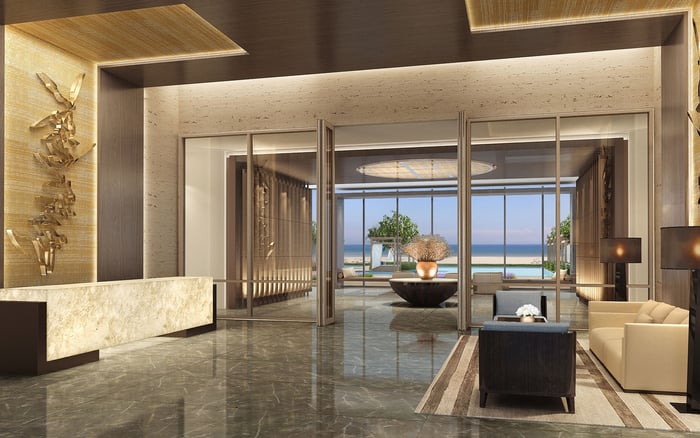
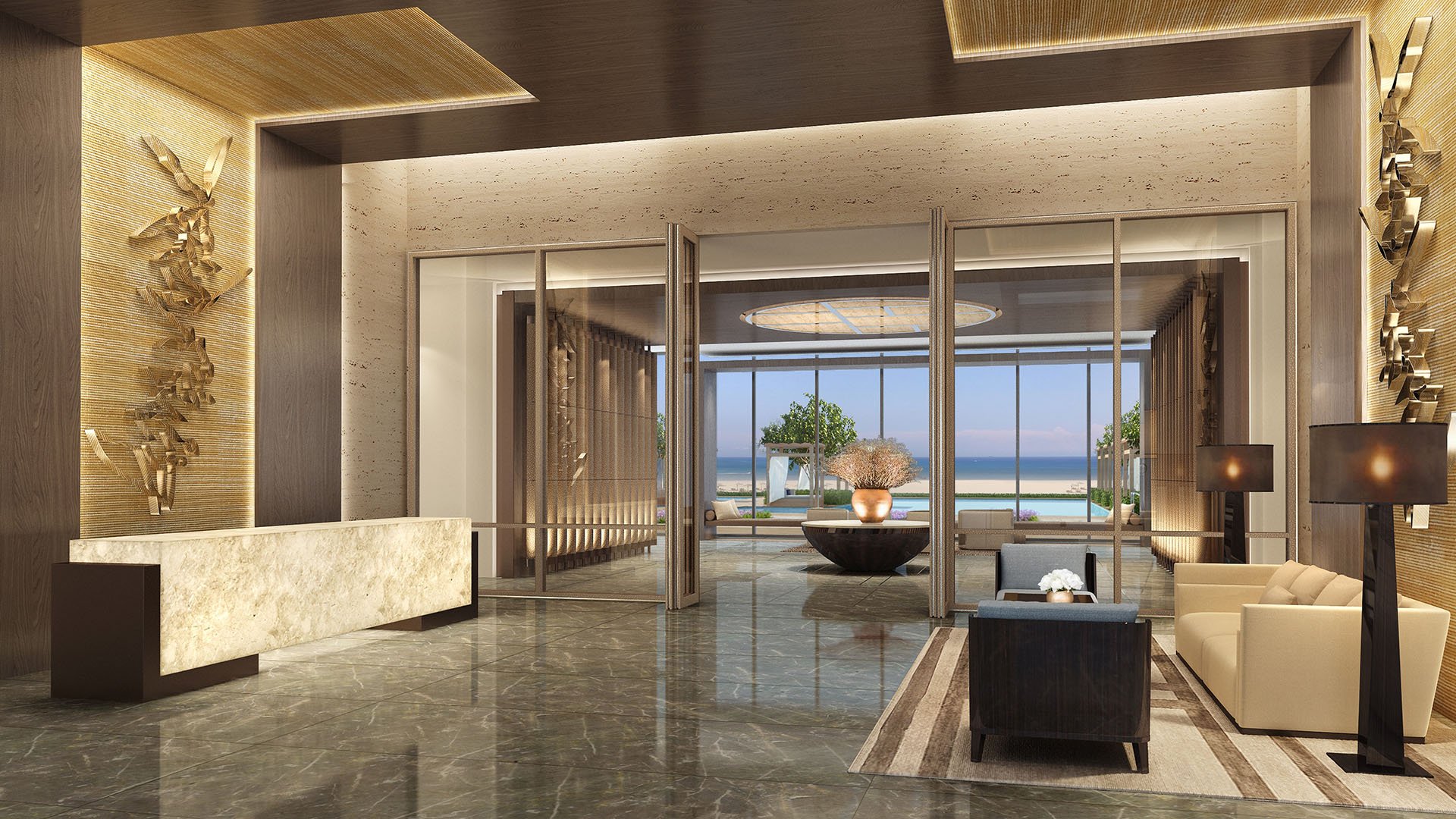
The model begins with a gated entrance and 24-hour security, followed by valet or garage arrival, doorman reception and a 24/7 multilingual concierge. These are not interchangeable amenities. Each represents a separate decision point at which identity, purpose and destination may be established.
A careful review should trace an ordinary arrival in real time. Does a resident use a credential at the gate? How is a ride-share driver handled? Who confirms an unexpected guest? Where does a delivery wait? What happens when a domestic employee or contractor arrives outside usual hours? The value of multiple staffed layers depends on whether information moves coherently between them.
Valet procedures deserve particular attention. Buyers should ask about key custody, vehicle release, garage credentialing and after-hours staffing. The objective is not theatrical visibility, but a path from curb to lobby that is both controlled and gracious.
This layered arrival concept is especially relevant within Surfside's Boutique residential market. Nearby properties such as Arte Surfside and The Surf Club Four Seasons Surfside reinforce why buyers should compare operating models, not simply amenity inventories or architectural scale.
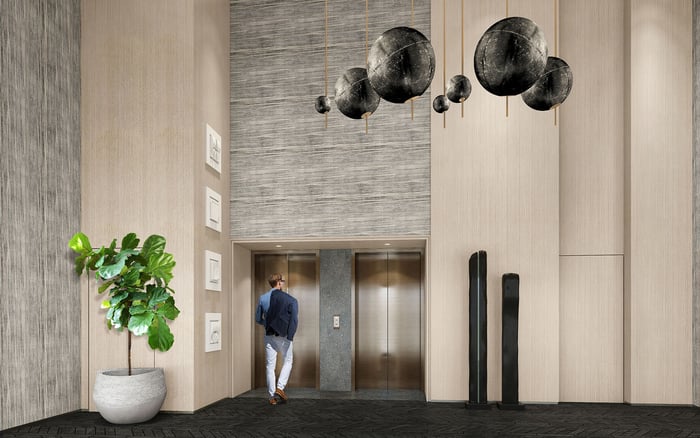
Every residence at Fendi Château has dedicated elevator access into a private foyer rather than relying solely on a conventional shared corridor. Flow-through plans and private foyers add physical separation between residential interiors and common circulation. A concierge-panel connection to building services further integrates each home with staffed operations.
Yet a private elevator is a spatial feature before it is a security conclusion. Available descriptions do not define whether elevator calls are controlled by a fob, restricted by floor, approved remotely or accompanied by staff. Buyers should request the current authorization rules for residents, guests, brokers, service personnel and emergency responders.
Building features also include Shabbat elevators. Their operation should be reviewed alongside any credential or floor restriction. The relevant question is not whether both systems exist, but how private-foyer access remains appropriately managed when elevator operating modes change.
Smart-building language warrants similar discipline. At least one residence has smart-home automation and private elevator entry, but in-home automation and building-wide access control are different systems. Ownership diligence should establish where responsibility passes from the association to the individual residence.
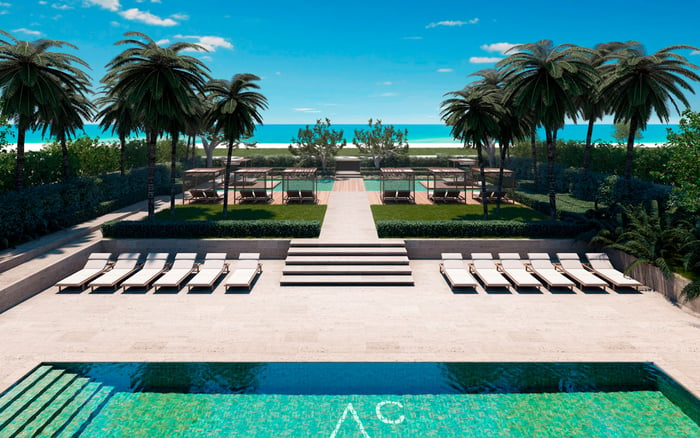
Oceanfront living creates another arrival edge. The property has approximately 300 linear feet of private beachfront, with direct beach access, an oceanfront pool, cabanas and cabana service. That managed environment extends well beyond the lobby.
Buyers should inspect how residents return from the beach, how credentials function when their hands are occupied and whether guests can move from cabanas to interior spaces without renewed verification. Pools, fitness and spa facilities, children's areas and entertainment rooms are semi-private common areas, each with distinct patterns of resident, staff and vendor use.
The same analysis applies when considering another contemporary Surfside address such as The Delmore Surfside. Waterfront privacy is strongest when street, building and shoreline access are treated as one continuous operating environment.
Current association documentation should carry more weight than broad marketing language. Request written details on access control, camera coverage, staffing, incident escalation and the retention or review of security records. Confirm how residents preauthorize guests, deliveries, contractors, employees and real-estate showings.
Ask management to explain a realistic scenario from beginning to end: an unannounced visitor at the gate, a late delivery, a lost credential or a guest attempting to select the wrong floor. The answers reveal whether the individual layers operate as a coordinated system.
Security diligence should remain separate from life-safety review. Emergency power, fire procedures, evacuation planning and structural monitoring address different risks and require their own documentation. Sophisticated ownership means evaluating both categories without allowing one to substitute for the other.
Ultimately, Fendi Château Residences Surfside offers an ownership framework shaped by controlled arrival, white-glove staffing, limited density and private-foyer entry. Its quality should be judged by the continuity among those features. Discretion is not a single amenity. It is the cumulative result of architecture, authorization and service behavior.
Where is Fendi Château Residences located? It is an oceanfront condominium at 9349 Collins Avenue in Surfside, Florida 33154.
How large is the building? The boutique property rises 12 stories and contains 58 luxury residences.
Does every residence have private elevator entry? Private elevator access into a dedicated foyer is a building-wide ownership feature.
What staffed arrival services are included? The package includes 24-hour security, valet, doorman service and a 24/7 multilingual concierge.
Why is the gate only the first security layer? Residents and visitors still pass through vehicle handling, lobby reception, elevator circulation and private-foyer access.
What should buyers ask about elevator authorization? They should verify credentialing, floor restrictions, guest approval, staff access and emergency procedures.
How should Shabbat elevator operation be evaluated? Buyers should confirm how that operating mode interacts with floor controls and private-foyer access.
Does private beach access affect security diligence? Yes. Beach entry, pool areas, cabanas and routes back into the building form a separate perimeter.
Are smart-home features the same as building security? No. Residence automation and association-controlled access may be separate systems with different responsibilities.
What should be reviewed beyond personal security? Emergency power, fire response, evacuation and structural-monitoring protocols require a distinct life-safety review.
For a discreet conversation and a curated building-by-building shortlist, connect with MILLION.
If branded residences are on your mind — as a home or as an allocation — we would be glad to share what we are seeing, privately.
Begin a quiet conversation