A buyer-focused guide to evaluating Surfside privacy as a complete sequence, from the driveway and garage to elevators, service routes, staffing and in-home separation.
For a buyer relocating from Barcelona, privacy in Surfside is best understood not as a single amenity, but as a sequence. The critical moments begin when a vehicle turns off Collins Avenue, continue through the driveway, valet or garage, and culminate at the residence door. A private elevator is valuable, but its practical significance depends on who can reach its call panel, how guests are cleared, and whether staff and deliveries follow separate routes.
This distinction should shape the search. A secluded residence can still involve a highly visible arrival, while a carefully controlled porte cochère may lead to elevators shared with vendors. The objective is continuity: limited exposure at every transition, reinforced by architecture, credentials, staffing, and enforceable building rules.
The most useful Surfside buyer's guides therefore treat privacy as an operating system. Buyers should test that system in person rather than rely on floor plans or an amenity description.
Begin at the curb during the hours when the household will actually arrive. Observe the turn into the property, time spent waiting, sightlines from the street and lobby, and the handoff between security and valet. Then repeat the exercise from the garage and on foot. Each route may offer a materially different level of discretion.
At The Surf Club Four Seasons Surfside, each residential tower has its own entrance, driveway, and porte cochère, establishing a controlled approach before the elevator journey begins. The development comprises 150 residences of approximately 1,800 to 7,800 square feet, with private elevator entry among the residence features. Even so, buyers should confirm the configuration of the precise unit under consideration. One residence at 9001 Collins Avenue, for example, has been offered with direct private elevator entry.
Seaway North at The Surf Club presents another instructive model. Its dedicated private arrival and valet entry are complemented by doorman, bellman, and security services. Electronic controls cover elevators and garage doors, restricting vehicle and vertical circulation to credentialed users. Select residences also have private self-parking, which may reduce dependence on valet handling.
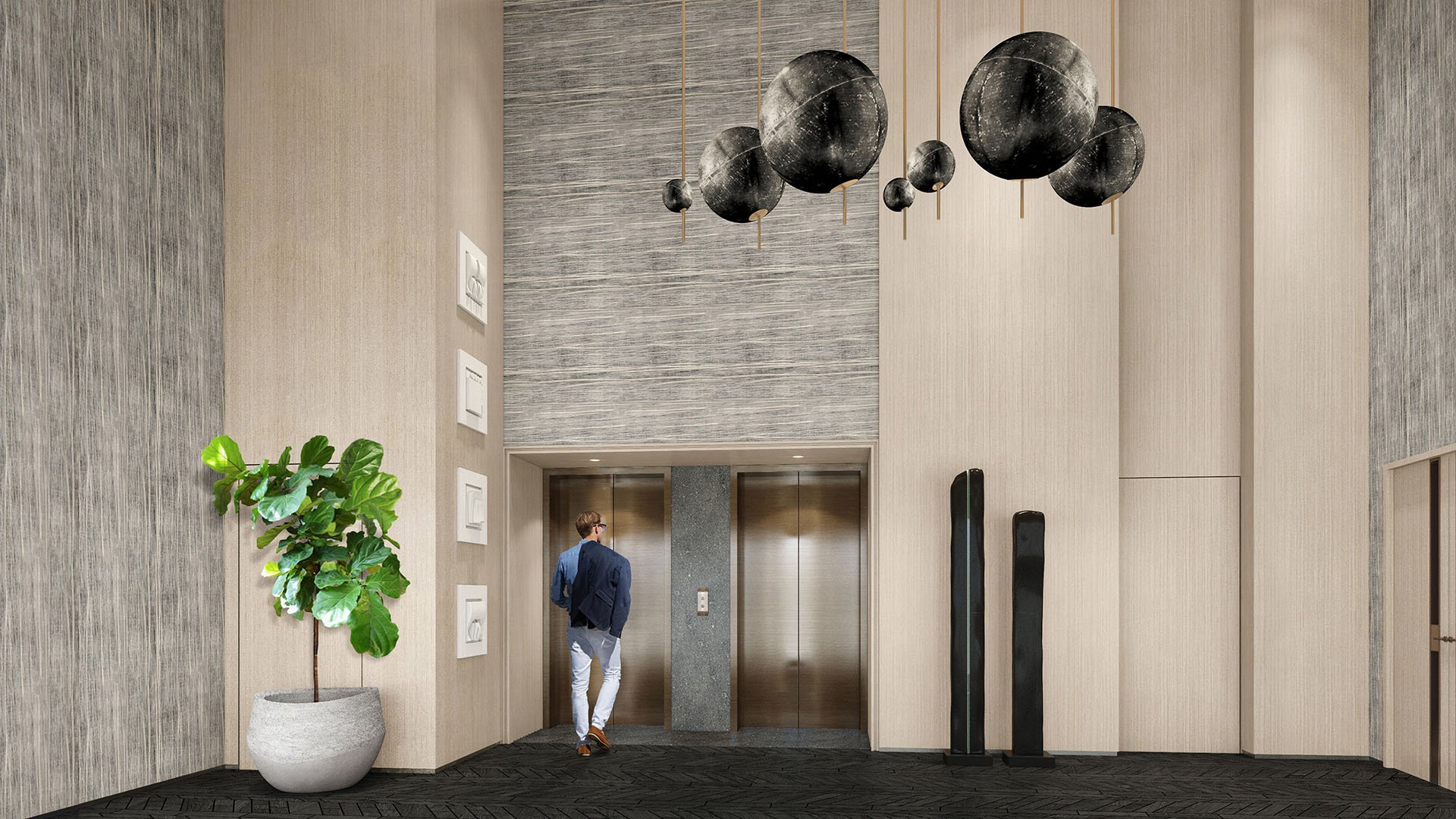
The phrase “private elevator” can describe several arrangements. The elevator may open directly into the residence, into a private foyer, or onto a low-occupancy landing. Buyers should determine which condition applies, who else can call the elevator to that floor, and what occurs during an emergency override.
At Arte Surfside, a boutique oceanfront building of 16 residences at 8955 Collins Avenue, homes occupy either a full floor or half floor. Direct private elevator entry is paired with fingerprint-recognition access control. The low residence count, limited number of neighbors per floor, and credentialed entry work together, but each component should still be tested during diligence.
Fendi Château Residences Surfside at 9349 Collins Avenue provides dedicated elevators that open into private foyers for all residences. Its gated entrance and 24-hour security add a staffed layer before elevator access. A concierge-panel connection also allows residents to communicate with building services and amenities without personally managing every request in the lobby.
For planned inventory, The Delmore Surfside at 8778 Collins Avenue describes direct private access through dedicated elevator foyers. Its 32 standard residences are planned as four- or five-bedroom homes spanning approximately 4,400 to 8,724 square feet. Buyers should review final documents and the exact residence plan rather than extrapolate from a general building description.
Discretion is tested most often by recurring activity, not occasional guests. Housekeepers, private chefs, contractors, florists, couriers, and large deliveries all require predictable access. The central question is whether their route intersects with the household's principal entrance or resident elevator.
The Surf Club separates staff and delivery traffic through dedicated service elevators. Fendi Château also has a service entrance, creating a route distinct from the principal residential entry. In one current residence offering there, staff quarters, smart-home automation, and private elevator entry demonstrate how that separation can continue within the home.
Ask management to map the entire service journey: where a driver checks in, where packages wait, which elevator is used, and how staff enter the residence. Confirm whether household employees may hold credentials, whether those credentials can be time-limited, and who has authority to issue or revoke them. Delivery hours, contractor procedures, and after-hours exceptions should be documented, not assumed.
A polished tour demonstrates design intent; documents reveal daily reality. Request the association rules governing visitors, deliveries, contractors, and household staff. Confirm security and front-desk schedules, guest-clearance procedures, credential administration, and emergency elevator overrides.
The buyer's inspection should include live tests. Arrive by valet, use the self-parking route if applicable, enter as a pedestrian, and simulate a guest announcement. Ask to see the service entrance and service elevator. Note every shared threshold, camera-monitored point, and place where a person waits.
Finally, compare the exact unit, stack, and foyer. Building-wide statements do not guarantee that every residence has an identical elevator or service configuration. Privacy in Surfside is strongest when the physical plan and management protocol reinforce one another from curb to interior.
Is a private elevator the same as direct entry into the residence? Not necessarily. It may open into the home, a private foyer, or a limited-access landing.
Should buyers inspect both valet and garage arrivals? Yes. Valet, self-parking, and pedestrian routes can create different levels of exposure and distinct checkpoints.
How does Arte Surfside limit shared circulation? Its 16 residences occupy full or half floors, with direct private elevator entry and fingerprint recognition.
Does Fendi Château separate service traffic? It provides a service entrance distinct from the principal residential entry, along with private residential foyers.
What arrival controls exist at Seaway North? It combines private arrival and valet entry with staffed services and electronic controls for elevators and garage doors.
Does The Surf Club separate deliveries from residents? Dedicated service elevators route staff and delivery traffic separately from resident elevators.
What should be confirmed about household staff access? Confirm permitted entrances, elevator routes, credential rules, schedules, and revocation authority in writing.
Are private elevator features identical throughout a building? Buyers should verify the exact unit and stack because configurations can differ by residence.
What should buyers ask about deliveries? Ask where deliveries are screened and stored, which elevator is used, and what hours apply.
What is the best way to test a building's privacy? Walk every arrival and service route, then compare the experience with association rules and management protocols.
For a confidential assessment and a building-by-building shortlist, connect with MILLION.
If branded residences are on your mind — as a home or as an allocation — we would be glad to share what we are seeing, privately.
Begin a quiet conversation