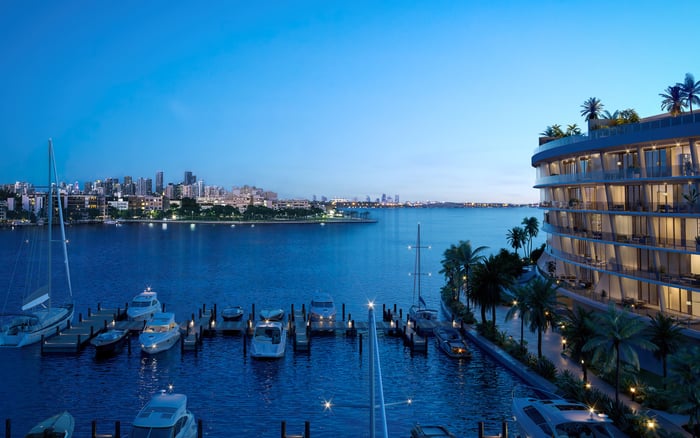
For collectors relocating from Zurich, the right Coral Gables residence must be evaluated as both a home and an operating environment for art. Service access, building rules, climate performance, storage, insurance, and customs planning all belong in contract diligence, before finishes and amenities determine the decision.

A move from Zurich to Coral Gables becomes more complex when the household includes fine art. The residence is not simply a destination; it is the final link in a controlled chain extending from deinstallation and packing through customs, road transport, building access, placement, and long-term environmental care.
The property decision should begin with a collection profile. Record the dimensions and packed weights of the largest works, anticipated crate sizes, handling restrictions, installation needs, and sensitivity to changes in temperature or humidity. A conservator and specialist art transporter can translate that profile into physical and environmental requirements for the home.
This discipline should inform every viewing. A buyer considering Ponce Park Coral Gables or The Village at Coral Gables should approach each as a distinct operational proposition. Marketing materials cannot replace written confirmation from management regarding routes, rules, dimensions, and mechanical performance.
The central access question is whether every crated work can travel from the transporter’s truck to its intended location without unsafe tilting, outdoor unpacking, or an improvised route. Ask management whether movers may use passenger elevators or must reserve a designated service or freight elevator.
Request the complete move-in packet before closing. Review any certificate of insurance, or COI, requirements; approved moving hours; deposits; loading procedures; elevator reservations; protective-padding rules; and management contacts. Confirm in writing who must make each reservation and whether the dock, service elevator, and security access require separate approvals.
Obtain measured elevator-door and cabin dimensions, weight limits, dock clearances, permitted truck dimensions, corridor widths, ceiling heights, turning radii, thresholds, and the complete route into the residence. For unusually large crates, arrange a route walk with building management and the art transporter. A scaled crate mock-up may help the team evaluate tight turns before delivery.
When reviewing Cora Merrick Park, apply this access test before comparing decorative finishes or amenity programs.
The presence of air conditioning alone does not establish that a residence is suitable for a particular collection. The relevant question is whether proposed display and storage zones can provide conditions appropriate for the specific media and whether the owner has a workable response plan for equipment interruptions.
Request available HVAC specifications, zoning information, maintenance documentation, alarm protocols, backup-power details, and performance records. Consider commissioning independent readings in display rooms, storage areas, and perimeter zones. The collection’s conservator should define suitable parameters for the works rather than relying on a generic target.
Examine direct sunlight, glazing, exterior-wall exposure, air-supply placement, and nearby plumbing. If dedicated storage is part of the purchase, verify its legal status, physical location, access, security, HVAC, monitoring, and emergency procedures during diligence.
A nearby comparison such as Four Seasons Residences Coconut Grove can broaden the search, but collection suitability still requires property-specific review.
Appoint a specialist art-logistics coordinator early enough to connect the Zurich pack-out with the Coral Gables delivery window. Assign responsibility for packing, condition reporting, customs documentation, storage, last-mile delivery, installation, building coordination, and exception handling.
Review insurance with a qualified specialist before the works are moved. Confirm the valuation basis, exclusions, geographic scope, storage terms, subcontractor handling, deductibles, and the points at which responsibility transfers between parties.
Customs planning should also begin before packing. Ask qualified Swiss and United States customs advisers to identify the declarations, permits, classifications, temporary-movement procedures, and supporting records applicable to the collection. The strategy should reflect the status of each work and whether the move is permanent or temporary.
The strongest sequence is practical: validate crate and truck fit; review scheduling, access, and insurance requirements; assess climate performance; establish the customs and transport plan; and only then rank finishes and amenities. Where appropriate, incorporate document review, access verification, and specialist inspections into the buyer’s diligence strategy.
A residence that passes this review can reduce avoidable handling, limit uncertainty on arrival day, and support long-term stewardship of the collection.
When should the building’s move-in packet be requested? Request it before closing so its access rules, deposits, COI terms, and reservation procedures can inform the property decision.
Can art movers use a passenger elevator? Building rules vary. Obtain written confirmation of the approved route and the elevator that movers must reserve.
Which freight-elevator measurements matter most? Confirm the door opening, cabin dimensions, weight capacity, and approach turns on the loading and residential floors.
Why should the transporter’s truck be reviewed? The truck must be compatible with the property’s approved loading area and route. Confirm permitted dimensions with management before scheduling delivery.
Is an elevator reservation enough to secure delivery? Do not assume it is. Ask whether loading access, security clearance, management approval, and elevator use require separate arrangements.
Does air-conditioned storage automatically protect fine art? No single feature establishes suitability for every collection. Have a conservator assess environmental stability, monitoring, maintenance, and the needs of the specific media.
Should climate conditions be independently tested? Independent readings can help evaluate proposed display and storage zones against parameters defined by the collection’s conservator.
What should a specialist insurance review address? It should address valuation, exclusions, geographic scope, storage, subcontractors, deductibles, and transfers of responsibility.
Who should determine the Swiss customs requirements? A qualified Swiss customs adviser should assess the collection and planned movement. United States import requirements should be reviewed separately with an appropriately qualified adviser.
What should be confirmed before selecting finishes and amenities? Confirm physical access, building procedures, environmental suitability, insurance arrangements, and the transport and customs plan first.
To compare the best-fit options with clarity, connect with MILLION.
If branded residences are on your mind — as a home or as an allocation — we would be glad to share what we are seeing, privately.
Begin a quiet conversation