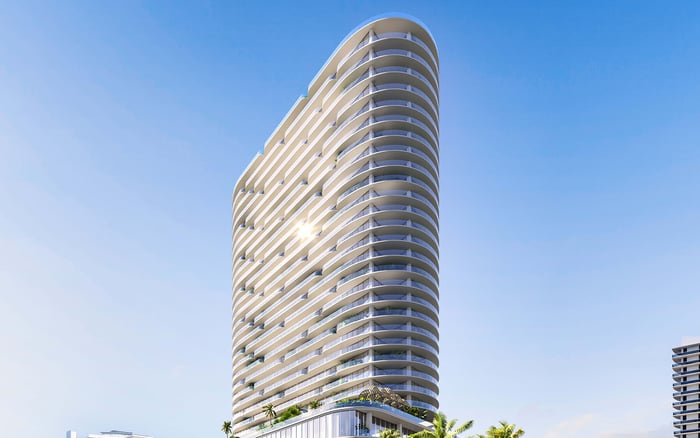
A buyer-focused look at Shoma Bay North Bay Village, with emphasis on mixed-use ownership, amenity rights, association control, cost allocation, rental rules and long-term due diligence before contract review.

Shoma Bay North Bay Village sits in one of South Florida’s more compelling residential corridors: an island municipality between Miami Beach and mainland Miami, connected by the John F. Kennedy Causeway. The setting is central to the appeal. It offers waterfront identity, urban proximity and the sense of a neighborhood still being shaped by its next development cycle.
For a luxury buyer, however, the first serious question is not only whether the residence, view or lifestyle feels right. It is what, precisely, is being owned. Shoma Bay North Bay Village is presented as a waterfront condominium development with a mixed-use concept, including residential condominiums and a retail or lifestyle component. That structure can be attractive, but it also makes contract review more layered than in a simple tower with only residential common areas.
Terms such as waterfront, new construction, pre-construction and investment are not marketing ornaments. They are prompts for due diligence. In a mixed-use condominium, ownership is best understood as a bundle of rights and obligations within a multi-stakeholder environment.
The central contract question is whether the residential owner’s interests are cleanly separated from the non-residential portions of the property. Buyers should ask how the retail or lifestyle areas are owned, who controls them, whether they are governed by the residential condominium association, and whether residential owners subsidize any part of their operation.
This is not a suggestion that the structure is unfavorable. Mixed-use development is now a core part of South Florida’s urban luxury narrative. The attraction is convenience, energy and a more complete daily environment. But buyers should review the condominium declaration and related documents to determine where residential ownership ends and commercial ownership begins.
That distinction matters in practical ways. If a retail or lifestyle component has separate owners, separate utility obligations or separate maintenance responsibilities, the documents should make that allocation clear. If the residential association shares costs, services or physical spaces with non-residential users, the formula for that sharing should be visible before contract execution.
Amenities are often described in broad lifestyle language, but contract documents should convert that language into legal categories. Before signing, buyers should identify which amenities are common elements, which are limited common elements, and which may be retained, controlled or operated outside the residential association.
A common element generally benefits the condominium ownership collectively. A limited common element may be reserved for particular units or groups of units. A developer-retained or commercially controlled component may be available to residents under rules that differ from true residential common ownership. These distinctions can affect access, cost, future modifications and the association’s leverage after turnover.
For buyers comparing North Bay Village options, this is also where neighboring projects enter the conversation. A purchaser looking at Continuum Club & Residences North Bay Village and Tula Residences North Bay Village should not assume that amenity language functions identically from one condominium to another. The architectural experience may be easy to compare. The ownership map is document-specific.
Pre-closing presentations can focus on finish, arrival sequence and lifestyle. Contract review should also focus on governance. Who controls the condominium association at the beginning? When does control turn over from the developer to unit owners? What obligations remain after that transition?
These questions become especially important in a mixed-use setting. If the residential association eventually gains owner control, it still may share systems, access points, insurance arrangements, maintenance obligations or easements with non-residential components. Buyers should understand whether the association can make decisions independently, or whether certain decisions require coordination with another owner, operator or commercial entity.
The budget deserves equal attention. Operating costs, amenity costs, insurance, reserves and future assessments should be allocated in a way that is understandable and consistent with actual use. A luxury buyer may accept substantial monthly costs when they correspond to service, maintenance and long-term quality. What buyers should avoid is uncertainty about who pays for what.
North Bay Village’s appeal is inseparable from water, light and proximity. Yet waterfront ownership is never just about what can be seen from a model residence or rendering. Buyers should review whether the condominium documents address views, waterfront access, easements or project-specific rights that may matter over time.
No condominium contract can make every surrounding condition permanent. Neighboring parcels may evolve. Municipal planning, zoning, infrastructure work and resilience priorities can influence long-term ownership costs and the experience of the neighborhood. For that reason, buyers should separate the emotional value of a view from the legal protections, if any, that attach to it.
This is where North Bay Village differs from more built-out luxury enclaves. In established areas, the surrounding context may feel more fixed. In an evolving island municipality, future redevelopment can be part of the value proposition and part of the risk analysis. A buyer comparing Shoma Bay with nearby bayfront markets such as The Well Bay Harbor Islands should look beyond finishes and ask how each project’s documents define access, use and shared rights.
Shoma Bay’s location can attract buyers who think in both lifestyle and rental terms. That is reasonable, but rental assumptions should be tested before contract signing. Buyers should review condominium restrictions and North Bay Village rules before assuming any short-term or investor-oriented rental income.
The issue is not only whether rentals are allowed. The more useful questions are how often, for how long, through what approval process, and under what enforcement standards. If an owner plans to use the residence seasonally, lease it periodically or hold it primarily as an investment asset, those details belong in the early due-diligence file.
This is also a reminder that different South Florida luxury markets solve rental questions differently. A buyer comparing a waterfront island condominium with a more urban residence such as 2200 Brickell should expect different governing documents, different municipal contexts and different assumptions about day-to-day use.
A thoughtful buyer should enter contract review with a focused agenda. First, ask for a plain-English explanation of the condominium structure, including residential, retail, lifestyle, parking, access and service areas. Second, request clarity on the association budget, reserves, insurance assumptions and allocation of shared costs. Third, identify any rights retained by the developer or any non-residential party.
Fourth, examine turnover provisions. The moment when owners gain control of the association is important, but so is what remains outside that control. Fifth, review easements and use rights, especially those tied to waterfront access, loading, parking, utilities and shared systems. Sixth, align rental plans with both project documents and local rules.
None of these questions should be viewed as adversarial. In the ultra-premium market, they are signs of a serious purchaser. The best contracts do more than convey a residence. They define the owner’s relationship to the building, the association, the commercial components and the municipality around it.
What is the main ownership question at Shoma Bay? The main question is what the buyer owns beyond the individual residence, including rights in common areas, amenities and shared components.
Why does the mixed-use structure matter? Mixed-use ownership can involve residential and non-residential components with different control rights, budgets and cost-sharing obligations.
Should buyers review the retail component before signing? Yes. Buyers should clarify whether retail or lifestyle areas are separately owned, separately controlled or financially connected to the residential association.
Are all amenities automatically owned by residents? Not necessarily. Amenities may be common elements, limited common elements or components retained or controlled outside the residential association.
What should buyers ask about association control? Buyers should ask who controls the association initially, when turnover occurs, and what obligations remain after owners take control.
Why are reserves and insurance important? They influence long-term carrying costs and can affect future assessments, especially where residential and non-residential components share obligations.
Can views or waterfront access be guaranteed? Buyers should not assume that. They should review the condominium documents for any stated rights, easements or protections.
Do North Bay Village rules matter for owners? Yes. Municipal planning, zoning, infrastructure and resilience considerations can influence long-term ownership costs and neighborhood conditions.
Can buyers assume short-term rental income? No. Rental strategy should be checked against both the condominium documents and applicable North Bay Village rules before signing.
Is this article legal advice? No. It is an editorial due-diligence guide, and buyers should review contracts with qualified legal and tax advisors.
For a discreet conversation and a curated building-by-building shortlist, connect with MILLION.
If branded residences are on your mind — as a home or as an allocation — we would be glad to share what we are seeing, privately.
Begin a quiet conversation