A practical, design-led guide to aging-in-place decisions for luxury buyers considering Miami, Fort Lauderdale, and Palm Beach residences.
Aging-in-place is often framed as a medical or technical concern. For South Florida’s luxury buyer, it is better understood as a design discipline: how a residence can remain beautiful, intuitive, private, and easy to live in over a long horizon. The most successful homes do not announce adaptation. They simply feel calmer, clearer, and more forgiving.
That distinction matters across Miami, Fort Lauderdale, and Palm Beach, where residences are often purchased not only for immediate lifestyle, but also for family continuity, seasonal rhythm, and legacy use. A home that supports aging well should still entertain gracefully, frame the view, welcome guests, and preserve personal independence.
The objective is not to make every room feel oversized or institutional. The objective is to remove friction. A thoughtful plan reduces thresholds, clarifies movement, softens lighting transitions, simplifies bathing, improves storage access, and makes service functions discreetly available. In the ultra-premium market, these moves should read as refinement.
The first test is how the residence receives you. A beautiful home can become difficult if the path from car, lobby, elevator, garage, or dock is awkward. Buyers should study the sequence before they study finishes.
In a condominium, the question is whether arrival feels direct and protected. Are elevator lobbies calm and easy to navigate? Is the route to the residence intuitive? Can packages, luggage, groceries, flowers, medical support, or visiting family move through the building without interrupting the household? In a single-family setting, the same logic applies to the motor court, garage, covered entry, and interior transition.
This is where Miami, Fort Lauderdale, and Palm Beach diverge. A Brickell high-rise may prize vertical convenience and staff-supported services. A Miami Beach residence may depend more on secure parking, elevator access, and glare control. A Fort Lauderdale waterfront home often requires closer review of dock-to-house movement, outdoor steps, and guest circulation. A Palm Beach retreat may place greater emphasis on privacy, household staff flow, and dignified arrival for multigenerational guests.
Open space alone does not create long-term ease. What matters is whether circulation is predictable. Hallways, door swings, furniture placement, kitchen islands, and terrace thresholds all determine how well a residence works as mobility needs evolve.
Aging-in-place design favors fewer pinch points. It also favors fewer surprises. Flooring should transition smoothly. Doors should be simple to operate. Controls should be reachable without visual clutter. A powder room should be convenient to entertaining areas without feeling exposed. The primary suite should feel private, but not remote from the daily life of the home.
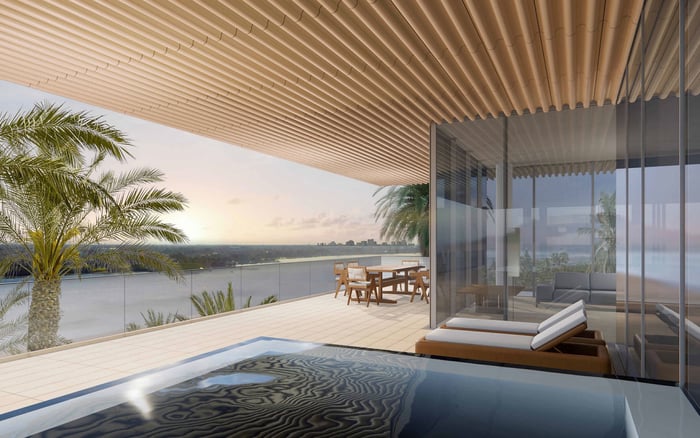
Luxury buyers should pay close attention to the relationship between living room, kitchen, primary suite, laundry, service entry, and outdoor space. The most elegant plan is often the one that makes daily life feel almost effortless. Balcony access deserves particular scrutiny, because exterior thresholds, door weight, and wind exposure can affect comfort over time. Terrace living can be superb for aging-in-place when shade, flooring, seating depth, and interior proximity are properly resolved.
Bathrooms reveal whether a residence has been planned for longevity. The ideal bath does not look adapted. It looks serene. Large-format stone, warm lighting, concealed blocking, curbless shower design, hand-shower placement, seated vanity options, and intuitive storage can all support long-term use without compromising atmosphere.
Buyers should look beyond the showpiece tub and ask practical questions. Is there enough room to move around the vanity? Is the shower entry simple? Could discreet grab support be added later without disrupting the design? Is lighting flattering but sufficient? Does the floor finish remain sensible when wet? Are towels, robes, and daily items stored at a natural height?
The primary bath is important, but guest baths also matter. A home that welcomes aging parents, adult children, long-stay guests, or future caregivers needs at least one secondary bath that is easy to use. In South Florida, where visitors often stay for extended periods, this flexibility is part of gracious living.
South Florida light is one of the region’s defining luxuries. It is also one of the design elements that requires the most control. Aging-in-place buyers should consider natural light, glare, nighttime navigation, and acoustic privacy as one integrated comfort system.
Bright daylight can be invigorating, but harsh glare can make reading, cooking, and moving through rooms less comfortable. Layered window treatments, shaded outdoor rooms, warm evening lighting, and clearly illuminated circulation paths are more than aesthetic preferences. They influence confidence and ease.
Sound deserves equal attention. A residence may have extraordinary views and still feel tiring if mechanical noise, street sound, pool activity, elevator proximity, or hard interior surfaces create constant interruption. Soft materials, thoughtful door placement, acoustic separation between bedrooms, and a quieter primary suite can make a home feel more restorative over time.
Luxury buildings and staffed estates can offer extraordinary convenience, yet aging-in-place design should not rely entirely on service. The best residences preserve independence by making everyday tasks simpler.
Kitchen storage should not require constant reaching or bending. Laundry should sit close enough to daily routines. Smart-home systems should be intuitive, not dependent on a specialist for ordinary use. Climate, shades, lighting, and security should be controllable in more than one way. Technology should support the owner, not become another layer of complexity.
For seasonal residents, remote management can be valuable, but the home should also be easy to reenter after time away. Clear controls, practical storage, durable finishes, and predictable maintenance access all contribute to a residence that feels ready when the owner returns.
Miami often rewards buyers who prioritize vertical living, amenities, proximity, and a highly serviced lifestyle. Aging-in-place in this context means studying elevator access, parking, building circulation, wellness spaces, and how a residence performs during busy social weeks. The home should be cosmopolitan without becoming complicated.
Fort Lauderdale places more emphasis on waterfront living, boating culture, and the transition between indoor and outdoor rooms. Here, the aging-in-place brief should include dock access, exterior surfaces, shaded lounging, guest accommodations, and easy movement between entertaining spaces. Comfort should extend to the water’s edge, not stop at the sliding doors.
Palm Beach typically calls for a more private, residential interpretation. The priority may be discretion, household support, garden access, guest suites, and formal rooms that still function comfortably for everyday living. Aging-in-place here is often about preserving elegance while making the home easier to operate quietly in the background.
Across all three, the best decision is rarely about age. It is about optionality. A well-planned residence can support an active couple today, visiting grandchildren tomorrow, a recovering knee after tennis, a parent in residence, or a future chapter that benefits from greater ease.
Before committing to a residence, ask how the home behaves on an ordinary day. Can you enter with luggage without negotiating steps? Can two people pass comfortably in key areas? Does the kitchen support cooking, entertaining, and simple daily use? Is the primary suite peaceful at night? Can guests stay without disrupting privacy?
Then ask how the home could evolve. Could lighting be improved without major demolition? Could a shower be adapted elegantly? Is there room for a seated moment near the entry, closet, bath, or terrace? Could a bedroom serve as a future wellness room, office, or caregiver suite if needed?
The most valuable aging-in-place features are often invisible at purchase. They are embedded in proportion, access, structure, and restraint. A residence that gets these fundamentals right will feel more luxurious, not less.
Does aging-in-place design reduce the elegance of a luxury residence? It should not. When handled well, it enhances elegance by making rooms calmer, clearer, and easier to use.
Should buyers prioritize a condominium or a single-family home? The better choice depends on service expectations, privacy, arrival sequence, and tolerance for maintenance. Both formats can support aging-in-place when planned carefully.
What is the most important room to evaluate first? Start with arrival and circulation, then evaluate the primary bath, kitchen, bedroom layout, and outdoor access.
Are elevators enough to make a residence future-ready? No. Elevators help, but thresholds, lighting, bathrooms, storage, and daily circulation are equally important.
How should waterfront buyers think about long-term comfort? Review movement between interior rooms, outdoor areas, docks, terraces, and guest spaces. The water lifestyle should remain easy, not just beautiful.
Is smart-home technology essential? It can be useful, but only if it is intuitive. Manual controls and simple backup options remain important.
Which design details are easiest to overlook? Door weight, glare, wet flooring, closet reach, night lighting, and the distance between parking and the main living areas are often underestimated.
Can a renovation solve most aging-in-place issues? Some issues can be improved, but structural constraints, elevator access, room proportions, and major plumbing locations may limit what is possible.
How does this differ between Miami, Fort Lauderdale, and Palm Beach? Miami often emphasizes vertical service, Fort Lauderdale emphasizes waterfront movement, and Palm Beach emphasizes privacy, household flow, and discreet comfort.
When should aging-in-place be considered in the buying process? It should be considered before purchase, because the best long-term features are usually embedded in layout, access, and building design.
When you're ready to tour or underwrite the options, connect with MILLION.
If branded residences are on your mind — as a home or as an allocation — we would be glad to share what we are seeing, privately.
Begin a quiet conversation