A discreet buyer’s guide to evaluating porte-cochère privacy during a private showing, from sightlines and staff choreography to guest arrival, vehicle handling, lighting, and after-dark exposure.
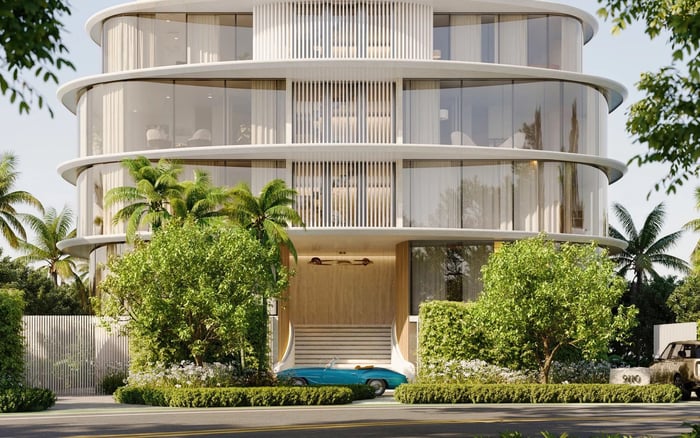
A porte-cochère is not simply a covered driveway. In South Florida’s most privacy-conscious residential market, it is the first room of the home, even when technically outdoors. It frames the transition from public road to private life, and during a private showing, it deserves the same scrutiny as the primary suite, elevator foyer, terrace, or service corridor.
The question is not whether the entry feels impressive for a few minutes. It is whether it protects discretion under real conditions: when another car arrives, when a guest steps out, when luggage is unloaded, when a driver waits, when evening lighting comes on, and when a resident would prefer not to be seen at all.
This matters across property types and neighborhoods. The same discipline applies whether a buyer is touring in Brickell, Miami Beach, Sunny Isles, Surfside, Bal Harbour, or Fisher Island. Architecture may vary, but the question remains constant: can arrival happen without becoming a performance?
Begin the privacy test from the street, not the front door. Ask your driver or advisor to pause before turning in. From that vantage point, study how exposed the porte-cochère is to passing traffic, neighboring towers, sidewalks, public access points, ride-share waiting areas, and adjacent commercial activity.
A strong arrival court often compresses visibility. It may rely on landscaping, walls, deep canopy lines, angled entry geometry, or a sequence of thresholds that prevents a direct view into the drop-off zone. A weaker one may reveal the entire arrival moment from the street, including faces, license plates, luggage, staff interaction, and elevator movement.
Do not evaluate beauty alone. A glamorous canopy can still be visually porous. A restrained entry can be exceptionally private if its approach sequence is well controlled.
During the showing, stand in at least five positions: the street approach, the vehicle drop-off point, the lobby threshold, the elevator corridor, and any nearby guest or valet waiting area. At each point, ask one simple question: who can see whom?
From the car, can you see directly into the lobby? If so, others may also see directly back to arriving residents. From the lobby, can a seated visitor watch every vehicle door open? From the elevator bank, can staff, guests, or other residents identify who has arrived before that person has crossed the threshold?
Then look upward. In vertical South Florida residences, privacy is not only lateral. Balconies, amenity decks, neighboring buildings, and glass façades can create overlooked arrival zones. A buyer focused only on the driveway may miss the most revealing angle, which is often from above.
A private arrival relies on human choreography as much as architecture. During the showing, observe how naturally staff manage the transition. Do they step toward the vehicle before doors open, or does the guest need to signal? Is there a clear place for a driver to pause without blocking the sequence? Are luggage, pets, garment bags, and packages handled without confusion?
The best service experience feels almost quiet. There is no cluster of people at the car, no search for keys, no public handoff of names or unit details, and no awkward wait while someone decides where a vehicle should go. Privacy is compromised when operations become visible.
Ask to experience the arrival as a resident would, not as a broker-led visitor. If the building or estate uses valet, security, private elevator release, or controlled access, ask that the process be demonstrated in sequence. The answer is not only which services exist. It is whether they work gracefully together.
Every porte-cochère has a dwell moment: the period when the vehicle is stopped and occupants are visible. In a truly discreet setting, that moment is short, shielded, and managed. In a less refined setting, it can stretch long enough to expose identity, companions, luggage, shopping bags, or security patterns.
During a showing, time how long it takes to move from vehicle stop to interior privacy. Include door opening, greeting, any security exchange, elevator call, and entry into a more private zone. Then imagine that same sequence during rain, a holiday weekend, a school pickup overlap, or a dinner-hour arrival.
A property does not need to feel empty to feel private. It needs to absorb activity without making residents compete for discretion.
Privacy can fail when circulation is poorly resolved. A porte-cochère should allow vehicles to enter, pause, release passengers, and exit without reverse maneuvers, bottlenecks, or visible negotiation. If cars must stack in a way that places one resident directly behind another, the arrival becomes social by default.
Look for separation where appropriate: resident arrival, guest arrival, service movement, deliveries, ride-share pickup, and valet return. Not every property can separate every use, but a thoughtful sequence reduces unnecessary overlap. In luxury settings, the point is not isolation for its own sake. It is control.
Ask what happens when two or three arrivals occur at once. A serene showing with a single car may reveal little. A credible privacy assessment imagines friction.
Daylight privacy and evening privacy are different. Glass becomes reflective. Interiors glow. Silhouettes sharpen. Security lighting can either protect discretion or place arrivals under a theatrical spotlight.
If the residence is a serious contender, schedule a second pass after dark. Stand outside the arrival zone and observe what can be seen when the porte-cochère is active. Can faces be identified? Are license plates highly visible? Does the lobby read as a stage? Are elevator doors, concierge desks, or seating areas too exposed through glass?
Lighting should guide and soften, not announce. The most elegant arrival sequences are legible to the resident but unrevealing to the passerby.
A porte-cochère in South Florida must do more than photograph well. It should protect occupants during sudden rain, humid evenings, coastal wind, and formal arrivals where gowns, tailoring, luggage, art crates, or children’s items are being moved.
During the showing, look at canopy depth, curb height, drainage, door-swing clearance, and the distance between vehicle and covered threshold. A narrow overhang may still leave a passenger exposed. A beautiful stone court may become inconvenient if water collects where residents step out.
Privacy includes comfort. When a guest is struggling with weather, bags, or footing, the arrival slows and becomes visible.
Security cameras can support privacy, but they can also raise questions about who sees the footage, how it is monitored, and whether the arrival zone is covered without feeling intrusive. During the showing, ask where cameras are placed in relation to the porte-cochère, valet point, lobby doors, and elevator access.
The goal is not to avoid cameras. In ultra-prime living, security and discretion often coexist. The issue is whether surveillance is intentional and professionally integrated, rather than conspicuous, excessive, or poorly aimed.
Also observe whether cameras, intercoms, and access panels require residents to pause in exposed places. A secure system should not force a private arrival to become a public wait.
Buyers often test privacy for themselves but forget everyone else who will use the arrival sequence. Family members, visiting friends, executive assistants, household staff, drivers, personal security, stylists, chefs, trainers, and pet caregivers may all pass through the porte-cochère.
A private residence should accommodate different arrival profiles without confusion. A formal dinner guest should know where to go. A staff member should not be routed through the most visible resident pathway if a service route is more appropriate. A child or older guest should be able to enter safely and directly.
The strongest arrival courts feel intuitive. They do not require explanation to preserve discretion.
The best test is sensory. A well-designed porte-cochère feels composed. The car glides in without exposure. Staff appear without hovering. The canopy shelters without darkening the mood. The lobby is near, but not visually surrendered. Other residents can arrive without forcing contact. A guest can step out without feeling watched.
For a buyer, that feeling has value. It protects routine, family life, social life, and the quiet pleasure of returning home. In South Florida luxury real estate, the arrival is often the moment when a property reveals its real discipline. The façade may impress, but the porte-cochère tells you how carefully privacy has been considered.
What is the first privacy test at a porte-cochère? Start from the street and study whether the drop-off zone is visible to passing cars, pedestrians, neighboring buildings, or waiting guests.
Should I evaluate the porte-cochère during the day or at night? Do both if the property is a serious contender. Evening light can reveal silhouettes, reflections, and visibility issues that are not obvious in daylight.
How long should an arrival take? It should feel efficient and unforced. Time the sequence from vehicle stop to interior privacy, including greeting, access, and elevator movement.
Why does staff choreography matter? Staff determine whether arrival feels seamless or exposed. Confusion at the car, valet stand, or lobby threshold can compromise discretion.
What sightlines are most often overlooked? Buyers often forget views from above. Balconies, amenity decks, neighboring towers, and glass corridors can overlook the arrival court.
Can a visually dramatic porte-cochère still lack privacy? Yes. Scale and materials may impress, but privacy depends on approach geometry, screening, circulation, lighting, and operational control.
What should I ask about valet flow? Ask how multiple arrivals are handled at once, where vehicles wait, and whether residents, guests, deliveries, and service traffic overlap.
How do weather conditions affect privacy? Rain, wind, and poor drainage can slow the arrival, making occupants more visible while they manage luggage, clothing, pets, or guests.
Are cameras a privacy benefit or concern? They can be both. The key is whether camera placement supports security without creating awkward pauses or unnecessary exposure.
Should guests use the same arrival route as residents? It depends on the property, but the route should be intuitive, controlled, and discreet for both residents and invited guests.
For a confidential assessment and a building-by-building shortlist, connect with MILLION.
If branded residences are on your mind — as a home or as an allocation — we would be glad to share what we are seeing, privately.
Begin a quiet conversation