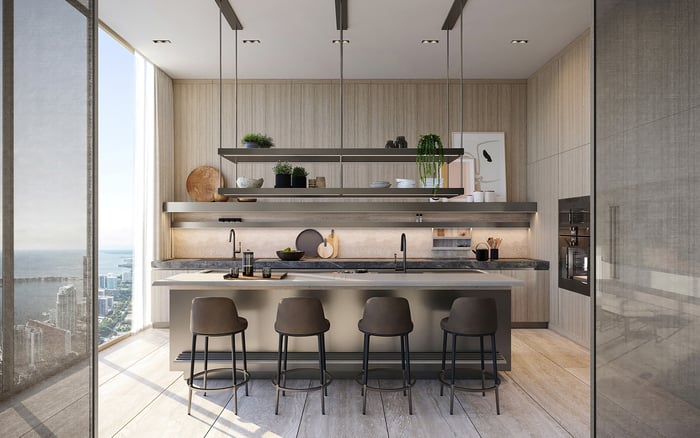
A private showing can do more than reveal light, views, and finishes. For international buyers, it can become a disciplined rehearsal for exchange-rate timing, deposit exposure, and offer readiness.

For an international buyer, a private showing is more than an aesthetic appointment. It is a live rehearsal for timing, liquidity, and conviction. The view may be perfect, the terrace may suit the season, and the floor plan may feel inevitable, but the decision still has to pass through another market: currency.
The most sophisticated buyers do not wait until the offer stage to consider exchange exposure. They bring that discipline into the showing itself. The question is not whether the currency market will move in your favor. The question is whether the residence still feels like the right acquisition if the exchange rate becomes slightly less generous between the showing, contract, deposit, and closing.
This is especially relevant across South Florida, where a buyer may compare a Brickell residence with an Aventura waterfront home, a Downtown tower, or a private island setting in a single week. The physical tour delivers the emotional signal. Currency timing tests whether that signal can withstand financial friction.
Before the appointment, define a simple currency band: the range in which you are comfortable proceeding without rewriting the entire strategy. It should include the exchange rate at the time of the showing, a preferred rate, and a defensive rate that would require a pause, a smaller offer, or a different payment structure.
This band should be written, not remembered. A private showing can compress judgment. Ocean light, privacy, ceiling height, and arrival sequence all influence perception. A written threshold protects the decision from becoming purely emotional.
If the residence is compelling at today’s conversion but uncomfortable after a modest currency move, that information belongs in the conversation immediately. It may affect how quickly you move, how much cash you keep available, or whether you explore a hedge with an independent financial adviser. The showing becomes more productive because it clarifies both desire and tolerance.
A private showing is the right setting to ask about timing, not only finishes. The buyer or adviser should understand when funds are likely to be required, what deposit sequence may apply, and whether the seller expects speed, certainty, or flexibility. In a resale negotiation, timing can become a meaningful part of the offer. In new construction, payment milestones may shape the buyer’s currency exposure over a longer period.
The goal is not to turn a showing into a legal or banking meeting. It is to gather enough practical context to know whether the acquisition should be pursued aggressively, patiently, or not at all. A beautiful property that requires funds at precisely the wrong currency moment may still be worth buying, but the buyer should know what risk is being accepted.
This is where discretion matters. Questions should be direct but calm: When would the seller ideally close? Is there a preferred deposit schedule? Would a cleaner contract matter more than a higher price? Is there any timing sensitivity? The answers can help determine whether currency risk can be managed through structure rather than guesswork.
The most common mistake is blending two separate judgments into one. A buyer sees the residence, loves it, notices the exchange rate, and treats the rate as confirmation that the property is right. That is not discipline. That is momentum.
Instead, evaluate the property twice. First, decide whether it belongs on the short list without reference to currency. Consider privacy, light, arrival, building culture, service, parking, outdoor space, and long-term usability. Then evaluate the same residence through the currency lens. Would you still want it if the exchange rate moved against you before contract? Would you still proceed if the required deposit had to be converted sooner than expected?
This two-step process is particularly useful for an investment purchase, where a buyer may be balancing lifestyle, preservation of capital, and optional future use. The private showing should answer whether the asset has enough intrinsic appeal to deserve financial engineering. If the answer is no, a favorable exchange rate should not rescue the decision.
Before the showing ends, run three quiet scenarios with your adviser. The first is the immediate-action scenario: if the currency remains within your preferred band, are you prepared to submit an offer quickly? This tests readiness and prevents delay from weakening an otherwise strong position.
The second is the adverse-move scenario: if the currency shifts against you before the first deposit, what changes? The answer might be nothing, a lower offer, a delayed closing request, or a decision to pass. The value is in deciding before emotion hardens into attachment.
The third is the competitive scenario: if another buyer appears, would you still pursue the residence at the defensive rate? This is the clearest test of conviction. If the answer is yes, the property may justify a more deliberate currency strategy. If the answer is no, the showing has done its job by defining the limit.
Luxury real estate often rewards decisiveness, but decisiveness is not urgency. A measured buyer can move quickly because the thresholds are already known.
Currency timing is not only a financial exercise. It is also a way to measure lifestyle value. Some residences are replaceable within the buyer’s search. Others are not. The harder a home is to replicate, the less useful it becomes to wait for a perfect exchange rate that may never coincide with the perfect property.
During the tour, ask what is truly rare. Is it the line of sight? The relationship between indoor and outdoor rooms? The service environment? The ability to host family without compromising privacy? The marina proximity, school access, or seasonal convenience? These qualities help determine whether a slight currency disadvantage is acceptable.
A buyer comparing multiple South Florida locations should also note how each market behaves emotionally. Brickell may feel efficient and vertical. Aventura may feel practical for family routines and waterfront access. Downtown may appeal to buyers who value cultural proximity and skyline energy. The right showing clarifies whether the currency question is attached to a specific residence or simply to the idea of buying.
After the appointment, the follow-up should be narrow and disciplined. Confirm the payment sequence, likely closing timeline, estimated carrying obligations, and any contract points that affect cash movement. Then compare those items against the currency band established before the tour.
If the residence remains compelling, act with clarity. If the numbers only work under perfect exchange conditions, pause. The best private showings do not always end in an offer. Sometimes they prevent an elegant mistake.
The essential principle is simple: do not let currency timing become an afterthought. In a global purchase, it is part of the architecture of the transaction. When tested during the showing, it can sharpen negotiation, protect liquidity, and reveal whether desire is strong enough to justify movement.
Should I check exchange rates during a private showing? Yes, but do it discreetly and within a pre-set range. The showing should test whether the property still works if the rate changes before contract.
What is a currency band? It is the exchange-rate range within which you are comfortable proceeding. It helps separate a serious acquisition from a rate-dependent impulse.
Should currency timing affect my offer price? It can, especially if the payment schedule creates near-term exposure. The cleaner approach is to know your threshold before negotiating.
Is this more important for cash buyers? Cash buyers often feel currency movement immediately because funds may need to be converted quickly. Financing can also involve timing considerations.
Can a seller adjust terms for currency risk? Sometimes structure matters as much as price. Closing timing, deposits, and certainty may all influence the negotiation.
Should I wait for a better exchange rate? Only if the property is replaceable and your timeline allows it. A rare residence may justify acting within a reasonable defensive range.
How do I avoid making an emotional currency decision? Write your thresholds before the showing. Then evaluate the home first as real estate and second as a currency-timed purchase.
Does this apply to pre-construction purchases? Yes, because payment milestones may extend over time. That can make currency planning a larger part of the acquisition strategy.
Who should advise me on hedging? Use an independent financial or currency professional. Real estate advisers can help identify timing issues, but hedging advice should be specialized.
What should I do immediately after the showing? Confirm payment timing, closing expectations, and your exchange-rate threshold. If all three align, you can move with greater confidence.
When you're ready to tour or underwrite the options, connect with MILLION.
If branded residences are on your mind — as a home or as an allocation — we would be glad to share what we are seeing, privately.
Begin a quiet conversation