A discerning buyer’s guide to separating polished family-storage renderings from the daily reality of school bags, sports gear, chargers, uniforms, and arrival routines in South Florida luxury residences.
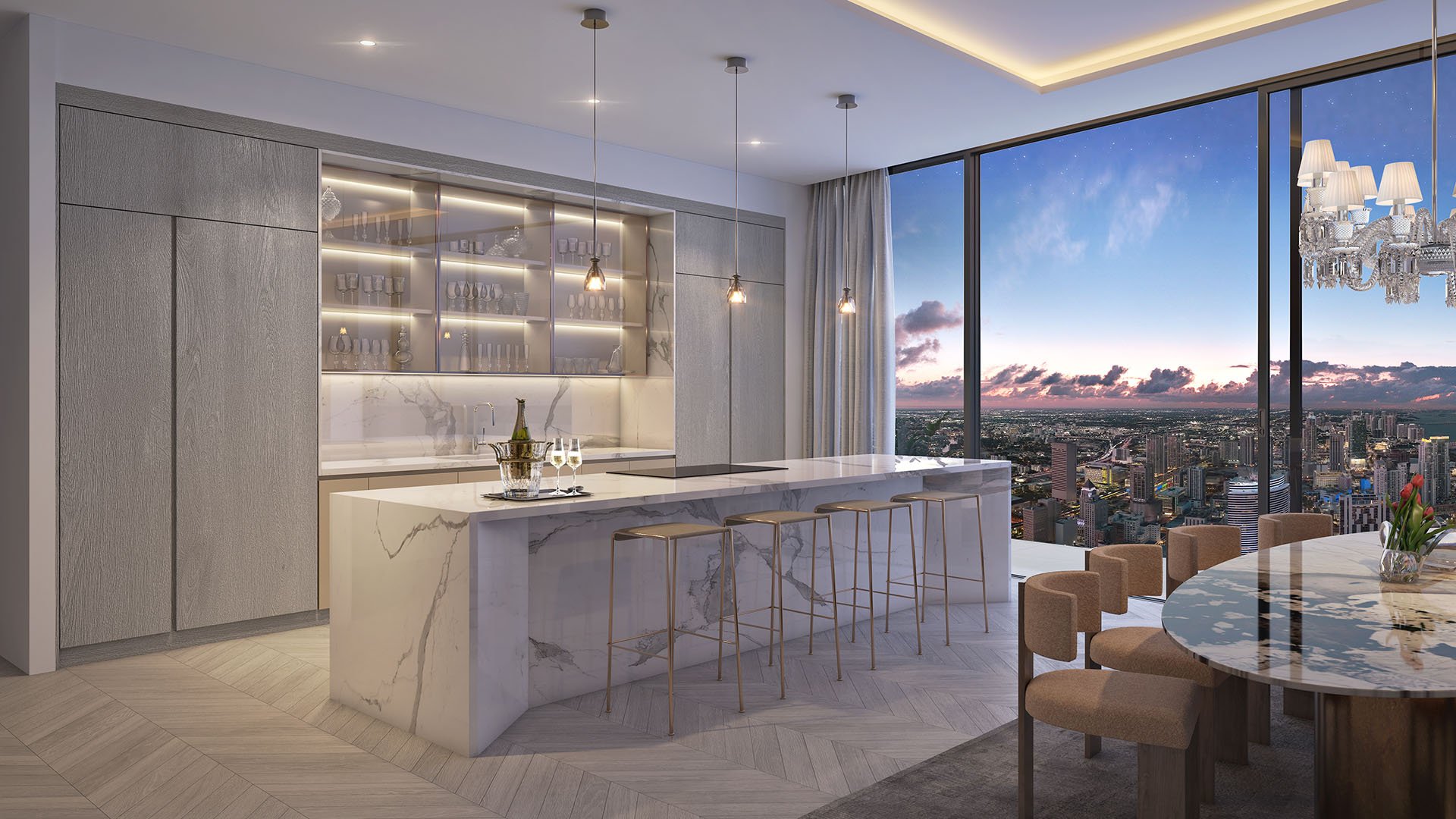
In a luxury residence, school-bag storage is rarely about the bag itself. It is about friction, privacy, mornings, tutors, sports gear, wet umbrellas, laptops, permission slips, house-staff circulation, and the difference between a serene arrival and a daily pileup. A polished image of a bench, a few hooks, and a woven basket can be charming. It can also be pure marketing theater.
For South Florida families, especially those balancing private-school calendars, second-home patterns, and high-service buildings, the question is not whether a storage nook exists. The question is whether it sits where life actually happens. A family entry too far from the elevator, garage, side door, or kitchen becomes decorative. Children will not detour for design purity. Bags land at the first practical pause.
The most successful homes treat school-bag storage as an architectural utility with the finish level of a primary dressing room. It should be beautiful, but beauty is the final layer. Flow, capacity, durability, access, and discipline come first.
The easiest way to detect theater is to trace the child’s path. In Brickell, arrival may begin at a private elevator vestibule or garage drop-off. In Coconut Grove, the rhythm may move through a garden entrance, kitchen door, or covered parking area. In Coral Gables, a side entry or family hall may do more daily work than the formal foyer. In Boca Raton, a garage-adjacent mud area may matter more than any photogenic built-in near the front door.
If the proposed school-bag zone is not on the natural route from arrival to snacks, homework, laundry, or bedrooms, it is not storage. It is staging. Ask where a child carrying a backpack, instrument, water bottle, lunch bag, and practice gear would stop without being reminded. That is the real location.
In new-construction residences, buyers should study plans with particular care. Renderings often compress family life into a perfect vignette. A narrow bench can look generous in an image and feel inadequate when three children arrive at once. A row of hooks can look orderly before it has to hold uniforms, jackets, swim bags, and tournament equipment.
A serious storage plan has measurable capacity. Each child needs a defined landing area, not a shared decorative zone where ownership becomes ambiguous. There should be space for the school bag itself, plus shoes, outerwear, lunch items, sports add-ons, and the smaller objects that create visual noise.
Depth matters. Many elegant cabinets fail because they are too shallow for a full backpack. Height matters as children grow. Hooks placed for a six-year-old may become awkward for a teenager, while high shelves that look tailored may be useless for younger children. A superior solution anticipates change.
Closed storage can preserve visual calm, but it must not become a black hole. Open cubbies are faster, but they can look messy unless proportioned with restraint. The best answer is often a hybrid: a concealed vertical zone for bulk, an open daily slot for immediate use, a drawer for small items, and a ventilated shoe area below.
Marketing theater often reveals itself through fragile finishes. School-bag storage is a contact sport. Corners get hit. Cleats scrape. Water bottles leak. Sunscreen transfers. Sand appears without invitation. A finish that belongs in a formal library may not belong in a family drop zone unless it has been specified for abuse.
Look for surfaces that can be wiped, hardware that feels substantial, and flooring that tolerates grit. A beautiful stone or wood finish can work if it is selected with reality in mind. The test is not whether the space photographs well on delivery day. The test is whether it still feels composed in the third week of school.
Ventilation is another quiet marker of seriousness. Closed cabinets for shoes, athletic gear, or damp items need airflow. Without it, the most elegant millwork becomes an odor chamber. Luxury is not merely what is visible. It is also what has been thoughtfully prevented.
A modern school-bag zone often needs power. Devices charge overnight. Headphones, tablets, watches, and laptops need a home. If every charger migrates to the kitchen island, the storage plan has failed. Integrated outlets, low-glare lighting, and a small surface for sorting forms can turn a pretty wall into a functioning command center.
Lighting deserves more attention than it usually receives. A dim hallway cabinet may look moody, but families need to find a jersey, a folder, or a missing shoe before sunrise. The most refined spaces use discreet lighting that clarifies without making the area feel commercial.
Consider sightlines as well. Some households want the storage zone visible enough to encourage accountability. Others prefer it hidden from guests and formal entertaining spaces. Neither is inherently better. The point is to align the plan with the way the household hosts, studies, travels, and resets.
Ask where the bags go when they are full, wet, or accompanied by sports equipment. Ask whether the doors can open without blocking circulation. Ask whether two children can use the area at the same time. Ask where lunch containers are emptied, where uniforms go, where the tutor’s materials land, and where weekend gear is separated from weekday gear.
If the answer depends on a child behaving like a stylist, be skeptical. Good design reduces the need for constant correction. It makes the right behavior the easiest behavior.
Also ask whether the storage can evolve. A preschool solution may not support high-school schedules. A family that currently needs stroller storage may later need space for tennis bags, musical instruments, debate materials, or travel backpacks. The best millwork is not over-personalized. It is adaptable, dignified, and proportioned for resale.
Family storage is an emotional feature, but it is also a value signal. A buyer walking through a residence can sense whether the home has been designed for real living or simply photographed for aspiration. Thoughtful daily infrastructure communicates care. It suggests that the same intelligence may carry through closets, laundry, service areas, and kitchen planning.
The opposite is also true. A beautiful residence with no credible place for school bags can feel strangely incomplete to family buyers. It may not reduce desire, but it can introduce hesitation. In competitive luxury markets, hesitation matters.
A discreet, well-placed storage zone does not need to announce itself. In fact, the finest examples almost disappear. They keep the public rooms calm, the morning routine faster, and the family’s private life elegantly contained.
School-bag storage is a small feature with an outsized ability to reveal design intelligence. Marketing theater asks you to admire the vignette. Real luxury asks whether the home supports the day before the dinner party, the morning before the flight, and the ordinary Tuesday when everyone arrives at once.
The most sophisticated buyers look beyond the bench cushion and the hooks. They study route, scale, finish, ventilation, power, and whether the solution respects how children actually move. In South Florida’s most desirable family residences, the quietest details are often the ones that make a home feel rare.
What is marketing theater in school-bag storage? It is a storage feature that looks persuasive in a rendering but does not function well in daily family life.
Where should school-bag storage be located? It should sit directly on the natural arrival route from the elevator, garage, or family entrance.
Is a front foyer bench enough? Usually not, unless the front foyer is truly where the family enters and unloads every day.
Should school-bag storage be open or concealed? A hybrid often works best, with quick-access areas for daily items and closed storage for visual calm.
What detail is most often overlooked? Depth is frequently underestimated, especially for full backpacks and sports-related gear.
Does this matter in a condominium? Yes. In a vertical residence, the transition from elevator to living space can become the family drop zone.
What should buyers ask during a showing? Ask where bags, shoes, devices, wet items, and sports equipment go on a normal school day.
Can storage be too customized? Yes. Overly specific millwork can age poorly as children grow or household needs change.
Does school-bag storage affect resale appeal? For family buyers, credible daily storage can make a residence feel more complete and easier to live in.
What is the simplest test of a good plan? Imagine three children arriving at once with full bags and no reminders, then see where everything naturally lands.
For a tailored shortlist and next-step guidance, connect with MILLION.
If branded residences are on your mind — as a home or as an allocation — we would be glad to share what we are seeing, privately.
Begin a quiet conversation