A buyer-oriented look at how Forté on Flagler’s private arrival sequence reframes luxury living along West Palm Beach’s South Flagler Drive waterfront corridor.
At the highest end of condominium living, arrival is not simply the moment a car stops and a door opens. It is the first proof of whether a building understands discretion, movement, service, and privacy. At Forté on Flagler West Palm Beach, private arrival is best understood as a sequence rather than a standalone amenity, beginning with the approach from South Flagler Drive and continuing through controlled entry, a motor-court-style transition, the lobby threshold, secure elevator access, and ultimately the residence itself.
That distinction matters for buyers comparing waterfront condominiums along the West Palm Beach corridor. A generic amenity list may reference valet, porte cochère, private elevator access, or lobby service as separate features. The sharper question is how those elements work together. At Forté, the appeal of private arrival lies in choreography: architecture sets the stage, operations manage the timing, technology supports control, and hospitality service softens the experience.
South Flagler Drive gives Forté its public-facing context. It is part of the waterfront residential corridor that defines much of the area’s luxury identity, with movement, views, and civic visibility close to the building’s edge. The arrival sequence begins there, but its purpose is to move residents away from the exposure of the street and into a more composed, protected environment.
This is where private arrival becomes a daily-life feature. The approach should feel intuitive for residents returning home, clear for invited guests, and appropriately separated from public street activity. For a buyer, the value is not only ceremonial. It is practical. The easier it is to come home during a busy afternoon, receive a guest without confusion, or coordinate service circulation without friction, the more a building’s luxury promise is felt in routine moments.
The same corridor is drawing attention from other residential offerings, including Alba West Palm Beach and Shorecrest Flagler Drive West Palm Beach. Within that context, Forté’s private arrival is not a decorative flourish. It is part of how the building positions itself among buyers reading the waterfront not only by view lines, but by privacy, access, and daily ease.
A motor-court-style transition is the hinge between the public approach and the private interior. In luxury residential design, this moment does more than provide cover or convenience. It creates pause. It allows the resident to leave the cadence of the street before entering the building. Done well, it also reduces the sense of overlap between residents, guests, deliveries, and passersby.
The language around valet and porte cochère can sound familiar, even interchangeable, across new high-end developments. At Forté, those ideas are more compelling when read as part of a coordinated system. The motor court supports the handoff from vehicle to building. Staff presence can make that handoff feel managed rather than exposed. The physical configuration can help reinforce separation between arrival traffic and the broader waterfront corridor.
For buyers focused on boutique living, this is a meaningful differentiator. Boutique does not only mean fewer people or a quieter lobby. It means the building can make individual movement feel more personal, more legible, and less anonymous. The arrival court is where that tone is first established.
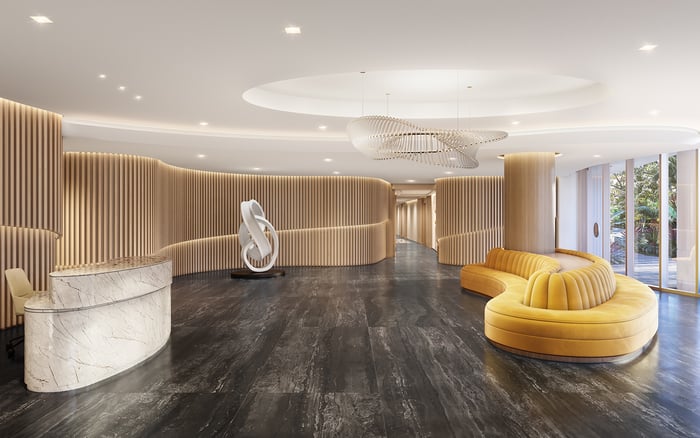
The lobby at Forté functions as a threshold between South Flagler Drive’s public energy and the privacy of the residential environment. That is a subtle but important distinction. In many buildings, the lobby is treated as a visual statement, a space intended to impress. In a more privacy-led building, the lobby must also filter, orient, and calm.
This threshold role is where design, architecture, and operations meet. The space should feel polished, but it should also help define who belongs where. Residents should experience a natural progression from entry to vertical circulation. Guests should be received with clarity. Service movement should feel accommodated without dominating the resident path. None of this requires spectacle. In fact, the most refined version of arrival often feels quiet because its complexity has been resolved before the resident notices it.
That quietness is part of the emotional dimension of luxury. A resident returning home should feel a shift in atmosphere: from visibility to privacy, from movement to composure. Arrival design can influence comfort, status, and belonging before a person reaches the residence door.
Private arrival does not end at the lobby. Secure elevator access is central to Forté’s resident-experience narrative because it extends privacy from the entry sequence into the building’s vertical circulation. For buyers, this is one of the most important parts of the conversation. A well-managed ground-floor experience loses power if the transition to the residence feels exposed or poorly controlled.
Secure elevators add another layer to the choreography. They support the sense that movement is intentional, filtered, and resident-centered. They also clarify the relationship between hospitality and security. The best luxury buildings do not make security feel clinical, nor do they allow hospitality to feel loose. They blend the two so access feels seamless, but not casual.
This is why private elevator access should not be read merely as a phrase in marketing copy. It is part of a larger chain: arrival, recognition, transition, controlled ascent, and residence entry. Buyers comparing Forté with other West Palm Beach conversations, such as South Flagler House West Palm Beach or Mr. C Residences West Palm Beach, should pay attention to how each building handles that chain, not just whether individual terms appear on an amenity page.
For a luxury buyer, the test of private arrival is experiential. How does the building feel at peak arrival times? Is guest drop-off clear without feeling public? Does the motor-court transition create privacy or simply mark an entrance? Does the lobby guide residents naturally toward secure circulation? Are service paths considered so daily operations do not interrupt the residential mood?
Forté’s positioning along the waterfront gives these questions added weight. The South Flagler Drive setting is visible and desirable, but visibility must be balanced by control. A building that handles arrival gracefully can make the waterfront feel like a privilege rather than a source of exposure.
This is also a lifestyle consideration. Owners do not experience a residence only through floor plans, finishes, and views. They experience it through repeated rituals: returning after dinner, greeting a guest, stepping out in the morning, coordinating a driver, or moving from car to elevator without friction. Over time, those rituals shape the perceived quality of the address.
For resale-minded buyers, private arrival may also support the property’s long-term desirability because it speaks to enduring luxury values: privacy, security, convenience, and emotional ease. These are less trend-driven than amenity fashions. They are part of why the first five minutes of coming home can matter as much as the view from the living room.
What is the private-arrival concept at Forté on Flagler? It is the coordinated movement from South Flagler Drive through controlled entry, a motor-court-style transition, the lobby, secure elevators, and the residence.
Why does private arrival matter for luxury buyers? It shapes privacy, convenience, security, and the emotional feeling of coming home, which are central to daily resident experience.
Is the motor court just a design feature? No. It acts as a transition point that helps separate residents from public street activity before they enter the building interior.
How does the lobby support privacy? The lobby functions as a threshold between the public waterfront corridor and the more controlled residential environment.
What role do secure elevators play? Secure elevator access extends the privacy and control of the arrival sequence upward toward the residence.
Is private arrival the same as valet service? Valet may be one part of the experience, but private arrival is broader, combining design, operations, technology, and hospitality.
How should buyers evaluate arrival design during a tour? Watch how vehicles, guests, residents, staff, and service circulation move through the property without conflict.
Why is South Flagler Drive important to the experience? It provides the waterfront setting, while the building’s arrival sequence helps create separation from public corridor activity.
Does private arrival affect daily convenience? Yes. It can simplify coming home, guest drop-off, service coordination, and movement from vehicle to residence.
Is Forté on Flagler best understood through its amenity list alone? No. Its private-arrival narrative is strongest when viewed as a complete resident-experience system.
For a discreet conversation and a curated building-by-building shortlist, connect with MILLION.
If branded residences are on your mind — as a home or as an allocation — we would be glad to share what we are seeing, privately.
Begin a quiet conversation