A refined buyer’s guide to evaluating catering kitchens in South Florida luxury residences, from circulation and ventilation to staging, service privacy, storage, terrace support and resale intelligence.
In South Florida luxury real estate, the catering kitchen is often misunderstood. A casual observer sees a second kitchen and imagines spectacle: private chefs, champagne towers and the polished theater of entertaining. A disciplined buyer sees something more consequential. The catering kitchen is infrastructure. It reveals how a residence manages privacy, staff, heat, sound, storage, deliveries and the movement of guests through a home.
That distinction matters. In a market shaped by waterfront living, frequent hosting and increasingly hotel-caliber residential service, the visible kitchen is only part of the story. The question is not whether the marble photographs well. The question is whether the home can absorb a dinner for twenty, a family weekend, a holiday gathering or a chef-led tasting without pushing service into the center of daily life.
This is why sophisticated buyers in Brickell, Miami Beach, Sunny Isles and Coconut Grove have learned to read the catering kitchen with the same rigor they apply to views, ceiling heights and building pedigree. At 2200 Brickell, for example, a buyer evaluating entertaining potential should look beyond the primary kitchen moment and ask how preparation, staging and cleanup would actually unfold during a full evening at home.
The first test is movement. Stand in the catering kitchen and imagine a chef, an assistant and a server working simultaneously. Can they enter without crossing the main entertaining zone? Is there a direct path to the dining area, terrace or service elevator? Does the route interrupt the family room, media space or bedroom corridor?
A strong catering kitchen usually supports two flows: one for residents and guests, and one for service. The best layouts allow staff to receive groceries, prep trays, plate courses and clear dishes with minimal visibility. This is not about hiding people. It is about preserving the atmosphere of the home. Luxury entertaining depends on choreography, and choreography depends on circulation.
Watch for pinch points. A beautiful galley that cannot hold two people comfortably may be more pantry than performance space. A second kitchen buried behind a laundry room may be useful for storage but awkward for a formal dinner. Conversely, a compact room with excellent adjacencies can outperform a larger, poorly placed one.
A catering kitchen earns its place when it can handle real cooking. That means ventilation, heat management and odor control. In South Florida, where indoor-outdoor living is central, the consequences of poor ventilation can travel quickly from kitchen to great room to terrace.
Ask how cooking air is exhausted. Look at the hood, the cooktop location and the relationship to windows or mechanical systems. If the catering kitchen is intended for meaningful chef use, it should not feel like a decorative closet with appliances. It should feel like a controlled workroom, scaled to the kind of cooking the household actually does.
This is especially important in vertical living. In a penthouse, where entertaining may concentrate around view corridors and outdoor space, a well-planned secondary kitchen helps protect the main living room from the realities of preparation. The luxury is not that guests never know dinner is being made. The luxury is that the evening never feels disrupted by the mechanics of making it.
Cabinetry is not the same as storage. A buyer should open every door and look for depth, logic and specialization. Where do platters go? Where are linens kept? Is there space for bulk beverages, glassware, serving pieces and small appliances that are not used daily? Are cleaning supplies separated from food and service items?
A true catering kitchen has a memory of events built into it. It anticipates repetition. It knows where the extra stemware lives. It accepts that catered evenings require staging before guests arrive and breakdown after they leave. If every inch of storage is shallow, ornamental or already dependent on overflow from the primary kitchen, the room may be more branding than utility.
In new-construction residences, buyers should be especially attentive to whether the catering kitchen is delivered as a genuinely functional room or as an optional upgrade concept. Renderings can make secondary kitchens look effortless. The walk-through should confirm clearances, appliance specifications, utility access and how the room supports daily family life when no event is happening.
South Florida luxury has become less stiff, but not less demanding. Buyers are not necessarily trying to recreate old-world formality. They are trying to create homes that function gracefully. Service privacy helps with that.
At 888 Brickell by Dolce & Gabbana, a buyer thinking like an owner would evaluate how a branded, highly designed environment accommodates the less glamorous details of hospitality: ice, trays, trash, deliveries, packaging and cleanup. The more polished the residence, the more important the invisible systems become.
The same principle applies in quieter residential settings. In Coconut Grove, the appeal is often a more relaxed domestic rhythm, but relaxed does not mean improvised. At Four Seasons Residences Coconut Grove, an owner focused on long-term livability would still ask how the home separates family life from staff circulation during a hosted evening.
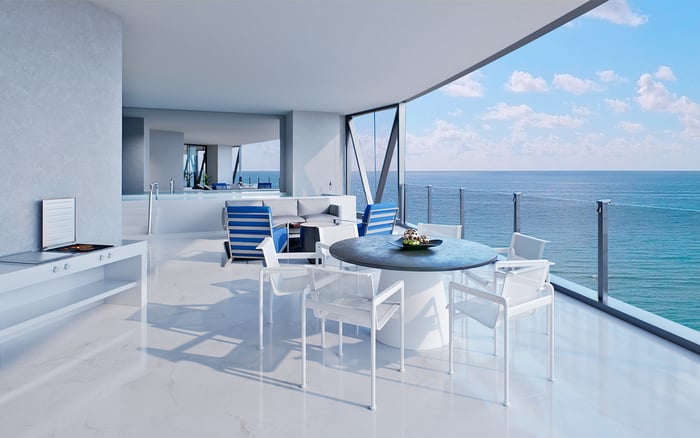
In South Florida, entertaining frequently migrates outdoors. A catering kitchen that ignores the terrace is missing part of the assignment. The buyer should ask how food and drinks move from preparation to open air. Is the route intuitive? Is there a wet bar or outdoor support nearby? Can service reach the terrace without passing directly through the principal seating arrangement?
This matters on the beach, the bay and the Intracoastal. At St. Regis® Residences Sunny Isles, the expectation of elevated coastal living makes outdoor hospitality part of the ownership experience. In Sunny Isles, a catering kitchen should be judged partly by how well it supports that transition from interior refinement to waterfront ease.
The most successful residences create layers. The primary kitchen remains beautiful and social. The catering kitchen absorbs preparation. The terrace receives guests without feeling like a service corridor. When those layers align, the home feels calm, even when it is working hard.
A catering kitchen can add meaningful appeal, but only when it is credible. Before assigning value, ask direct questions. What appliances are included? Are there separate refrigeration zones? How is ventilation handled? Where does trash go? Is there a service entrance? Can caterers stage without using guest bathrooms, private halls or main seating areas?
Also ask how the room will live on ordinary days. A second kitchen that only works twice a year may still be valuable for the right household, but the best examples serve multiple roles: morning prep, wine service, family overflow, staff support, holiday staging and discreet cleanup. Flexibility is part of the value.
The buyer who reads a catering kitchen correctly is not seduced by size alone. They study sequence, pressure and discretion. They understand that luxury is often measured by what guests never see.
What is the difference between a catering kitchen and a second kitchen? A catering kitchen is planned for preparation, staging and service support, not simply duplicate appliances. Its value comes from workflow, privacy and event readiness.
Should every luxury condo have a catering kitchen? No. It matters most for buyers who entertain frequently, employ staff, host extended family or want strong separation between social spaces and preparation areas.
What is the first thing to inspect in a catering kitchen? Start with circulation. If staff cannot move efficiently between delivery, prep, dining and cleanup zones, the room may not perform as intended.
Is ventilation more important than appliance branding? Often, yes. Premium appliances matter, but poor heat and odor management can undermine the entire entertaining experience.
How does a catering kitchen affect resale? It can strengthen appeal for hospitality-focused buyers when the layout is functional. A poorly placed or symbolic second kitchen may add less value.
Should the catering kitchen connect directly to the terrace? Direct connection is ideal but not always required. What matters is whether food, drinks and service can reach outdoor areas gracefully.
Is a small catering kitchen still worthwhile? Yes, if it has proper clearances, storage, ventilation and adjacency. A compact but intelligent room can outperform a larger, inefficient one.
What storage should buyers look for? Look for deep storage for platters, glassware, linens, beverages and small appliances, with cleaning supplies separated from food service.
Do catering kitchens matter in branded residences? They can matter even more because highly polished living spaces need back-of-house systems that preserve the atmosphere of the home.
What is the luxury buyer’s rule of thumb? Judge the catering kitchen by how calmly the residence functions when fully occupied, fully staffed and actively entertaining.
For a discreet conversation and a curated building-by-building shortlist, connect with MILLION.
If branded residences are on your mind — as a home or as an allocation — we would be glad to share what we are seeing, privately.
Begin a quiet conversation