A buyer-focused MILLION editorial on weighing South Florida island prestige against mainland ease across privacy, access, amenities, liquidity, and carrying costs.
In South Florida’s top tier, the island-versus-mainland decision is rarely about whether both options qualify as ultra-luxury. They do. The more meaningful question is what kind of privilege the residence is meant to deliver each day. One path favors physical separation, a tightly curated arrival, and the kind of rarity that begins before you reach the front door. The other favors effortless movement, established neighborhood life, and a schedule that can absorb school runs, office meetings, club dinners, and airport departures without a second layer of logistics.
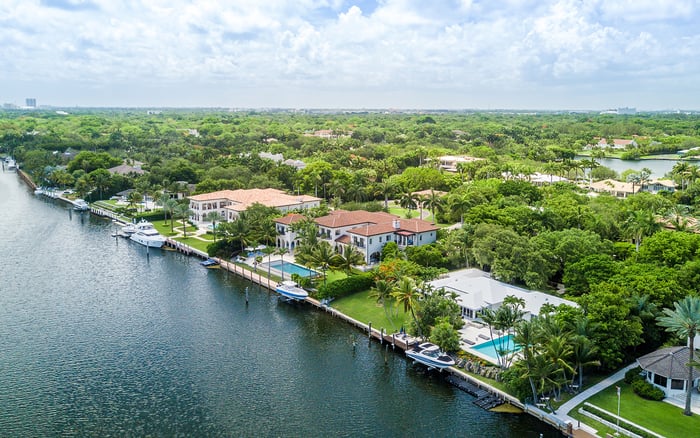
For many buyers, Fisher Island represents the purest expression of island prestige. Access is limited, which means the journey itself becomes part of the ownership experience. That controlled threshold is central to its appeal, as is the resort-style environment built around marina access, beach club life, golf, tennis, spa, and dining. Properties such as The Links Estates at Fisher Island and The Residences at Six Fisher Island embody that idea of privacy as an amenity rather than simply a condition.
On the other side of the comparison, Coral Gables stands out as the clearest mainland counterpoint. It competes less on seclusion and more on everyday ease: established residential districts, simpler transportation patterns, and smoother access to schools, offices, clubs, and Miami International Airport. For buyers who want ultra-luxury without feeling operationally removed, addresses such as Ponce Park Coral Gables and The Village at Coral Gables illustrate how prestige can be embedded in urban form, architecture, and neighborhood identity rather than in physical isolation.
Between those poles sits Key Biscayne. It has an island identity, beaches, and village infrastructure, yet remains directly connected to Miami by the Rickenbacker Causeway. In practice, that makes it a useful middle category: more distinctive than the mainland, less operationally demanding than a fully access-controlled island.
The cleanest way to compare island prestige with mainland ease is to score each option across five buckets: privacy, access, amenity depth, liquidity, and carrying costs.
Privacy is where island addresses usually lead. Geography naturally limits supply, and scarcity tends to preserve both discretion and social signaling. In a place like Fisher Island, privacy is reinforced not just by price point, but by the mechanics of entry and the controlled residential environment.
Access is where mainland luxury generally regains ground. Coral Gables offers simpler point-to-point mobility and fewer daily dependencies. A buyer who expects multiple appointments across Miami in a single day will often feel the difference immediately. Key Biscayne, while still an island, softens this issue because road access preserves a more conventional rhythm.
Amenity depth can favor either side, but the expression differs. On a prestige island, amenities are often integrated into a more self-contained residential world. On the mainland, the amenity set may extend beyond the property line into clubs, shopping, dining, schools, and business infrastructure that are easier to reach regularly.
Liquidity matters more than many trophy buyers initially admit. Mainland submarkets often benefit from a broader buyer pool and a more familiar set of comparables, while niche island inventory can be rarer, more specialized, and occasionally slower to price with precision. That does not make island ownership weaker. It makes it more bespoke.
Carrying costs deserve disciplined attention. Florida’s tax environment may be favorable at the state level, but the real distinctions usually emerge through insurance exposure, homeowners association structures, maintenance intensity, and the particular attributes of the asset itself. Waterfront status, dockage, lot dimensions, and municipal location can all materially alter the annual picture.
The most seductive misunderstanding in ultra-luxury real estate is that island living buys only scenery. In reality, it buys choreography. Arrival is controlled. Visitor access is filtered. The neighborhood feels finite, knowable, and resistant to dilution. That is why island addresses tend to carry greater social signaling power when rarity is the core objective.
This is especially true in communities where the residential environment is tightly managed and deeply amenitized. Marina access, golf, tennis, beach club access, and private dining are not incidental perks in these enclaves. They are part of a system designed to reduce contact with the outside world when the owner prefers not to engage it. For a second-home buyer or a principal resident with a highly visible profile, that controlled atmosphere can outweigh practical inconvenience.
Yet island prestige also demands tolerance for friction. Every movement carries one more variable. Weather, traffic on a causeway, guest coordination, service access, deliveries, and routine scheduling all become slightly more intentional. For the right buyer, that friction is not a drawback. It is part of the appeal of exclusivity.
Mainland luxury is often underestimated because it lacks the theatrical threshold of an island arrival. But for many sophisticated buyers, convenience is not a compromise. It is a form of luxury in itself.
Coral Gables, in particular, offers a durable kind of prestige rooted in planning, architecture, and neighborhood continuity. The appeal lies in doing ordinary things beautifully and efficiently. Children can move through private-school routines more easily. Business owners can move between meetings without building in a transportation buffer. Social life can extend across clubs, restaurants, and cultural venues without every outing feeling like a logistical event.
Mainland depth can also make financing more straightforward because lenders often have a larger base of comparable transactions in established non-island submarkets. That same breadth can support a healthier resale framework, especially for buyers who value optionality. For some households, the ability to enter and exit a position with less market narrowness matters more than owning the rarest possible address.
When buyers hesitate between the romance of an island and the utility of the mainland, Key Biscayne is often the most intelligent place to linger in the analysis. It preserves a distinct island identity, beach proximity, and village services, while still maintaining direct road access to Miami.
That hybrid quality matters. It allows a buyer to retain a sense of retreat without fully accepting the operating model of a more insulated island enclave. In practical terms, Key Biscayne can feel like a private world at home and a connected address when the day requires movement.
For families, that balance can be particularly compelling. For part-time residents, it can also reduce the sense that every arrival and departure must be staged. In ultra-luxury, that middle ground is not indecisive. It is often the most refined answer to a complex brief.
At this level, broad market averages are of limited use. The comparison has to be asset by asset. Buyers should examine assessed value, lot size, waterfront exposure, dockage, tax characteristics, building or association rules, and any rental restrictions early in the process.
Insurance deserves special scrutiny for any coastal or waterfront residence. The difference between two homes with similar aesthetics can be significant once storm exposure, elevation, and building characteristics enter the underwriting conversation. The same principle applies to homeowners association rules. Some prestige island communities can be materially more restrictive, which may suit one owner perfectly and frustrate another.
The most useful question is not which setting is better in the abstract. It is which setting best aligns with the owner’s actual calendar, privacy threshold, and tolerance for operational complexity.
If your priority is rarity, symbolic value, and a residential environment that feels purpose-built to exclude noise, island living usually wins. If your priority is fluid movement, daily efficiency, and a broader framework of convenience, mainland luxury often proves more intelligent over time.
South Florida is unusual because both choices can be deeply prestigious. The distinction is not whether one is luxurious and the other is not. It is whether luxury is being defined by separation or by ease.
Is Fisher Island the strongest example of island prestige in this comparison? Yes. Its controlled access and self-contained amenity environment make it a clear benchmark for privacy-driven ultra-luxury.
Does mainland living mean giving up prestige? No. In places like Coral Gables, prestige comes from neighborhood quality, planning, and convenience rather than isolation.
Why is Key Biscayne such an important middle case? It offers true island identity with direct road access, making it more practical than a fully access-dependent island.
Which option is usually better for daily commuting? Mainland luxury is typically easier for regular movement between offices, schools, clubs, and the airport.
Do island homes always have higher carrying costs? Not automatically. Costs vary by the specific asset, especially when insurance, waterfront exposure, and HOA structures are considered.
Is liquidity different between island and mainland ultra-luxury? Often, yes. Mainland markets may have broader buyer pools, while island inventory can be more niche and bespoke.
Should financing considerations affect the lifestyle decision? They can. Mainland properties may offer lenders more comparable sales, which can simplify underwriting in some cases.
Are rental rules worth reviewing before making an offer? Absolutely. Some high-prestige island communities can be more restrictive than mainland luxury properties.
What is the best way to compare two specific homes? Score both across privacy, access, amenity depth, liquidity, and carrying costs, then test those results against your real schedule.
Who should choose the island over the mainland? Buyers who value discretion, scarcity, and social signaling above daily convenience are usually the best fit.
To compare the best-fit options with clarity, connect with MILLION.
If branded residences are on your mind — as a home or as an allocation — we would be glad to share what we are seeing, privately.
Begin a quiet conversation