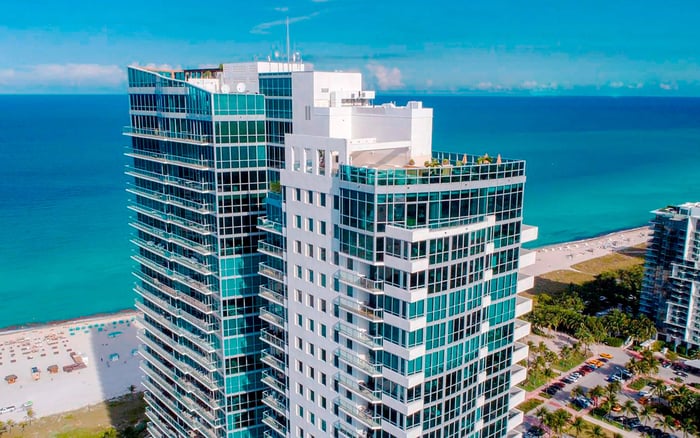
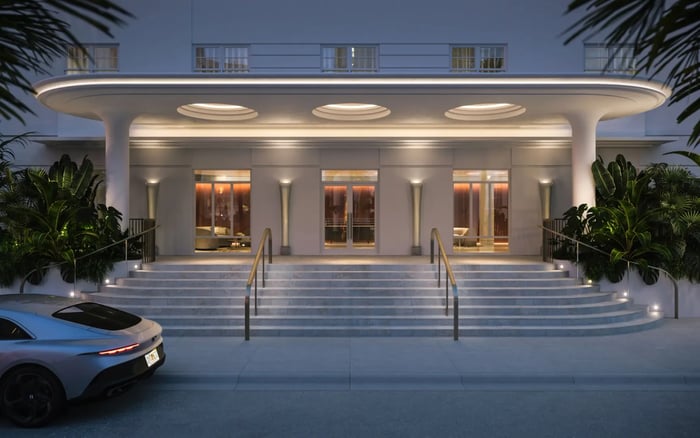
An editorial look at how Shore Club Private Collections Miami Beach positions oceanfront ownership around discretion, lower density, managed service, and lock-and-leave ease.

For a certain Miami Beach buyer, the most valuable square footage is not always the most visible. It is the residence that allows oceanfront living to feel composed, serviced, and quietly controlled. Shore Club Private Collections Miami Beach is framed for precisely that audience, positioning ownership around privacy, discretion, and reduced day-to-day property responsibility rather than spectacle.
That distinction matters in South Beach, where the oceanfront has long balanced residential prestige with public energy. The Shore Club name carries recognition from a historic hospitality setting, but the Private Collections concept shifts the emphasis away from a public-facing address and toward a more residential expression of luxury. The message is not simply that a buyer can live by the beach. It is that the beach can be enjoyed without inheriting the operational friction of a standalone coastal home.
In a Miami Beach search, the defining filters are not only oceanfront and beach access. For the ultra-premium buyer, they increasingly include anonymity, fewer daily handoffs, reliable service, and the ability to arrive to a residence that feels prepared. That is where Shore Club’s positioning becomes specific.
Oceanfront ownership can be seductive, but it is rarely effortless. Salt air, seasonal occupancy, staffing needs, vendor coordination, insurance sensitivity, security expectations, and the sheer exposure of coastal property all add complexity. Shore Club Private Collections answers that complexity with a managed model, making full-service operations central to the ownership proposition.
For part-time and absentee owners, this is more than convenience. It is confidence. The residence is intended to feel closer to a lock-and-leave home than a management-intensive beachfront estate. That framing is especially relevant for buyers who divide time among multiple residences and expect the Miami Beach home to be ready between stays, not waiting for oversight.
This also explains why the project’s value is not presented only through beachfront square footage. The ocean is the lifestyle asset, but the service platform is the mechanism that makes ownership workable. Resort-grade operations, integrated maintenance, staffing coordination, and property oversight are not decorative amenities in this context. They are part of the architecture of ease.
The phrase Private Collections is doing important work. It signals scarcity, limited access, and a more curated residential environment rather than the identity of a conventional high-volume condominium. The development is described around a limited collection of large-format residences, a structure that supports lower density and a more private ownership experience.
For privacy-minded buyers, density is not an abstract planning concept. It affects elevator encounters, service consistency, amenity pressure, valet rhythm, staffing familiarity, and the general tone of arrival. A lower-density building can feel more like a club than a vertical neighborhood, particularly when the service model is calibrated around residents rather than transient public use.
That club-like intimacy is central to the project’s message. On a high-profile Miami Beach site, privacy does not come from disappearing. It comes from controlling the environment around the owner: access, movement, service, and the number of people sharing the residential experience.
Shore Club’s positioning sits within a broader evolution of Miami Beach luxury. Buyers still want views, sand, terraces, and proximity to the water, but the leading edge of demand has become more exacting. The question is less “How close is it to the ocean?” and more “How quietly can I own it?”
That is why nearby and comparable Miami Beach conversations often include projects such as 57 Ocean Miami Beach and The Perigon Miami Beach. Each speaks to the importance of design, address, and coastal identity, yet Shore Club’s particular editorial angle is the transformation of a known hospitality name into a more private residential proposition.
The repositioning is meaningful because the Shore Club site has public memory. The redevelopment leverages that recognition, but the ownership story now points away from nightlife-driven hospitality and toward residential discretion. For buyers who value privacy, that pivot is not cosmetic. It is the difference between owning at an address people know and living in a setting that still protects the owner’s daily experience.
At the highest end of the market, maintenance is not merely a cost line. It is a lifestyle risk. A residence that requires constant intervention can become the opposite of luxury, especially when the owner is not local. Shore Club’s managed framework is designed to reduce that burden by making service, oversight, and care feel embedded in the property rather than externally assembled.
This is where the second-home buyer may find the proposition most persuasive. A beachfront residence should not require the owner to behave like a property manager. It should allow arrival, retreat, hosting, and departure with a sense of continuity. The stronger the operational platform, the less the owner has to translate personal standards into a new set of instructions every season.
The same logic explains why boutique scale has become powerful in ultra-premium coastal ownership. A smaller residential environment can support more personal recognition, quieter service touchpoints, and a greater sense that the building is being run around residents rather than volume.
A conventional condominium often sells the inventory story: views, floor plans, amenity menus, and price bands. Shore Club Private Collections is framed differently. Its strongest pitch is the combination of oceanfront access, controlled residential intimacy, and an ownership model that reduces maintenance anxiety.
That does not mean design prestige and views are secondary. They remain essential. But for the buyer who already has access to beautiful residences elsewhere, beauty alone may not be decisive. The differentiator is how ownership feels after closing: how easily the residence can be used, how discreetly the owner can move, how consistently the property can be cared for, and how little operational noise interferes with the purpose of being there.
In that sense, the project belongs in the same high-expectation Miami Beach conversation as Setai Residences Miami Beach and The Ritz-Carlton Residences® Miami Beach, where service, address, and residential polish are inseparable. Shore Club’s distinction is the way it reframes a familiar beachfront site around a more private future.
The essential idea is simple: Shore Club Private Collections Miami Beach is not only selling life on the sand. It is selling a more controlled way to own on the sand. For buyers who care about privacy and maintenance, that is the sharper luxury proposition.
The project’s appeal comes from aligning four priorities that rarely sit comfortably together: oceanfront lifestyle, limited residential density, full-service operations, and discretion. If those priorities matter more than public visibility or condominium scale, Shore Club’s framing becomes compelling.
For the right buyer, the question is not whether Miami Beach remains desirable. It is whether the ownership experience can be made quiet enough, serviced enough, and reliable enough to match the expectations of a global luxury portfolio.
Who is Shore Club Private Collections Miami Beach best suited for? It is framed for buyers who value privacy, discretion, oceanfront access, and reduced day-to-day property responsibility.
Is the project positioned like a traditional high-volume condominium? No. Its Private Collections identity emphasizes scarcity, exclusivity, and a limited collection of large-format residences.
Why does maintenance matter so much for this type of buyer? Oceanfront ownership can involve complex upkeep, staffing, and oversight, especially for part-time owners. A managed model helps reduce that burden.
Does the concept support lock-and-leave ownership? Yes. The ownership experience is designed to feel closer to a lock-and-leave residence than a management-heavy standalone beachfront home.
How does the Shore Club legacy affect the project? The redevelopment uses the Shore Club name recognition while shifting the experience toward private residential living.
What makes the privacy message credible? The positioning relies on limited resident density, controlled residential access, and a more intimate, club-like environment.
Is oceanfront access still central to the appeal? Yes. The oceanfront setting remains a core lifestyle asset, while the managed platform addresses the complexity of owning there.
Why might absentee owners consider this model? Full-service operations can help maintain the residence between stays, giving owners more confidence when they are away.
How should buyers compare Shore Club with other Miami Beach projects? Buyers should look beyond views and finishes, focusing on privacy, service reliability, density, and operational ease.
What is the best way to shortlist comparable options for touring? Start with location fit, delivery status, and daily lifestyle priorities, then compare stacks and elevations to validate views and privacy.
For a discreet conversation and a curated building-by-building shortlist, connect with MILLION.
If branded residences are on your mind — as a home or as an allocation — we would be glad to share what we are seeing, privately.
Begin a quiet conversation