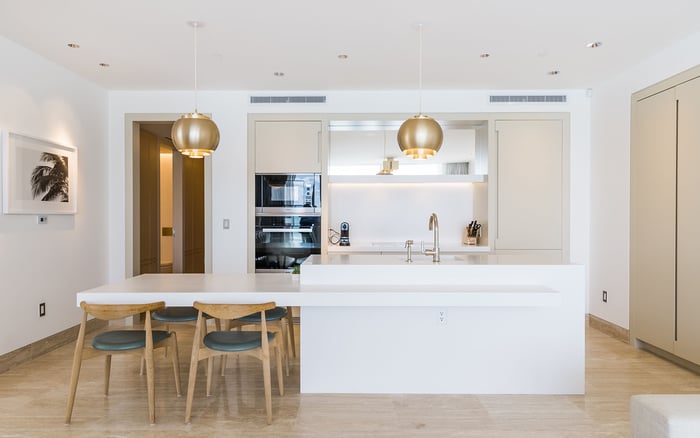
A buyer-focused guide to evaluating staff-ready service circulation in Fort Lauderdale residences, from service elevators and vendor access to privacy, storm readiness, and daily household flow.

For the ultra-premium buyer, staff-ready service circulation is not a secondary convenience. It is the quiet infrastructure that allows a residence to live elegantly under pressure. In Fort Lauderdale, where waterfront living, yachting schedules, entertaining, seasonal occupancy, and household staffing often converge, the question is not simply whether a home is beautiful. The question is whether the home can operate beautifully.
Service circulation refers to the routes used by staff, vendors, deliveries, maintenance teams, caterers, pet care providers, wellness professionals, and household managers. In a well-planned residence, those routes are separate, legible, secure, and discreet. In a compromised plan, they collide with the owner’s private arrival, guest entertaining spaces, principal bedroom corridors, or waterfront terraces.
This is why buyers comparing Fort Lauderdale Beach condominiums, Las Olas residences, and waterfront estates should evaluate operational flow as early as they evaluate views, finishes, and amenities. Even the most polished home can feel disorderly if every flower delivery, dog walker, chef, housekeeper, and contractor must pass through the same ceremonial entry.
Begin at the curb, porte cochère, marina edge, garage, or private elevator vestibule. Ask how the owner arrives, how guests arrive, and how service providers arrive. Those three paths do not always need to be fully separate, but they should never feel confused.
In a full-service condominium, the buyer should understand whether vendors check in at the front desk, a service desk, a loading area, or a managed back-of-house entry. In a private home, evaluate whether the staff entry is dignified and practical, not merely a side door that forces people through landscaping, pool equipment zones, or informal storage areas.
Residences such as Four Seasons Hotel & Private Residences Fort Lauderdale invite the same buyer discipline as any high-service address: do not stop at the lobby impression. Trace the everyday path of groceries, luggage, dry cleaning, flowers, catering, and maintenance from arrival to destination.
In vertical living, the elevator strategy is central. Buyers should ask whether there is a service elevator, how it is accessed, how it is scheduled, and whether it reaches the residential floor in a way that avoids the most private areas of the home. If the residence has a private elevator, clarify whether staff and vendors use the same elevator or a separate operational route.
The floor plan matters as much as the building plan. Once a delivery reaches the residence, where does it go? Ideally, service traffic should move toward the kitchen, pantry, laundry, staff room, storage, or utility zones without cutting across the living room, gallery, formal dining area, or primary suite approach.
A plan that looks expansive on paper can still fail operationally if every route narrows at a single corridor. During a showing, physically walk the path from the service point to the kitchen with the imagination of a caterer carrying trays, a housekeeper moving linens, or a technician bringing tools. Luxury is often revealed by what the eye does not have to see.
Staff-ready circulation depends on adjacency. A service entry that opens near the kitchen is useful. A service entry that opens near the kitchen, laundry, storage, utility areas, and staff bath is far better. The strongest residences allow household work to happen in a coherent back-of-house zone.
Look for a kitchen that can support both family life and professional assistance. A show kitchen may photograph beautifully, but buyers who entertain frequently should ask where prep happens, where catering equipment lands, how trash is removed, and whether staff can reset a dinner without crossing through seated guests.
At St. Regis® Residences Bahia Mar Fort Lauderdale, as with any marina-adjacent or resort-style residential environment, the buyer’s questions should extend beyond finish level. Ask how beach days, boat provisioning, guest arrivals, and catered evenings move through the building without diminishing privacy.
The most desirable Fort Lauderdale residences support two experiences at once: a serene owner experience and a highly functional service experience. The owner should feel ease. The staff should feel clarity. Guests should perceive neither friction nor logistics.
For buyers who entertain, this separation is essential. A chef should be able to work without becoming part of the cocktail hour. A housekeeper should be able to refresh a powder room or collect glassware without crossing the principal entertaining axis. A florist should have a sensible route from arrival to display areas. A valet or driver should not need improvised instructions every time the household hosts.
In new-construction purchases, request the most current floor plans and ask the sales team to identify service routes explicitly. Do not assume that a premium brand, waterfront location, or large square footage automatically means staff-ready planning. Some residences are spacious yet operationally thin. Others are more compact but exceptionally well choreographed.
Service circulation is also a security conversation. Buyers should ask who controls vendor access, how credentials are handled, whether service providers are logged, and where they wait if they arrive early. For private homes, consider gate protocol, camera placement, package areas, and how temporary workers access the property without being given unnecessary exposure to private rooms.
The best systems are not theatrical. They are calm, predictable, and easy for staff to follow. Complicated access rules often fail in real life. Clear pathways, controlled doors, and logical arrival points reduce the need for exceptions.
At Riva Residenze Fort Lauderdale, or any residence near the river and urban waterfront, buyers should think in layers: building entry, elevator access, residential threshold, internal service route, and secure storage. Each layer should reinforce the next.
Fort Lauderdale buyers should evaluate how a residence operates when conditions are less than perfect. During storm preparation, staff may need to move outdoor furniture, secure terraces, manage supplies, coordinate shutters or impact systems, and protect art, wine, equipment, and vehicles. A home with poor back-of-house flow can become chaotic precisely when calm matters most.
Seasonal ownership adds another dimension. If the residence is occupied part time, staff and property managers may need routine access for inspections, housekeeping, climate checks, deliveries, repairs, and pre-arrival preparation. The residence should allow this work without compromising the owner’s sense of privacy or requiring constant personal involvement.
The practical test is simple: if the owner is away, can the residence still be managed gracefully? If the owner is hosting, can the staff still work invisibly? If the weather changes quickly, can the household respond without disorder?
A beautiful floor plan should be read twice. First, read it as an owner: views, light, bedroom separation, terrace depth, entertaining sequence. Then read it as an operator: deliveries, trash, laundry, staff arrival, luggage, catering, pets, maintenance, emergency access, and storage.
This second reading often reveals the difference between luxury presentation and luxury performance. Buyers considering Sixth & Rio Fort Lauderdale, or any residence connected to the Las Olas lifestyle, should ask how urban convenience and daily logistics coexist. Walkability and waterfront proximity are valuable, but they do not replace a disciplined service plan.
A strong service circulation strategy should reduce improvisation. Staff should not need to ask which route to use each time. Vendors should not appear unexpectedly in private spaces. Deliveries should not stack at the formal entry. Trash should not travel through the entertaining core. When the plan solves these issues quietly, the residence feels more composed.
Before contract, ask direct, practical questions. Is there a service elevator or designated service route? Where do vendors enter and check in? How are deliveries handled? Can catering reach the kitchen without crossing the main living areas? Where are linens, supplies, luggage, and seasonal items stored? Is there a staff bath or staff-support area? How does trash leave the residence? How is access managed when the owner is away?
Then verify through movement. Walk the routes, not just the rooms. Open the doors. Stand where staff would stand. Imagine a busy Friday afternoon before guests arrive, a post-boating return with wet towels and provisions, or a storm-preparation day when multiple tasks happen at once.
In Fort Lauderdale, true luxury is not only a view across the water. It is the confidence that the residence can receive, serve, protect, and reset itself with discretion.
What is staff-ready service circulation? It is the planned movement of staff, vendors, deliveries, and household operations through a residence without disturbing owner and guest spaces.
Why does it matter in Fort Lauderdale luxury real estate? Fort Lauderdale living often combines waterfront use, entertaining, seasonal ownership, and household staffing, all of which require smooth operational flow.
Should every luxury condo have a service elevator? Not always, but buyers should understand the designated service route and whether it protects privacy, timing, and access control.
What is the biggest red flag in a floor plan? A single route that forces deliveries, staff, guests, and owners through the same formal spaces is usually a sign of weak circulation.
How should buyers evaluate vendor access? Ask where vendors enter, how they are logged, which elevator they use, and where they go once they reach the residence.
Does a large residence automatically have good service circulation? No. Size can help, but adjacency, separation, storage, and route clarity matter more than square footage alone.
What should seasonal owners prioritize? They should prioritize secure staff access, easy maintenance routes, storage, and a plan that supports inspections when the owner is away.
How does entertaining affect service circulation? Frequent entertaining requires catering routes, kitchen support, trash removal, and staff movement that do not interrupt the guest experience.
What should buyers ask about storm readiness? Ask how staff secure terraces, move outdoor items, manage supplies, and access utility areas during preparation and recovery.
When should service circulation be reviewed? Review it during the first serious tour, then again before contract with the floor plan, building access rules, and daily household routines in mind.
For a confidential assessment and a building-by-building shortlist, connect with MILLION.
If branded residences are on your mind — as a home or as an allocation — we would be glad to share what we are seeing, privately.
Begin a quiet conversation