A discreet buyer’s guide to judging private elevators, controlled arrival, service circulation, privacy, and long-term livability before purchasing in Edgewater.

In Edgewater, private elevators and controlled arrival are often presented as luxury markers. For a serious buyer, they should be evaluated less as amenities and more as operating systems. The question is not simply whether the residence has a private elevator. It is whether the entire path from curb to residence feels secure, intuitive, discreet, and gracious at once.
That distinction matters. A private elevator that opens into a residence can feel extraordinary when paired with thoughtful lobby choreography, clear access control, adequate staffing, elegant waiting areas, and a service plan that protects the privacy of daily life. Without those elements, the feature can become theatrical rather than truly useful.
This is especially relevant in Edgewater, where buyers often balance panoramic waterfront living, cultural proximity, and high-design new-construction options against the practical realities of vertical living. When comparing residences such as Aria Reserve Miami, EDITION Edgewater, Villa Miami, and The Cove Residences Edgewater, the arrival experience deserves the same scrutiny as views, finishes, and floor plans.
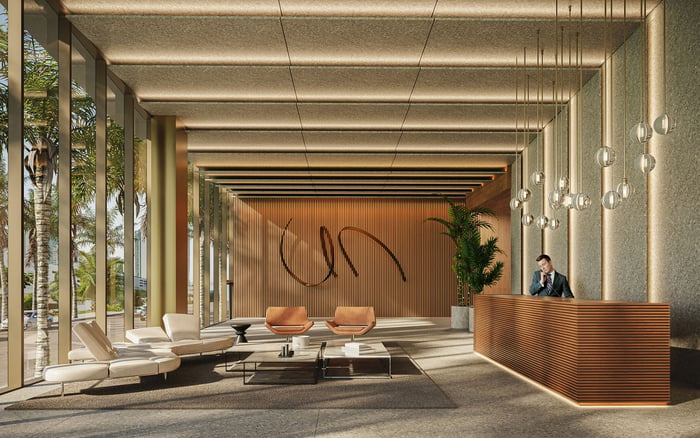
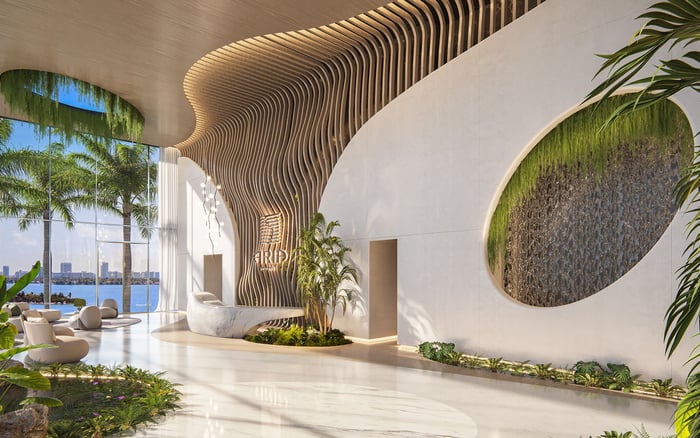
A controlled arrival begins before anyone reaches the elevator. Buyers should walk the sequence as if arriving on a normal evening, returning with luggage, and receiving dinner guests. The most refined buildings make these moments feel effortless. The porte cochere, valet interaction, lobby threshold, security point, elevator call, and private foyer should read as one continuous composition.
Ask where a guest pauses, who greets them, and how they are cleared to proceed. A controlled system should not feel cold or complicated. It should feel calm. If a visitor must guess where to stand, whom to speak with, or which elevator to use, the design has not fully succeeded.
The best approach is experiential: enter from every likely path, including valet, self-parking if applicable, rideshare, pedestrian access, and service entry. Luxury is revealed in repetition. A beautiful first impression matters, but a flawless fifth arrival matters more.
Private elevators are often marketed around exclusivity, but their true value is controlled visibility. A well-conceived system limits accidental encounters without making residents feel isolated. It should allow guests to be received elegantly, staff to circulate appropriately, and deliveries to be handled without turning the residence into a lobby extension.
The most important question is simple: who can arrive at your door, and under what conditions? Buyers should understand whether the elevator opens directly into the residence, into a private vestibule, or onto a semi-private landing. Each configuration can work beautifully, but each requires different expectations around access, monitoring, and etiquette.
Also consider sound. A private elevator foyer should not transfer every arrival into the living room. Door placement, sight lines, and acoustic separation can determine whether the feature feels cinematic or intrusive. In a waterfront home, the eye may be drawn immediately to the bay, but the arrival should still preserve a moment of transition.
The best controlled-arrival systems are not complicated for the people who use them daily. Buyers should ask how residents admit guests, how vendors are handled, how temporary access is granted, and what happens if a phone, fob, or app is unavailable. The experience should be secure, but it should not depend on a fragile chain of perfect behavior.
This is where a walkthrough with building personnel or the sales team becomes useful. Ask them to demonstrate the guest process in real time. How is the elevator called? Does the resident approve access remotely? Can a guest be sent directly to a private foyer, or must they be escorted? Is there a protocol for household staff, family members, and recurring service providers?
A buyer should also distinguish between privacy and friction. Excessive steps can make hosting feel burdensome. Too few steps can weaken the sense of control. The right solution is quiet precision, where everyone understands the process and no one feels processed.
Ultra-premium living depends on the invisible choreography behind the public spaces. Private elevators may create a beautiful owner arrival, but daily living also involves housekeepers, maintenance personnel, florists, caterers, pet care, personal trainers, and deliveries. Buyers should understand whether those movements pass through the same elevator bank, a service elevator, a separate corridor, or a managed receiving area.
This does not mean service must be hidden in an old-fashioned sense. It means circulation should be dignified, efficient, and respectful of the residence. If every delivery requires a workaround, the building may feel less convenient over time. If every service provider appears at the same threshold used for formal guests, privacy may feel less complete than the brochure suggests.
In Edgewater, where residences often emphasize open plans and dramatic views, the private foyer can become a critical buffer. It should function as a receiving room, not merely a landing. Look for space to pause, place a bag, greet a guest, or manage an arrival without pulling the entire household into the moment.
Buyers should ask practical questions with the same seriousness they bring to design. What happens when an elevator is out of service? How are residents notified? Is there an alternate route that preserves reasonable privacy? How are peak arrival times managed? Who has authority to override access in an emergency?
Private elevator systems are most impressive when they are resilient. A luxury building should have clear answers for repairs, inspections, guest overflow, move-ins, and emergency access. The point is not to anticipate inconvenience with anxiety. It is to ensure the building has already anticipated it with discipline.
Maintenance responsibility is equally important. Buyers should understand what is maintained by the association, what is managed by the building, and what obligations may attach to the residence itself. The more complex the arrival system, the more valuable clear governance becomes.
A private elevator can help define the emotional value of a residence, particularly for buyers who prize discretion. Yet its resale strength depends on how naturally it improves the home. If the elevator opens into a beautifully scaled foyer, separates public and private zones, and supports both entertaining and everyday arrival, it can become part of the residence’s identity.
If the system feels awkward, overly technical, or poorly integrated into the plan, buyers may discount it. The feature should enhance the architecture rather than compensate for it. In a market where design expectations are increasingly sophisticated, the arrival must be more than a line item.
For Edgewater buyers, the wisest evaluation pairs aspiration with discipline. Visit at different times if possible. Ask operational questions. Walk the service path. Consider how the home receives a dinner party, a family member, a delivery, and a quiet return after travel. The best controlled arrival is not loud about its intelligence. It simply makes privacy feel natural.
Is a private elevator always better than a semi-private elevator? Not always. A semi-private system can perform beautifully if access, staffing, and circulation are well managed.
What should I test during a private elevator tour? Walk the full path from curb to residence, then ask to see how guests, vendors, and deliveries are handled.
Does controlled arrival make hosting more difficult? It should not. A strong system protects privacy while allowing guests to arrive with clarity and ease.
Should the elevator open directly into the residence? Direct entry can be elegant, but many buyers prefer a private foyer that creates a gracious buffer.
What is the most overlooked issue with private elevators? Service circulation is often overlooked, yet it affects deliveries, staffing, maintenance, and daily comfort.
How important is building staffing? Very important. Even sophisticated access technology depends on attentive personnel and clear protocols.
Can private elevators affect resale value? They can support resale when they are well integrated into the floor plan and daily living experience.
What should buyers ask about elevator downtime? Ask about alternate access, resident notifications, repair procedures, and emergency protocols.
Is controlled arrival mainly about security? Security is central, but the best systems also improve discretion, hospitality, and the rhythm of daily life.
How should Edgewater buyers compare buildings? Compare the entire arrival experience, not just the elevator itself, and judge how it works on ordinary days.
For a discreet conversation and a curated building-by-building shortlist, connect with MILLION.
If branded residences are on your mind — as a home or as an allocation — we would be glad to share what we are seeing, privately.
Begin a quiet conversation