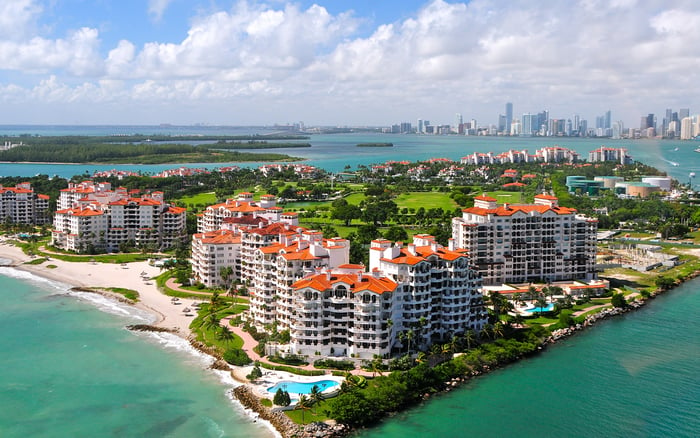
Golden Beach is one of South Florida’s rare municipalities designed to stay quiet: a barrier-island town with a residential-only charter, exceptionally limited single-family inventory, and controlled access that prioritizes privacy. For buyers weighing an oceanfront compound against a branded condo lifestyle nearby, the town’s appeal is less about amenities and more about governance, security, and enduring scarcity.
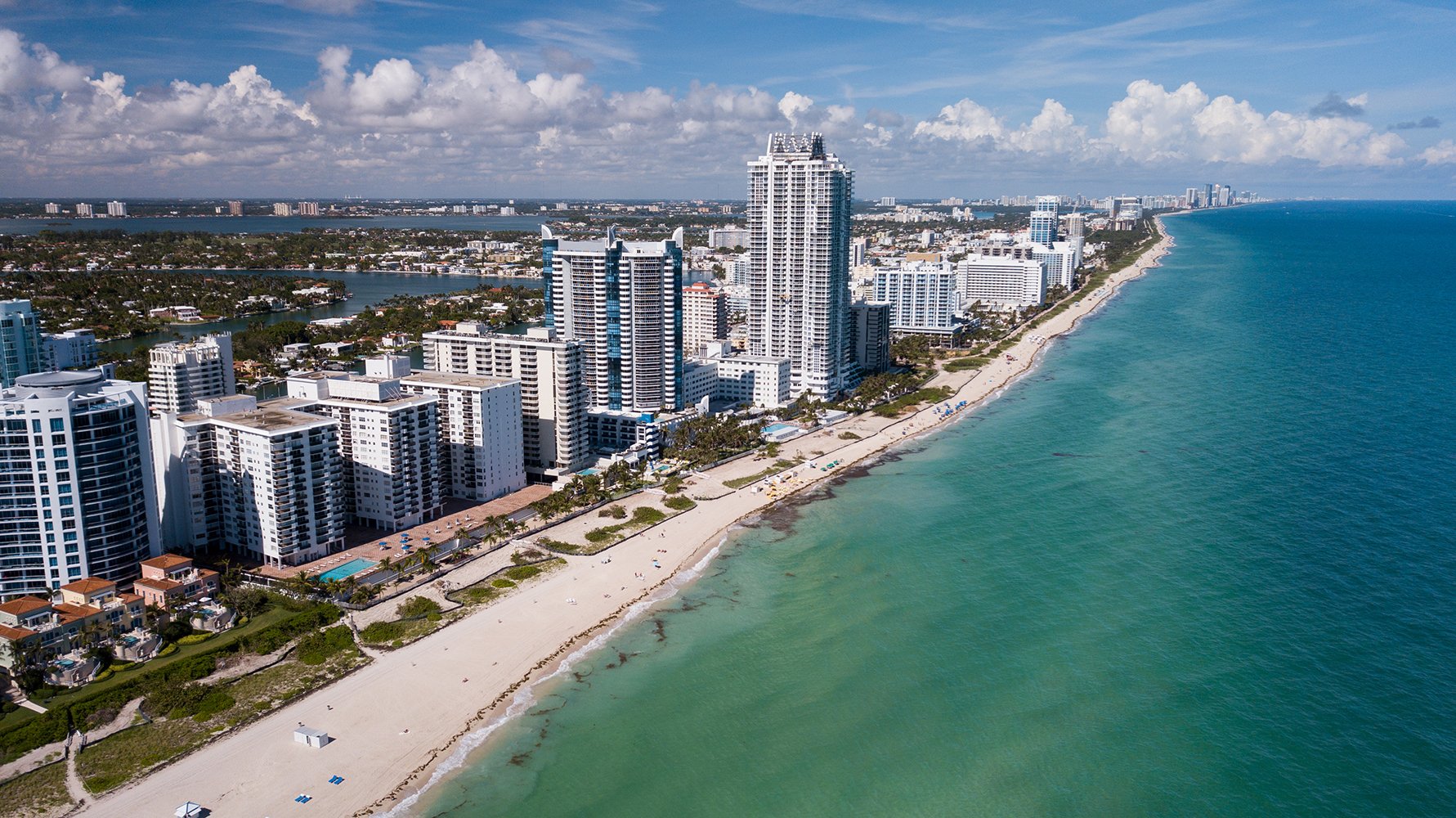
There are plenty of luxury addresses along the sand in Miami-Dade and Broward. Very few, however, operate as a true town whose core mission is to remain residential. Golden Beach, incorporated in 1929, occupies a narrow barrier island between the Atlantic Ocean and the Intracoastal Waterway. It sits between Sunny Isles Beach to the south and Hallandale Beach to the north, close enough for access to the wider South Florida lifestyle, yet intentionally buffered from its intensity.
Golden Beach’s distinction is not a single record-breaking sale, nor a fleeting architectural trend. It is governance. The town’s charter and zoning are structured to prohibit commercial development, a deliberate choice that keeps the streetscape focused on private residences rather than retail strips, nightlife, or hotel density. In a region where “quiet” can be seasonal or cyclical, zoning is a more durable form of luxury.
The physical scale reinforces the point. Golden Beach spans approximately 0.42 square miles in total area, and the 2020 Census reported a population of 961. At that size, the community reads less like a neighborhood and more like a tightly bounded enclave. It becomes an Exclusive-area by design, not by branding.
Golden Beach’s market begins with one fact that shapes everything else: scarcity. The town cites 364 single-family homes. That count matters because it is not simply low inventory in a given season, it is a structural cap that limits supply over time. In coastal South Florida, where new development often rebalances pricing and buyer options, a hard ceiling on housing stock changes the underwriting.
For buyers, the experience can feel binary. Either a home matches your criteria and timing, or it does not. There is no condo tower pipeline to widen choice sets. There are no mixed-use phases that gradually deliver new product. Golden Beach functions as a single-family-home market with a fixed number of seats.
Public market indicators help define the baseline before the conversation moves to trophy compounds. Redfin has reported a median sale price around $7.2 million, and Zillow’s Home Value Index has shown Golden Beach around $7.38 million. In most places, those would be outliers. Here, they serve as a practical shorthand for “typical” in a municipality where typical still sits firmly in the ultra-luxury tier.
This scarcity also reframes how buyers view condition. In submarkets with constant new construction, older properties compete against an ever-refreshing roster of modern alternatives. In Golden Beach, scarcity can keep the land component in the driver’s seat, even when a home is not newly built.
Luxury buyers often describe privacy in visual terms: mature hedging, long setbacks, discreet driveways, and private dock lines. Golden Beach adds a layer that is less visible and often more consequential: access control at the municipal level.
The town is known for limited entry points and restricted through-traffic, creating a gated effect without presenting as a conventional gated subdivision. For certain buyers, that distinction is meaningful. It feels civic rather than HOA-driven, and it can read as more enduring than rules set by a board whose priorities can shift year to year.
Golden Beach also operates its own police department. In an ultra-high-net-worth context, local control over public safety is more than a headline. It influences how owners think about staffing, travel schedules, and the practical reality of leaving a property dark for extended periods.
Beyond security, the town emphasizes resident-oriented amenities, including the Beach Pavilion area and parks and recreation offerings. These are not intended to rival Miami Beach’s cultural calendar. The point is a quiet daily rhythm and a predictable environment, two attributes that become harder to purchase as the region’s density expands.
In the terms buyers actually use, Golden Beach’s proposition sits at the intersection of Gated-community logic, Oceanfront geography, and the controlled permanence of a residential-only charter.
Golden Beach is sometimes spoken about as though it were a single price point. In practice, it is a range with a very high ceiling.
At the top end, public portals have shown asking prices that position the town alongside global trophy markets. A property associated with 105 to 115 Ocean Boulevard has been publicly listed at $68 million on major portals, and 387 Ocean Boulevard has been marketed at $49 million. These figures are not the market in its entirety. They are the market’s statement: oceanfront land in a municipality with a fixed home count can trade like a rare asset class.
The town also attracts alternative selling strategies that often appear in ultra-luxury segments. The 387 Ocean Boulevard property, for example, has been promoted through an auction-oriented marketing campaign. The intent is price discovery, a strategy that can make sense when the buyer pool is global, the product is difficult to comp, and the seller is testing the true depth of demand rather than anchoring to one number.
Celebrity and new-money narratives surface here as well, in part because the inventory is small and the address is easily recognizable. The sale of Tommy Hilfiger and Dee Ocleppo’s Golden Beach home to Grant Cardone for $24 million in 2021 was widely reported. Cardone later marketed the same property with a Bitcoin-denominated price, a reminder that today’s luxury market can include nontraditional wealth profiles and unconventional marketing.
These moments do not define Golden Beach. They do underscore how, in a town of 364 homes, any notable transaction can quickly become part of the local record.
Golden Beach’s barrier-island footprint creates two distinct lifestyles separated by a short distance.
On the Atlantic side, oceanfront living tends to prioritize direct beach access, sunrise exposure, and the status of being on the sand within a residential-only municipality. Here, pricing often reads as a function of frontage and rarity, not solely interior square footage. For buyers who value permanence, oceanfront in Golden Beach can feel like ownership of an increasingly finite shoreline.
On the Intracoastal side, the lifestyle is often more yacht-forward: water views, potential dockage, and daily proximity to boat traffic. The town remains low density either way, but the lived experience changes depending on whether your horizon is open ocean or the protected waterway.
Public listings illustrate how wide the pricing spectrum can be within the same municipality. A newer luxury listing example, 194 S Island Drive, has appeared around $29.95 million on public portals, pointing to the price band for contemporary waterfront builds. Meanwhile, other oceanfront listings such as 205 Ocean Boulevard have appeared with ultra-high asking prices relative to footprint, illustrating how prime positioning can produce extreme pricing.
For buyers, the practical work is identifying what you are actually paying for: frontage, privacy, architectural modernity, dockage, or the less tangible advantage of a street that rarely changes.
Golden Beach is often the right answer when the brief is strict: a true house, a true town, and minimal public programming. The appeal is the ability to live on the water with a high degree of control, without the daily exposure that comes with more active destinations.
Some buyers, however, want the opposite structure. They want service, operational predictability, and the ability to lock-and-leave without managing the complexity of a stand-alone estate. For those households, Miami Beach naturally enters the comparison set.
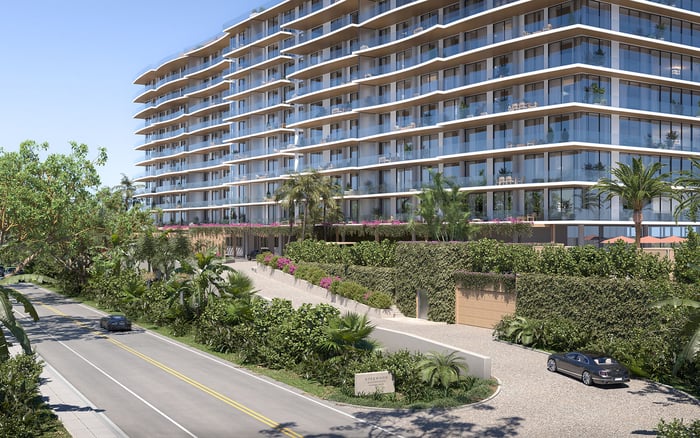
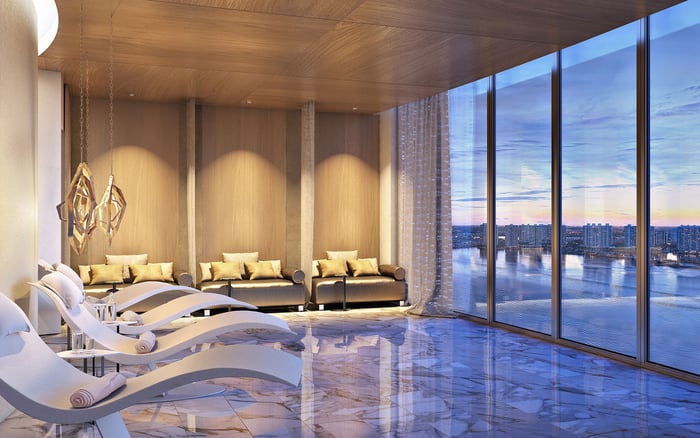
Branded and service-rich residences can deliver a different version of privacy: privacy inside a staffed envelope, with layered security and hotel-caliber operations. For multi-home owners and frequent travelers, that operational model can be the more rational luxury.
In the quieter north end of the island, 57 Ocean Miami Beach represents a beachfront, amenity-forward lifestyle that remains comparatively restrained by Miami Beach standards. For buyers who prefer a globally familiar hospitality context, Setai Residences Miami Beach offers a service-first framing that contrasts with the self-managed reality of single-family ownership.
Golden Beach and Miami Beach are less substitutes than two different answers to the same question: do you want privacy delivered through land, or through operations?
Golden Beach’s position between Sunny Isles Beach and Hallandale Beach is not just a map note. It is a lifestyle hedge.
Sunny Isles is known for vertical luxury, expansive ocean views, and a global buyer mix. Golden Beach, by comparison, is horizontally scaled and purposefully residential. For some households, that proximity is ideal. You can reach restaurants and services nearby, then return to a town that feels self-contained.
The contrast becomes a useful buyer tool. Choosing between a high-floor condominium with panoramic views and a private compound framed by palms and setbacks is not only a real estate decision, it is a decision about daily rhythm. Golden Beach’s rhythm is quieter, more controlled, and less dependent on the broader market’s development cycle.
For buyers who like the idea of access without immersion, this adjacency can be a differentiator: close to the region’s amenities, but buffered by governance and scale.
Golden Beach tends to appeal to buyers who underwrite risk through structure rather than headlines. Instead of asking, “What might be built next door,” they ask, “What is allowed to be built next door.” In a residential-only municipality, the answer is clearer, and the clarity itself becomes part of the value.
Sophisticated buyers also evaluate ownership culture. Data sources profiling the town have shown very high median household income and very high homeownership, consistent with an owner-occupied enclave rather than an investor-driven rental market. That profile often supports steadier neighborhood character and fewer abrupt shifts in how the community feels from one season to the next.
At the county level, the luxury market has become more stratified, with benchmarks that separate the “merely expensive” from the truly rare. Golden Beach sits in that rare tier because supply is finite and governance is aligned with preservation.
For buyers who still want a serviced footprint on the sand for part of the year, Miami Beach’s highest-caliber residential hospitality can complement a Golden Beach primary. The Ritz-Carlton Residences® Miami Beach and Casa Cipriani Miami Beach illustrate the other end of the privacy spectrum: staffed discretion and turnkey operations further south, versus municipal quiet north of Sunny Isles.
Some luxury locations become famous because they are loud. Golden Beach’s familiarity tends to be quieter, but it is real.
A small example is the cultural imprint of “461 Ocean Boulevard,” the Eric Clapton album titled after a residence associated with Golden Beach. It is not a tourism talking point. It is an artifact of how certain addresses enter the wider imagination through story rather than marketing.
In a town with 364 homes, stories accumulate quickly. A single notable transaction, an unusual marketing choice, or a cultural reference can become part of the place’s identity. That kind of recognition feels organic because it is not curated; it is simply what happens when scarcity and visibility intersect.
Golden Beach ultimately trades on a rare combination in South Florida: ocean-to-Intracoastal geography, a residential-only framework, and a scale that makes change feel slow. For the right buyer, that stability is the amenity.
Is Golden Beach actually residential-only? Golden Beach’s charter and zoning prohibit commercial development, reinforcing its single-family, residential-only character.
How small is Golden Beach compared with neighboring areas? It is roughly 0.42 square miles in total area and had 961 residents in the 2020 Census, which supports a low-density, enclave feel.
What does “controlled access” mean in practice? Golden Beach is known for limited entry points and restricted through-traffic, creating a gated effect that prioritizes resident privacy.
What is a realistic pricing baseline for Golden Beach? Public market indicators have placed medians and value indices in the $7 million range, while prime waterfront listings can be marketed far higher depending on frontage and positioning.
For private guidance on Golden Beach versus serviced beachfront living, connect with MILLION Luxury.
If branded residences are on your mind — as a home or as an allocation — we would be glad to share what we are seeing, privately.
Begin a quiet conversation