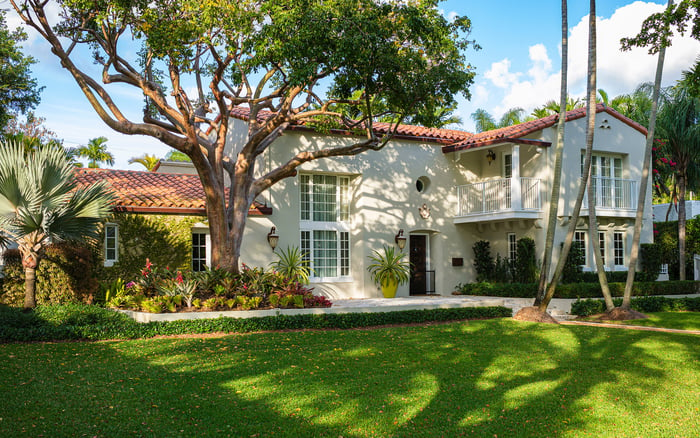
In South Florida, “best address” can mean two very different things. One is a private, guard-gated mainland enclave in Coral Gables where estate lots, governance, and year-round residency dominate the conversation. The other is a controlled-access island in Biscayne Bay, synonymous with celebrity lore and record-setting trophy trades. Gables Estates and Star Island each represent extreme scarcity, but they express it differently: one through a limited, community-like waterfront inventory, the other through a single causeway and a head-turning public narrative. Below, MILLION Luxury frames what the recent headline deals, home-value data, and neighborhood structure suggest for buyers who want discretion, security, and long-term positioning.
At the highest tier of South Florida residential real estate, value is rarely decided by finishes alone. The real premium concentrates around conditions that cannot be recreated at scale: true waterfront frontage, access that can be controlled, and neighborhood frameworks that preserve the character of an address over time. Gables Estates and Star Island sit in the same conversation because each compresses those advantages into a remarkably small inventory.
Recent coverage has reinforced that positioning from two different angles. Gables Estates in Coral Gables has been identified as the most expensive neighborhood in the U.S. using Zillow home-value data. That framing matters because it speaks to neighborhood-wide pricing power, not only a single trophy closing. Star Island, associated with Miami Beach, anchors its reputation with a different kind of signal: a publicly reported $120 million sale that set a Miami-Dade residential price record.
For buyers deciding where to concentrate both capital and lifestyle, the question that tends to matter most is not which enclave is louder in the press. It is which one aligns with your definition of privacy, your comfort with visibility, and your preference for a neighborhood that operates less like a subdivision and more like a curated community.
Both addresses offer scarcity. Both offer waterfront. Both offer gates. Yet the lived experience, and the market psychology surrounding each, diverge in ways that can shape everything from resale dynamics to how your home feels on an ordinary Tuesday.
Gables Estates is widely described as a private, guard-gated waterfront community in Coral Gables, and its finite scale is foundational to its appeal. It is often cited at roughly 179 homes or lots. For an ultra-luxury buyer, that number is not trivia; it sets expectations. Even at full build-out, it remains a small universe, and its supply constraint is structural rather than cyclical.
The neighborhood is also notable for the way it is governed. Buying in reportedly involves a club-style membership component, which signals a different posture than a standard HOA. In the top tier, this can be an advantage: it formalizes expectations, supports shared stewardship, and creates an additional layer of community screening that some buyers value as much as the waterfront itself.
Pricing benchmarks have been equally defining. A record Coral Gables and Gables Estates sale was reported at $55 million for 340 Leucadendra Drive. Separately, celebrity transactions have served as cultural markers that keep Coral Gables in the national luxury conversation. Realtor.com reported that The Weeknd bought a Coral Gables mansion at a price reported at $50 million (41 Arvida Parkway). These are best read as indicators of where top-end demand has been willing to transact, rather than as automatic comps for the next listing.
Coral Gables also brings its own established identity into the equation. The city is known for emphasizing cohesive aesthetics, with a Board of Architects and published Mediterranean design guidance that reinforce architecture as civic identity. Even in a single-family waterfront enclave, that context matters. It influences the streetscape, the long-term consistency of neighboring properties, and what tends to feel appropriate over time.
In practice, Gables Estates often appeals to buyers who want the benefits of a secured enclave without stepping outside the rhythms of a functioning residential city. It is a mainland pinnacle, but it is still anchored in Coral Gables, with its broader expectations around neighborhood character.
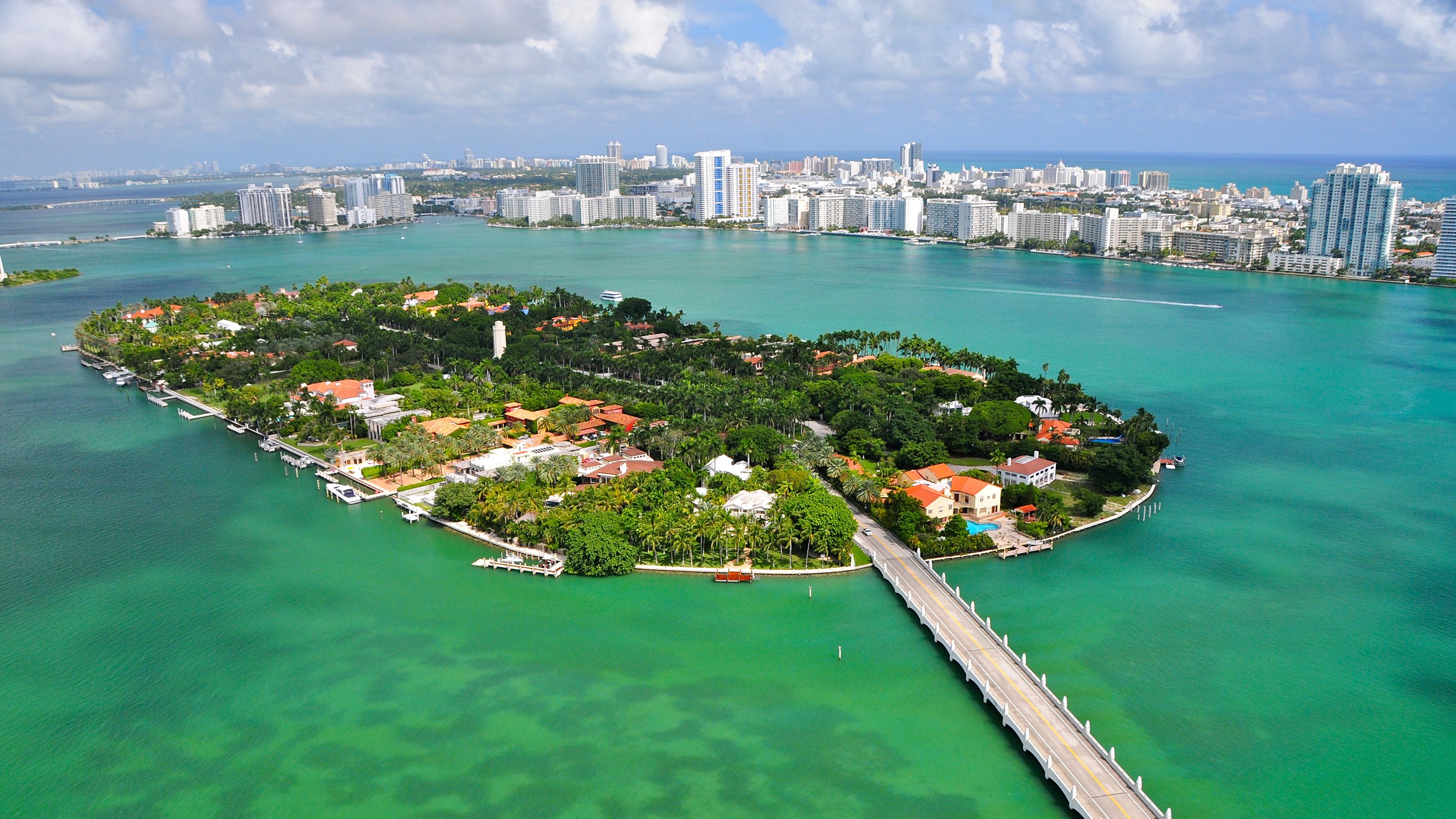
Star Island occupies a different psychological category in South Florida. It is a man-made island in Biscayne Bay tied to Miami Beach, created in the early 1920s. Its story is interwoven with Miami’s evolution: dredging-era ambition, a waterfront sense of spectacle, and an address that has long functioned as shorthand for status.
The first differentiator is scale. Star Island’s housing stock is commonly cited at roughly 30 homes or properties. When a neighborhood is measured in a few dozen parcels, each transaction becomes intensely idiosyncratic. Negotiations are shaped less by broad market patterns and more by the small set of buyer profiles willing and able to compete for a specific lot, view corridor, and orientation.
Access is the second differentiator. Star Island is gated and controlled-access, connected by a single causeway. That singular entrance can feel both more secure and more conspicuous. The infrastructure itself communicates a message: arriving here is a moment, and departure is too. For some owners, that heightened definition is part of the appeal.
Then there is the headline sale. A $120 million transaction on Star Island (26 Star Island Drive) was reported as setting a Miami-Dade residential price record. The same reporting identified Vladislav Doronin as seller and Michael Ferro Jr. as buyer. Beyond the numbers, the detail underscores the kind of participants this market can attract at the uppermost tier.
Star Island’s public-facing notoriety is unusual even for Miami. Its celebrity-home reputation is strong enough to support a boat-tour industry focused on viewing famous waterfront residences. Some buyers enjoy that aura and accept the visibility as part of the cachet. Others view it as a meaningful trade-off, especially if discretion is a primary objective rather than a secondary benefit.
A record-breaking closing and a neighborhood-wide value designation both carry weight, but they describe different kinds of market strength.
Star Island’s $120 million benchmark is a top-of-market signal. It indicates that, at least once in recent memory, the market was willing to pay an unprecedented price for a specific property on that island. That can elevate perception, influence seller expectations, and reinforce Star Island’s positioning as a trophy address with the capacity to reset local narratives.
Gables Estates being identified as the most expensive neighborhood in the country using Zillow home-value data suggests something more distributed. It points to broad strength across the enclave rather than reliance on a single outlier. For long-term holders, that distinction can matter because it implies a deeper price floor supported by many high-value homes, not just a headline that may be difficult to replicate.
Both enclaves also benefit from standardized neighborhood datasets and market pages that track trends and indicators, including pages maintained by Zillow and metrics tracked by Redfin for each area. Those tools are useful for context and directionality, particularly when comparing momentum across submarkets. The most sophisticated buyers, however, treat them as supporting material, not as appraisal substitutes. In a segment where properties are effectively one of one, the story is always in the specifics: frontage, dockage, setbacks, build quality, privacy lines, and the way a home presents from both street and water.
In other words, record pricing can define perception, while neighborhood-wide value can define resilience. Both are valuable, but they answer different questions.
From a distance, both addresses look like gated-community choices. Up close, the day-to-day experience can feel very different.
Gables Estates offers a mainland version of security. A private, guard-gated perimeter can deliver discretion without a constant reminder that you live in a place people watch. Because Coral Gables is a functioning residential city with schools, resources, and a strong family orientation, the enclave can align with buyers who want a primary-residence cadence. The lifestyle tends to read as established and residential rather than performative.
Star Island’s single-causeway access is more theatrical by design. It can reduce random through-traffic, but it also concentrates movement into one visible channel. Layer in the well-known boat-tour culture around celebrity homes, and privacy becomes something you actively manage. The gate matters, but so does the neighborhood’s public perception from the water.
For a buyer who prioritizes anonymity, the practical question is not simply “Is it gated?” It is “How does it feel to arrive and depart, and how does the address circulate in the public imagination?” In South Florida, that social layer can be as consequential as the physical infrastructure.
Luxury buyers often talk about style as taste. In these neighborhoods, style is also governance, context, and long-term identity.
Coral Gables is famously protective of its Mediterranean Revival character, and the city’s design guidance reinforces a cohesive visual language. That can be a feature if you prefer a legacy look and want surrounding streetscapes to remain harmonized over decades. Cohesion also tends to support a sense of continuity, which many traditional luxury buyers equate with stability.
Star Island leans more toward iconic individuality. The island’s identity is not a unified architectural thesis. Instead, it is a collection of statements, each competing for presence on the bay. That can be thrilling if you want your home to function as a landmark and you are comfortable with an address that carries a public narrative.
In both cases, architectural posture is tied to liquidity as much as beauty. Cohesive environments can support steady demand from buyers who want timelessness and predictability. Iconic environments can command extreme premiums, but they may also narrow the buyer pool to purchasers who want to participate in that story and accept the attention that comes with it.
These two addresses can both be “right,” depending on what you are optimizing for.
Gables Estates tends to suit buyers who want a grounded South Florida life: privacy without constant public attention, proximity to the established Coral Gables ecosystem, and a community structure that is reportedly more club-like than a standard HOA. If your ideal home is a long-hold residence that feels insulated from the volatility of fashion, the enclave’s finite inventory and neighborhood-wide value designation may read as a form of positioning.
It is also a fit for buyers who prefer that discretion feel natural rather than engineered. The gate is there, but the environment still reads as residential and routine, which can be an advantage if you are living full-time and want security without spectacle.
Star Island tends to suit buyers who understand the power of a globally recognizable address. Scarcity is extreme, the narrative is famous, and the top end can set records that reshape the market’s conversation. If your home is part residence, part asset, and part cultural symbol, Star Island’s visibility can be a feature rather than a drawback.
It is also well-suited to buyers who accept that trophy markets are inherently bespoke. Comparable sales can be limited. Negotiations can be more personality-driven. And the experience of owning can include a degree of public curiosity that is uncommon elsewhere, even within Miami.
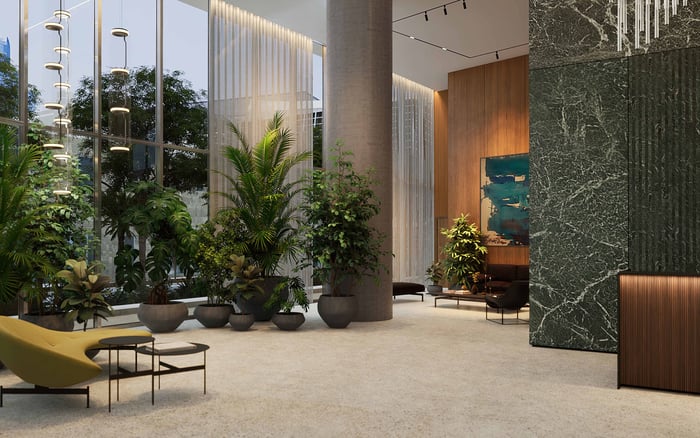
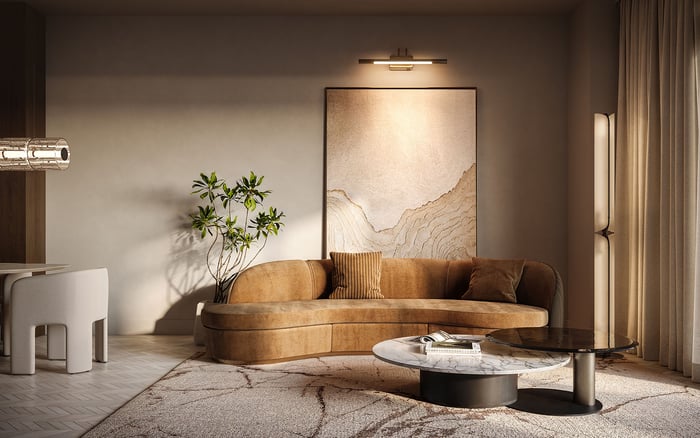
Not every ultra-premium buyer wants to operate a single-family waterfront compound, even at the highest level. For those who want Miami Beach positioning with a more lock-and-leave lifestyle, the most compelling alternatives tend to be service-rich, design-forward residences that deliver privacy through staffing, access control, and professional management.
In that lane, buyers often compare newer and boutique offerings that keep the experience residential rather than transient. A few examples that fit the conversation include Shore Club Private Collections Miami Beach for buyers drawn to a branded, amenity-driven lifestyle; Setai Residences Miami Beach for those who prize a globally legible hospitality standard; and The Ritz-Carlton Residences® Miami Beach for purchasers who want service culture as part of the value proposition. For a more intimate oceanfront posture in the broader Miami Beach market, 57 Ocean Miami Beach can be the right kind of modern counterpoint.
The strategic takeaway is simple. If you are buying for discretion, operational ease, and time efficiency, a meticulously run condominium residence can sometimes outperform an estate in lived luxury, even if the estate wins on land, frontage, and legacy narrative. The decision is less about status and more about how you want your days to run.
Is Gables Estates really the most expensive neighborhood in the U.S.? It has been identified as the most expensive neighborhood in the U.S. using Zillow home-value data as reported in national coverage, which speaks to broad neighborhood-level pricing strength.
How many homes are on Star Island and Gables Estates? Star Island is commonly cited at roughly 30 homes or properties, while Gables Estates is widely described at roughly 179 homes or lots, underscoring very different types of scarcity.
What are the headline record sales buyers reference today? A Star Island sale was reported at $120 million and described as a Miami-Dade residential price record. A Coral Gables and Gables Estates record sale was reported at $55 million, with additional widely covered high-profile purchases around the $50 million level.
Which is more private: a mainland gate or a single-causeway island? Both can be secure, but privacy is experienced differently. A mainland gated enclave can feel more discreet day-to-day, while a single-causeway island can be more visible and more narratively exposed from the water.
Work with MILLION Luxury to identify the South Florida address that best matches your definition of privacy, position, and permanence.
If branded residences are on your mind — as a home or as an allocation — we would be glad to share what we are seeing, privately.
Begin a quiet conversation