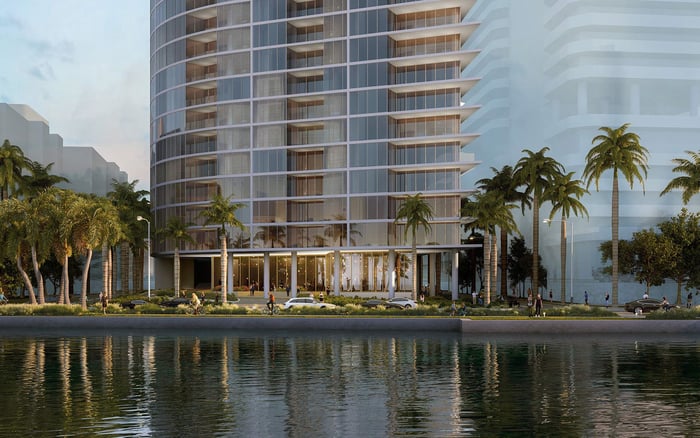
A discreet buyer-focused comparison of Forté on Flagler West Palm Beach and The Cove Residences Edgewater, emphasizing privacy, service culture, brand promise, staffing expectations, and household autonomy.

For South Florida’s most discerning condominium buyers, the decision is no longer simply waterfront versus skyline, Miami versus Palm Beach County, or amenity-rich versus quiet. The sharper question is operational: what kind of household does the building allow you to run?
That is the real distinction embedded in Forté on Flagler West Palm Beach and The Cove Residences Edgewater. The comparison is most useful when it stays focused on brand promise, staffing reality, governance, privacy, and day-to-day autonomy rather than relying on broad lifestyle labels.
For buyers weighing West Palm Beach and Edgewater, the point is not to declare one model universally superior. It is to identify which ownership environment best supports the way a household actually lives.
Forté on Flagler is best read through a residential lens. The relevant question is whether the building’s promise supports quiet control, personal routine, and an ownership experience that feels private rather than over-programmed.
For a buyer accustomed to private homes, staffed estates, or carefully managed seasonal routines, that distinction matters. A condominium can feel luxurious on paper while still asking owners to adapt too much to the rhythm of shared spaces. The stronger residential model works in the opposite direction: it lets the household remain the center of daily life.
That is why brand promise should be translated into practical ownership questions. Does the residence support real living? Are arrivals handled with discretion? Is service available without becoming intrusive? Are social and amenity spaces optional rather than unavoidable?
Luxury buyers often ask about service as if it can be measured only by the number of staff members or the length of an amenity menu. That is too blunt. The better question is whether the staffing culture reinforces the way the household wants to live.
A privacy-oriented service model is often felt in what it prevents: friction at arrival, unnecessary interaction, uncertainty around access, and the subtle loss of control that can occur when a building’s daily life becomes too visible. For some owners, the most valuable service is not constant attention; it is the quiet confidence that routines will be handled correctly.
This is where buyers comparing Forté on Flagler with The Cove Residences Edgewater should be precise. The issue is not whether one building sounds more glamorous. It is whether the service promise is supported by operating habits, access protocols, management culture, and rules that protect the resident’s sense of control.
Household autonomy is the ability to live according to one’s own rhythm. It includes when you entertain, how often you use common spaces, how visible your routine becomes, whether deliveries and guests are managed discreetly, and whether the building’s social culture feels optional rather than unavoidable.
Forté on Flagler may be especially relevant for buyers who prioritize a quieter residential experience over a heavily programmed hospitality environment. That is not a small preference. For some buyers, the most valuable amenity is the absence of pressure: no constant social calendar, no crowded arrival sequence, and no sense that private residential life has been absorbed into a club-like ecosystem.
The Cove Residences Edgewater should be evaluated through the same lens. Buyers should ask how the building’s daily life will feel on ordinary days, not only during a sales presentation. Does the residence allow a household to operate independently? Are services available without becoming intrusive? Are common spaces designed to enhance life without defining it?
The West Palm Beach side of the comparison speaks to buyers who may prefer a calmer residential posture, while Edgewater introduces a different urban condominium context. The relevant issue is not simply the neighborhood name. It is how each setting shapes privacy, arrival, service rhythm, resident interaction, and the owner’s ability to remain in control of daily life.
This is especially important for owners splitting time between residences. A second-home buyer may want the building to perform smoothly during arrivals and departures, while a primary resident may care more about daily quiet, staff continuity, and the ability to avoid unnecessary programming.
The right choice depends less on market buzz and more on household temperament. Buyers should decide which environment makes ordinary days easier, not only which one produces the most dramatic first impression.
Brand promise can be powerful, but only when it is legible in ownership. Buyers should translate every promise into a practical question. If a building promises privacy, how many homes share the key spaces? If it promises service, who coordinates it, and how consistently? If it promises design, does the residence itself support real living, or is the design mainly visible in common areas?
For Forté on Flagler, the disciplined approach is to examine whether the ownership experience supports privacy, individualized attention, and control over day-to-day household life. For The Cove Residences Edgewater, the same test should apply before drawing conclusions from branding, amenity language, or neighborhood energy.
A beautifully presented building can disappoint if its operating culture creates congestion, inconsistency, or too much dependence on shared programming. Conversely, a quieter residential model can be more persuasive when it protects the owner’s routine and reduces unnecessary friction.
For buyers at this level, the most revealing questions are rarely flashy. Ask how arrivals are handled at peak times. Ask how staff learn resident preferences. Ask whether the building culture encourages privacy or constant social overlap. Ask how guest access, deliveries, vendors, and household support are managed. Ask whether the residence itself reduces dependence on common spaces.
Also ask how rules and governance protect the daily experience. Service is not only what staff can do for an owner; it is how consistently the building prevents avoidable problems. The strongest ownership model is one where the household does not have to fight the building’s systems to live privately.
In the end, the comparison between Forté on Flagler West Palm Beach and The Cove Residences Edgewater should not be reduced to a simple winner. It is a question of alignment: which ownership model best protects privacy, supports service expectations, and preserves household autonomy?
What is the main ownership distinction in this comparison? The distinction is between two ownership models tested through privacy, service culture, governance, brand promise, and household autonomy.
Why does household autonomy matter in a luxury condominium? It determines whether owners can live according to their own routines without feeling absorbed into a building’s social or hospitality programming.
How should buyers evaluate service staffing? Buyers should look beyond headcount and examine whether staffing supports privacy, consistency, access control, and discreet daily operations.
Should brand promise decide the purchase on its own? No. Brand promise should be tested against governance, service execution, residence design, and the actual operating culture of the building.
What should buyers ask about arrivals and access? They should ask how arrivals, guests, vendors, deliveries, and peak-time movement are handled so the household can operate smoothly.
Why compare West Palm Beach and Edgewater through operations rather than image? Image can be persuasive, but daily ownership depends on privacy, service rhythm, resident interaction, and how the building functions on ordinary days.
What kind of buyer may prefer a quieter residential model? A buyer who values discretion, personal routine, and optional use of shared amenities may prefer a model that feels less socially programmed.
How can common spaces affect household autonomy? Common spaces can enhance daily life when they are optional, but they may reduce autonomy if owners feel dependent on them or constantly exposed to shared activity.
What is the most practical way to compare these two options? Compare how each model handles privacy, service expectations, governance, shared spaces, and the owner’s ability to control everyday life.
What is the best way to shortlist comparable options for touring? Start with location fit, delivery status, and daily lifestyle priorities, then compare stacks and elevations to validate views and privacy.
When you're ready to tour or underwrite the options, connect with MILLION.
If branded residences are on your mind — as a home or as an allocation — we would be glad to share what we are seeing, privately.
Begin a quiet conversation