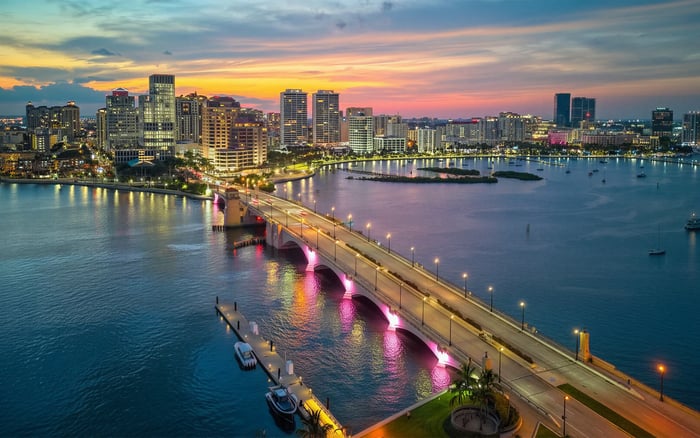
Fort Lauderdale and West Palm Beach share Florida’s core tax advantages, but they support different versions of daily South Florida life. Fort Lauderdale offers larger-city scale, aviation access, and a deeper marine economy, while West Palm Beach delivers a more intimate downtown tied closely to Palm Beach’s cultural and luxury orbit.

For a full-time South Florida buyer, Fort Lauderdale and West Palm Beach are not divided by tax climate or sunshine. They are divided by scale, logistics, daily rhythm, and the social and cultural orbit one wants to inhabit year-round.
Both cities share Florida’s lack of state personal income tax, a foundational reason affluent households establish primary residency here. Both also sit within a homestead framework where exemptions and property-tax protections can matter meaningfully for owners who make Florida their permanent home. Yet those benefits are administered locally, and that distinction matters. Fort Lauderdale is in Broward County. West Palm Beach is in Palm Beach County. Assessments, records, exemptions, and day-to-day property administration move through different county systems.
The better choice is not universal. Fort Lauderdale is the larger urban anchor, with more expansive aviation, marine, and downtown infrastructure. West Palm Beach is smaller, more curated in feel, and closely tied to Palm Beach’s luxury ecosystem. The practical answer depends less on peak-season weekends than on August mornings, school-year logistics, airport runs, flood diligence, and how often daily life must extend beyond the neighborhood.
Fort Lauderdale suits buyers who want a true city base without moving into Miami. Its larger population supports a broader urban platform, with a more active downtown-growth profile, established dining corridors, arts access, professional services, and a powerful marine identity.
Las Olas Boulevard remains one of the city’s defining lifestyle spines, combining dining, shopping, galleries, and nightlife in a format that serves residents as well as visitors. Downtown Fort Lauderdale has an urban-development focus, reinforcing the sense of a city still expanding its residential, office, hospitality, and cultural layers.
The city’s marine character is not cosmetic. Fort Lauderdale sits within one of South Florida’s major yachting and marine-services ecosystems, strengthened by proximity to Port Everglades and by a regional network of marine businesses. For owners who keep yachts, work in the marine economy, or simply want boating woven into daily life, Fort Lauderdale has a structural advantage.
Aviation is another major point. Fort Lauderdale-Hollywood International Airport gives the city a powerful commercial-airport advantage, while Fort Lauderdale Executive Airport adds business-aviation depth. For residents who travel frequently for work, family, or seasonal movement, that combination can reduce friction in ways that matter more than a brochure ever will.
West Palm Beach offers a different proposition. It is not trying to be Fort Lauderdale at a smaller scale. Its appeal is a more contained downtown experience, with waterfront access, dining, events, arts, and business activity organized around a defined urban district.
The Square functions as a central mixed-use anchor for retail, dining, entertainment, and residential activity. The Norton Museum of Art adds cultural weight, giving the city a serious arts institution that strengthens its year-round relevance beyond restaurants and waterfront walks.
The deeper advantage is adjacency. West Palm Beach gives full-time residents access to the Palm Beach orbit without requiring them to live across the bridge. That may appeal to buyers who want proximity to Palm Beach social life, private clubs, philanthropy, wealth management, cultural programming, and established luxury services while maintaining a more urban daily base.
Palm Beach International Airport serves the area, and for many West Palm Beach residents it is one of the city’s defining conveniences. The airport experience can feel more manageable than larger regional hubs, though route needs and travel patterns should be checked against each household’s schedule.
Both cities benefit from direct rail connectivity across South Florida and beyond, with service linking Fort Lauderdale and West Palm Beach to Miami, Boca Raton, and Orlando. That changes the calculus for owners who split meetings, family, or leisure among several Florida nodes.
Still, rail is only part of the picture. Full-time life depends on where one actually drives on school mornings, Friday evenings, hurricane-prep days, and during high season. Fort Lauderdale’s larger urban footprint can be advantageous for access, but it can also mean more congestion and more complex neighborhood-to-neighborhood movement. West Palm Beach may feel easier to understand, but trips involving Palm Beach, airport routes, school commutes, and seasonal traffic patterns should be tested at the actual times they will occur.
A buyer comparing the two should spend ordinary weekdays in both cities, not just a polished winter weekend. Dine out on a Tuesday, drive to the airport at rush hour, walk the downtown in the heat, and see how the city feels when no event is creating the energy.
For a practical buyer checklist, the labels are simple: Fort-lauderdale, West-palm-beach, Broward, Palm-beach, Downtown, and Marina. Those six lenses capture much of the real-world distinction between the two markets.
For families, the school question is central and must be handled at the address level. Fort Lauderdale public-school decisions fall within Broward County Public Schools. West Palm Beach public-school decisions fall within The School District of Palm Beach County. Attendance boundaries, magnet programs, private-school logistics, commute times, and extracurricular travel can alter the experience of a property dramatically.
Healthcare access should be evaluated with the same specificity. The most relevant question is not whether South Florida has medical infrastructure, but whether preferred physicians, hospitals, specialists, and wellness routines are convenient from the exact home under consideration. Full-time residency turns occasional inconvenience into weekly reality.
The family calendar also reveals differences. Fort Lauderdale may better support households with multiple work commutes, broader social circles, boating schedules, and frequent flights. West Palm Beach may better support households oriented around Palm Beach institutions, a more compact downtown, cultural programming, and a quieter daily pattern.
From a state-income-tax perspective, the two cities are on equal footing. The meaningful differences begin at the county and property level. Fort Lauderdale properties sit under Broward County administration for assessment records, exemptions, and valuation data. West Palm Beach properties sit under Palm Beach County administration.
For a primary-residence buyer, homestead planning should be part of the purchase timeline rather than an afterthought. The same is true for understanding assessed value, portability questions, exemption deadlines, and how a particular property’s history may affect future carrying costs.
This is where luxury buyers should be especially disciplined. A waterfront home, a newer condominium, and an older residence in an established neighborhood can carry very different insurance, tax, maintenance, and resilience profiles. The headline price is only one part of the annual ownership experience.
Both cities are low-lying South Florida coastal communities, so flood and sea-level-rise exposure belong at the center of due diligence. The right approach is property by property, not city by city. A home’s elevation, flood-zone status, drainage context, building systems, garage level, seawall condition, and insurance history can matter as much as the neighborhood name.
Fort Lauderdale’s extensive waterways and marine infrastructure create exceptional lifestyle value, but waterfront ownership requires technical scrutiny. West Palm Beach’s coastal and waterfront adjacency demands the same seriousness. Buyers should review flood maps, elevation information, insurance availability, and building resilience before falling in love with a view.
This is especially important for full-time residents, because storm season is not theoretical. It affects maintenance planning, travel decisions, generator strategy, landscaping, vehicle storage, and the comfort of remaining in place during disruptive weather.
Choose Fort Lauderdale if your life depends on aviation efficiency, marine access, a larger urban base, more varied neighborhoods, and a city that feels commercially and logistically expansive. It is the stronger choice for buyers who want South Florida energy without defaulting to Miami, and for those who see boating, business travel, and downtown momentum as everyday assets.
Choose West Palm Beach if you want a more intimate city with strong cultural anchors, a defined downtown, proximity to Palm Beach, and a slightly more composed daily rhythm. It is the stronger choice for buyers who value access to Palm Beach luxury while preferring to live in a mainland urban setting.
Neither city wins on glamour alone. Fort Lauderdale wins on scale and infrastructure. West Palm Beach wins on intimacy and Palm Beach adjacency. The best full-time choice is the one that still feels elegant in the off-season, efficient on a school morning, resilient in a storm cycle, and easy after the tenth airport run of the year.
Is Fort Lauderdale larger than West Palm Beach? Yes. Fort Lauderdale is the larger city by population, supporting its role as a bigger urban anchor.
Do both cities offer the same Florida income-tax advantage? Yes. Both benefit from Florida’s lack of state personal income tax for residents.
Are property taxes handled the same way in both cities? The state framework is shared, but Fort Lauderdale is administered in Broward County and West Palm Beach in Palm Beach County.
Which city is better for frequent flyers? Fort Lauderdale has a strong aviation advantage with both a major commercial airport and an executive airport.
Is West Palm Beach convenient for air travel? Yes. Palm Beach International Airport is the primary commercial airport serving the West Palm Beach and Palm Beach area.
Which city is stronger for yachting and marine services? Fort Lauderdale has the deeper marine identity, supported by a large regional yachting and marine-services ecosystem.
Which downtown feels more compact? West Palm Beach generally offers a more contained downtown experience, especially around its dining, events, arts, and waterfront core.
Do both cities have rail connectivity? Yes. Both are directly linked by rail to key Florida nodes including Miami, Boca Raton, and Orlando.
Should buyers compare flood risk citywide? No. Flood and elevation diligence should be performed property by property in both cities.
Which city is better for a full-time family? It depends on school boundaries, commute patterns, airport needs, healthcare access, and the exact neighborhood under consideration.
To compare the best-fit options with clarity, connect with MILLION.
If branded residences are on your mind — as a home or as an allocation — we would be glad to share what we are seeing, privately.
Begin a quiet conversation