A discreet guide for estate sellers using Formula 1 Miami as a lens for choosing the right South Florida base, with emphasis on access, privacy, service, storage, and daily lifestyle fit.

For a buyer leaving a large estate, Formula 1 Miami is less a glamorous weekend than a revealing stress test. It compresses the questions that matter all year: how easily can you arrive, host, retreat, recover, and move through South Florida without turning the residence into another property to manage?
Large estates reward scale. They deliver privacy through acreage, guest capacity through square footage, and control through distance. A South Florida base asks for a different expression of luxury. The right choice may be vertical, serviced, waterfront, club-adjacent, or quietly residential, but it should replace the burdens of estate living with choreography. Arrival sequences should feel natural. Staff protocols should be clear. Parking and car logistics should be realistic. Interiors should live well before and after the spectacle.
The F1 buyer is often balancing two impulses. One is proximity to energy, restaurants, hotels, private events, and late reservations. The other is the desire to close the door and feel entirely removed. The smartest purchase does not simply choose between them. It defines which moments require access and which moments require insulation.
Before choosing a South Florida base, estate sellers should make a candid inventory of what their current property does for them. Not what it costs, but what it quietly solves. Does the estate absorb visiting family? Does it house multiple vehicles? Does it allow dogs to move freely? Does it support live-in or daily staff? Does it provide privacy without building protocols?
Those answers shape the search more than a floor plan alone. A buyer coming from a compound may need a residence with a serious service backbone, not just beautiful finishes. Elevators, receiving, valet flow, guest arrival, package handling, maintenance response, and hurricane-season preparation all matter. So do the quieter practicalities: storage, owner closets, secondary refrigeration, laundry capacity, acoustic separation, pet routes, and where drivers wait.
A base for race week must also work on an ordinary Tuesday. If the home performs only during social peaks, it risks becoming an expensive hotel suite. If it functions only as a sanctuary, it may frustrate the owner when South Florida’s cultural calendar accelerates.
For this discussion, use the buyer shorthand carefully: Brickell for immediacy, Miami Beach for resort texture, Coconut Grove for softer privacy, Fort Lauderdale for a calmer northern axis, and second home as the ownership pattern rather than a lesser residence. Each can be correct, but each asks for a different tolerance for motion.
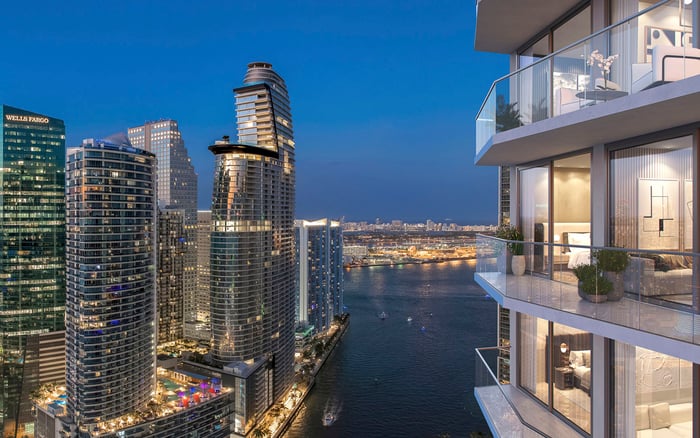
Brickell suits the buyer who wants a metropolitan base with dining, business, waterfront views, and a more urban cadence. A residence such as St. Regis® Residences Brickell belongs in the conversation for buyers who want a branded residential environment in the center of that energy, especially when lock-and-leave simplicity is part of the brief.
Miami Beach speaks to a different instinct. It is about the mix of sand, hospitality, architecture, wellness routines, and evening life. Buyers evaluating The Ritz-Carlton Residences® Miami Beach are usually not trying to replicate an estate. They are choosing a serviced coastal base where the day can move from privacy to social ease without feeling improvised.
Coconut Grove often appeals to estate sellers who are not ready to surrender greenery, neighborhood texture, and a more residential pace. Vita at Grove Isle can be part of that consideration for buyers who want a quieter Miami setting while remaining connected to the broader South Florida circuit.
Fort Lauderdale has its own logic for those who want boating culture, a less compressed rhythm, and access to Broward as part of the daily map. Four Seasons Hotel & Private Residences Fort Lauderdale gives that buyer a hospitality-forward lens on the coastline without forcing the decision into Miami alone.
Estate buyers often assume privacy is measured in gates, hedges, and distance from neighbors. In a vertical or serviced residence, privacy is more operational. It is defined by how arrivals are handled, how clearly public and private areas are separated, how discreetly staff functions, how guest access is controlled, and whether the owner can host without turning home life into a lobby experience.
Ask how the residence behaves when the calendar is loud. Can guests arrive without confusion? Can a driver, chef, assistant, trainer, or security professional work around the home without disrupting the owner? Is the elevator sequence intuitive? Can a family member come and go without passing through a social gauntlet?
For buyers leaving estates, the mistake is assuming that privacy must decline. It may simply change form. A well-run building or boutique waterfront residence can reduce exposure by eliminating the operational sprawl of a large property. The key is to evaluate the systems behind the beauty.
Formula 1 Miami makes access feel urgent. Buyers think about airports, reserved tables, marina plans, private dinners, and how long it takes to cross the region at peak moments. But the more refined question is what happens after access. Where do you decompress? Where does the household reset? Does the residence support quiet mornings, wellness routines, work calls, and family meals?
A balcony is not just an amenity when leaving a large estate. It may become the substitute for a garden, a morning room, or the place to step away from guests. A marina may matter for a buyer whose South Florida life is built around the water. Golf may matter not because it fills the calendar, but because it anchors a club rhythm and a social circle beyond major-event weekends.
The most successful buyers separate event access from everyday restoration. They may choose a base near the action, but only if the home has enough serenity to make ownership feel restorative. They may choose a quieter enclave, but only if the friction of movement does not make every dinner feel like a campaign.
A serious South Florida search should include a service audit. This is where the buyer tests whether the residence can absorb the habits of estate living without the acreage.
Begin with cars. How many vehicles are truly used, and how many are identity objects? Where will they live? How easy is it to retrieve one at short notice? Then consider staff. Does the residence support recurring service providers, private chefs, assistants, pet care, trainers, and stylists without awkward circulation?
Next, study entertaining. A large estate can forgive poor planning because it has rooms to spare. A condominium or serviced residence requires sharper intention. Where do coats go? Where does catering stage? Can overnight guests feel independent? Can the owner host a small dinner without making the entire home feel exposed?
Finally, examine storage. Estate owners often underestimate how much life is held in garages, attics, service rooms, and secondary structures. Art crates, luggage, seasonal wardrobes, sports equipment, pet supplies, wine, tableware, and children’s belongings need a new plan. The right base is not necessarily the largest one. It is the one that knows where everything belongs.
The buyer leaving a large estate should name the mission of the South Florida property before falling in love with a view. Is this the principal residence, a seasonal base, a race-week and winter entertaining platform, a family gathering point, or a lock-and-leave pied-à-terre with exceptional service?
That answer should guide the building type, location, staff model, and budget allocation. A true home needs daily comfort and personal storage. A social base needs arrival clarity and entertaining infrastructure. A wellness base needs quiet, light, outdoor space, and easy routines. A boating or club base needs geographic alignment more than headline prestige.
Formula 1 Miami simply reveals the stakes. The best South Florida base lets the owner participate in the region’s most visible moments without being consumed by them. It should feel composed during peak demand and equally persuasive when the calendar goes quiet.
Should Formula 1 Miami influence where I buy in South Florida? It can be a useful lens, but it should not be the only reason to choose a base. Use it to test access, privacy, entertaining, and recovery.
Is Brickell the best choice for race-week convenience? Brickell is compelling for buyers who want an urban, service-rich environment. The tradeoff is accepting a more metropolitan rhythm.
Should a former estate owner avoid condominium living? Not necessarily. A well-run residence can replace acreage with service, security, and ease if the operational details fit your lifestyle.
What is the biggest adjustment after leaving a large estate? Storage and circulation are often the biggest surprises. Buyers should plan for cars, luggage, staff access, pets, and guest flow early.
Is Miami Beach better for a social buyer? Miami Beach can suit buyers who value resort energy, dining, wellness, and coastal routines. The right building should still provide retreat.
Why consider Coconut Grove instead of a more central location? Coconut Grove may appeal to buyers who want a softer residential feel while staying connected to Miami’s broader cultural and social map.
Does Fort Lauderdale make sense for a Miami-focused buyer? It can, especially for buyers who prefer a calmer coastal rhythm or have Broward, boating, or northern-county priorities.
How important is a branded residence for this type of buyer? Branding can matter when it translates into reliable service and management. The experience behind the name is more important than the name alone.
Should I prioritize views or building operations? Views create desire, but operations create long-term satisfaction. Former estate owners should evaluate both with equal discipline.
What should I do before touring properties? Define the mission of the base, your service needs, your guest patterns, and your tolerance for activity. That clarity makes the search sharper.
For a tailored shortlist and next-step guidance, connect with MILLION.
If branded residences are on your mind — as a home or as an allocation — we would be glad to share what we are seeing, privately.
Begin a quiet conversation