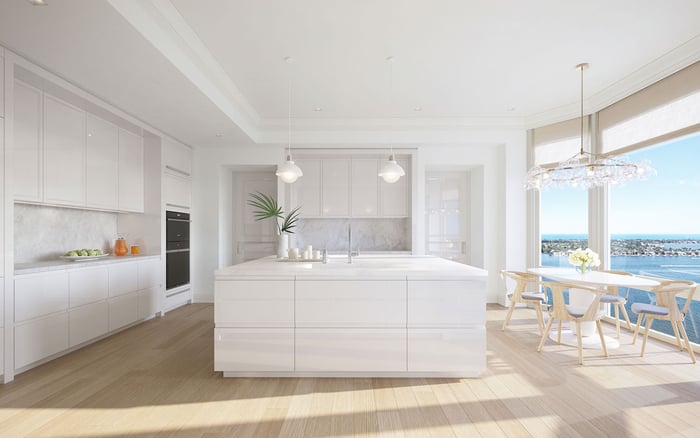
At Fendi Château Residences Surfside, laundry-room placement becomes a refined test of whether an ultra-luxury floor plan truly supports privacy, staff circulation, family routines, and long-term resale perception.

At Fendi Château Residences Surfside, first impressions are designed to register immediately: branded design, exclusivity, beachfront living, and the calm authority of a residence shaped for the Surfside and Bal Harbour oceanfront corridor. Yet for a discerning 2026 buyer, the most revealing part of a showing may not be the view, the public rooms, or even the terrace. It may be the laundry room.
That sounds deliberately unglamorous, which is precisely the point. In an ultra-luxury condominium, a laundry room is not merely a utility space. It is a daily operating node that influences staff workflow, family routines, housekeeping privacy, acoustic comfort, humidity control, storage discipline, and the way a residence feels after the first weekend of ownership. Fendi Château Residences Surfside belongs to a category where buyers are not evaluating standard condominium functionality. They are evaluating whether a private residence can perform like a large-scale home in a vertical, oceanfront setting.
For MILLION readers, the question is not whether the laundry room is attractive. It is whether its placement supports the lifestyle that the architecture, brand, and location promise.
Branded residences sell a complete experience. At Fendi Château, that experience is framed by design identity, exclusivity, and beachfront living. The stronger the front-of-house promise, the less tolerance buyers have for friction behind the scenes. If service spaces interrupt the primary suite, expose housekeeping movement to guests, or push daily clutter into public circulation, the plan begins to feel less resolved.
The Surfside buyer is often sophisticated, seasonal, international, or accustomed to multiple high-end homes. That buyer understands that beauty alone does not solve living. A residence may have generous entertaining areas and compelling indoor-outdoor flow, yet still feel compromised if laundry runs through the wrong corridor or sits too close to quiet sleeping zones. This is especially relevant in the Bal Harbour and Surfside corridor, where comparable expectations are shaped by buildings such as Arte Surfside, The Surf Club Four Seasons Surfside, Oceana Bal Harbour, and St. Regis Bal Harbour.
In this tier, support zones are part of the luxury product. Laundry rooms, staff areas, service entries, and storage do not need to dominate the plan, but they must be positioned with intelligence.
A practical buyer test begins with one question: is the laundry room close enough to the bedrooms for convenience, but separated enough from primary living and sleeping areas to avoid noise, visual clutter, and service overlap?
Proximity matters. A laundry room placed too far from bedrooms can create unnecessary movement across the residence, especially for families, long stays, and owners who host guests. But closeness without separation can become a liability. Washers, dryers, folding, steaming, hampers, linens, and staff activity should not feel present in the primary suite or visible from the entertaining areas.
A well-considered placement protects both sides of the lifestyle. It allows housekeeping to operate efficiently while preserving serenity where the owner sleeps, dresses, hosts, and retreats. The best plans do not make the resident choose between convenience and privacy. They allow both.
In a residence positioned around exclusivity, privacy is not limited to elevators and entry sequences. It extends to what guests do not see and what residents do not hear. Laundry placement should be reviewed for acoustic separation from bedrooms, media areas, and formal living spaces. It should also be considered in relation to staff circulation. If housekeeping must repeatedly cross the primary entertaining path, the home may feel less composed in actual use.
Humidity control is another quiet but important factor. In South Florida, service rooms must be judged not only for convenience, but also for how they relate to ventilation, adjacent storage, linens, closets, and finishes. Buyers do not need to become engineers during a showing, but they should ask how the support space behaves when the residence is fully occupied, towels are moving from beach to bath, and the home is being prepared for dinner guests.
This is where floor-plan efficiency becomes experiential. A laundry room can appear minor on paper, yet influence the rhythm of the entire residence.
Resale is often discussed through views, brand, building stature, and scarcity. Those remain central. But in the ultra-premium segment, a buyer walking through a residence will also sense whether the plan has operational maturity. Poorly located support zones can weaken the impression created by refined finishes, expansive rooms, and beachfront outlooks.
The reason is simple: luxury buyers are not only buying the visible rooms. They are buying the absence of inconvenience. A laundry room that supports staff access, protects public spaces, and keeps family routines discreet can become a subtle advantage. It may not headline a listing, but it can influence how confidently a buyer understands the home.
For Fendi Château, the evaluation is especially relevant because the residence is framed around flow, terraces, and indoor-outdoor living. If the plan celebrates openness, service placement must prevent that openness from becoming exposed to daily operations.
Do not rush the service areas. Walk the route from the primary bedroom to the laundry room. Then walk it from secondary bedrooms, guest areas, the kitchen, service entry, and main entertaining space. Notice whether laundry movement feels natural or forced. Ask where hampers, linens, ironing, folding, beach towels, and household supplies would live.
Listen for potential sound adjacency. Consider whether a late-evening wash cycle would disturb bedrooms or whether morning housekeeping would intersect with guests. Look for separation between clean storage and damp items. Consider whether the laundry room supports a household with staff, visiting family, and seasonal turnover.
The most valuable question may be emotional: does the service plan make the home feel calmer? If the answer is yes, the design is working. If the answer is no, even an exceptional view may not fully compensate.
Fendi Château Residences Surfside illustrates a larger shift in new-construction luxury evaluation. Buyers are increasingly sophisticated about how residences live, not just how they photograph. They are attentive to oceanfront presence, brand alignment, terrace experience, and the invisible logic of service circulation.
Laundry-room placement is not a small detail when the home is expected to function at a private-estate level. It is a discipline test. It reveals whether the plan supports family life, staff movement, guest privacy, and long-term ownership with the discretion that true luxury requires.
Why does laundry-room placement matter at Fendi Château Residences Surfside? It affects everyday convenience, staff workflow, privacy, and how efficiently the residence functions beyond its presentation spaces.
Should the laundry room be near the bedrooms? Ideally, it should be close enough for practical use while separated enough to avoid noise, clutter, and service activity near sleeping areas.
What is the biggest mistake buyers should watch for? A laundry room that forces housekeeping or family routines through formal living areas can weaken the overall floor-plan experience.
Does laundry placement affect resale? It can influence buyer perception because well-planned support spaces make a luxury residence feel more complete and easier to own.
How should seasonal residents evaluate the laundry room? They should test whether the space supports arrivals, departures, guest stays, beach towels, linens, and staff preparation without disrupting the main residence.
Is acoustic separation important? Yes. Laundry equipment and service movement should be buffered from bedrooms, media rooms, and quiet private spaces whenever possible.
Why is humidity control part of the test? In South Florida, damp towels, linens, and service storage need thoughtful placement so the residence remains fresh and orderly.
How does staff circulation relate to laundry placement? The best layouts allow housekeeping to work efficiently without crossing primary entertaining zones or compromising owner privacy.
What should buyers compare in the Surfside market? They should compare how service spaces support the lifestyle promised by each luxury building, including privacy, flow, and daily convenience.
Is this only a functional issue? No. In ultra-luxury residences, function becomes part of the aesthetic experience because calm living depends on invisible efficiency.
For a discreet conversation and a curated building-by-building shortlist, connect with MILLION.
If branded residences are on your mind — as a home or as an allocation — we would be glad to share what we are seeing, privately.
Begin a quiet conversation