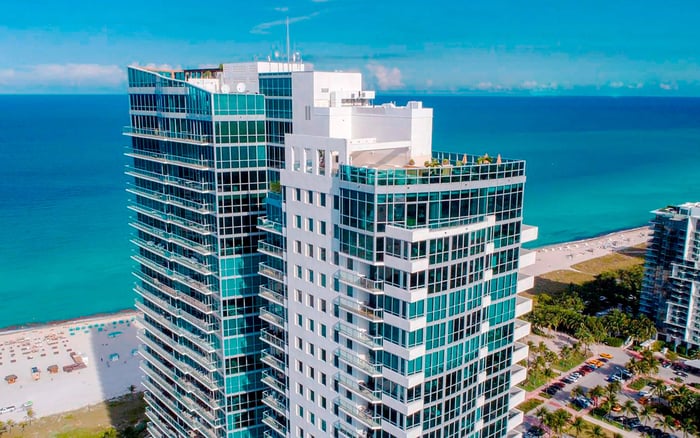
Setai Residences Miami Beach presents a pet policy that is best understood as selective rather than unusually severe. Its 50-pound weight ceiling sits above many Miami Beach luxury-condo norms, yet the building balances that relative flexibility with breed screening, behavioral review, insurance requirements, amenity restrictions, and meaningful penalties for non-compliance. For buyers in the luxury tier, the practical takeaway is clear: Setai is more accommodating on size than many peers, but far from casual in administration.

For pet owners considering Setai Residences Miami Beach, the central question is not whether the building allows pets. It does. The more useful question is whether the policy feels unusually strict within the upper tier of Miami Beach condominium living.
On balance, the answer is no, at least not on weight. Setai permits pets up to 50 pounds, allows a maximum of two pets per unit, and may consider exceptions with developer approval. In a market where many luxury buildings cluster closer to a 25- to 35-pound ceiling, that 50-pound threshold reads as relatively generous.
Where the policy becomes more exacting is not in the headline number, but in the structure around it. Breed restrictions, behavioral review, veterinary references for dogs, a separate Pet Occupancy Addendum, proof of liability insurance, designated relief areas, and fines for violations create a framework that is polished, controlled, and unmistakably serious. Taken together, those elements make Setai moderately permissive on size, but disciplined in administration.
In luxury condominiums, pet policy often functions as a quiet filter on lifestyle. A 20-pound or 25-pound cap effectively favors toy and small companion breeds. A 50-pound cap broadens the field materially, giving owners of mid-sized dogs a more realistic path to approval.
That distinction matters in Miami Beach, where many buyers expect their home to support a fuller version of personal life rather than a narrowly managed pied-à-terre experience. At Setai, the disclosed limit suggests a willingness to accommodate owners who are serious about residence use, not just occasional occupancy.
This is one reason the policy compares favorably with nearby luxury inventory. In conversations around oceanfront living, buyers often assume the most prestigious buildings are automatically the most restrictive. Yet a lower-than-expected weight ceiling can make a branded or design-forward address less practical for a pet household than anticipated. For comparison, buyers evaluating other waterfront lifestyle options such as 57 Ocean Miami Beach or The Perigon Miami Beach should pay close attention not just to whether pets are permitted, but to where the size threshold actually falls.
If weight alone were the measure, Setai would read as notably accommodating. But luxury buildings rarely evaluate pet ownership on size alone, and Setai is no exception.
The building maintains a prohibited breed list tied to liability underwriting, with standards referenced in its architectural and building documentation. New residents with dogs must also provide veterinary references and behavioral documentation for discretionary review before final approval. That means buyers are not simply checking a box on an application. They are entering a review process in which temperament, documentation quality, and insurability all carry weight.
This is the point at which some owners may experience the policy as strict. A 48-pound dog may be acceptable in theory, but approval is still conditioned on breed classification, behavior history, and administrative review. In practical terms, Setai is not operating as a casual pet-friendly tower. It is operating as a luxury residential environment that permits pets on controlled terms.
The same logic appears throughout the rule set. Snakes, reptiles, and other non-domesticated animals are expressly prohibited. Pets are barred from the main pool, spa, and fitness areas. Relief areas are limited to designated ground-level locations and walking paths. These details are ordinary in sophisticated buildings, but they reinforce the point that permission is tightly bounded by place and protocol.
Well-run luxury condominiums often reveal their true posture through paperwork rather than marketing language. At Setai, pet owners are required to sign a separate Pet Occupancy Addendum and provide proof of pet liability insurance, with $1 million in coverage recommended.
That requirement tells buyers something important. The building is not approaching pets as a light amenity issue. It is treating them as a liability-managed component of ownership. Weight and breed rules are often shaped less by design preference than by underwriting standards, and that reality helps explain why even elegant, resident-focused properties keep certain pet rules conservative.
This is also why policy violations carry real consequences. Unregistered pets or pets that fall outside size or breed compliance can trigger fines ranging from $100 to $500 per violation, along with removal orders. Existing residents whose pets exceed current standards may be grandfathered under limited circumstances, but those exemptions generally do not transfer to later owners.
For resale buyers, that last point is especially important. A visible pet in the building does not automatically mean a new purchaser can expect the same treatment. In the luxury market, legacy permissions often stay with the resident, not the residence.
The most balanced reading is that Setai is lenient on one dimension and conventional on several others. The 50-pound ceiling stands above average for Miami Beach high-rise product, and only a minority of comparable buildings operate at that threshold. That makes the building less strict than many peers on weight.
Breed restrictions, however, are broadly in line with market practice across Miami-Dade luxury properties. So are addenda, deposits or fees in some policy structures, common-area limitations, and insurer-influenced review standards. Buyers who have toured high-touch properties like Apogee South Beach or Shore Club Private Collections Miami Beach will recognize the pattern: the more refined the asset, the more carefully management tends to preserve operational order.
That does not make the environment anti-pet. It means the building values predictability. For owners with one or two well-documented, well-behaved pets that fall within the disclosed standards, Setai is likely to feel workable. For owners of larger dogs, restricted breeds, poorly documented animals, or households expecting informal enforcement, the same policy may feel materially tighter.
So, how strict is Setai really?
On weight, it is relatively flexible. A 50-pound limit is meaningfully more permissive than what many luxury Miami Beach condominiums allow, and that alone places the building on the more accommodating side of the local spectrum.
On breed, documentation, and enforcement, it is serious and highly managed. The policy asks owners to demonstrate insurability, behavioral suitability, and administrative compliance, then follow a clearly bounded set of rules once in residence.
For sophisticated buyers, that distinction is useful. A truly strict building would likely combine a low weight threshold with inflexible pet counts and a narrow approval posture. Setai instead offers a broader size allowance, then offsets that flexibility with careful screening and liability controls. The result is not laxity. It is selective permission.
That is often the luxury sweet spot: enough flexibility to accommodate real life, enough structure to preserve discretion, order, and resident confidence.
Qualifying service animals are not treated as pets under applicable ADA rules, so ordinary pet restrictions do not apply in the same way. Documented emotional support animals may also fall outside standard pet limitations under applicable housing rules, although buyers should verify current association practice before relying on that assumption.
For purchasers working through those categories, the prudent approach is to distinguish clearly between pet policy and accommodation policy. In a building with sophisticated compliance standards, the documentation pathway matters as much as the underlying need.
Is Setai Residences Miami Beach unusually strict about pet weight? Not by local luxury standards. Its 50-pound limit is relatively generous compared with many nearby high-rise policies.
How many pets can an owner keep at Setai? The policy allows up to two pets per unit, subject to approval and compliance with the building’s standards.
Can pets over 50 pounds ever be approved? Publicly disclosed policy indicates exceptions may be considered with developer approval, but that should not be assumed.
Are breed restrictions part of the policy? Yes. Setai maintains a prohibited breed framework tied to liability underwriting and building standards.
Do dog owners need to submit documentation? Yes. New residents with dogs must provide veterinary references and behavioral documentation for review.
Are exotic pets allowed at Setai? No. Snakes, reptiles, and other non-domesticated animals are expressly prohibited.
Are pets allowed in resort-style amenity spaces? No. Pets are not permitted in the main pool, spa, or fitness areas.
What happens if an owner violates the pet rules? Violations can lead to fines of $100 to $500 per incident and, in some cases, removal orders.
Do grandfathered pet exceptions transfer to a new buyer? Generally, no. Existing exceptions may apply to a current resident but usually do not pass to a later owner.
Are service animals treated the same as pets? No. Qualifying service animals are not treated as pets under ADA rules, and support-animal questions should be reviewed carefully.
For a confidential assessment and a building-by-building shortlist, connect with MILLION Luxury.
If branded residences are on your mind — as a home or as an allocation — we would be glad to share what we are seeing, privately.
Begin a quiet conversation