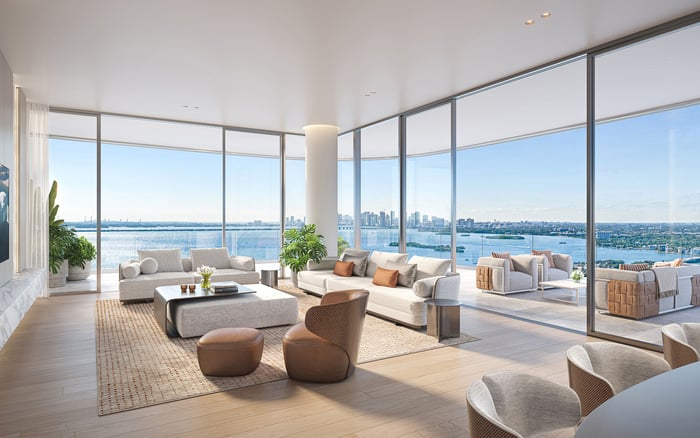
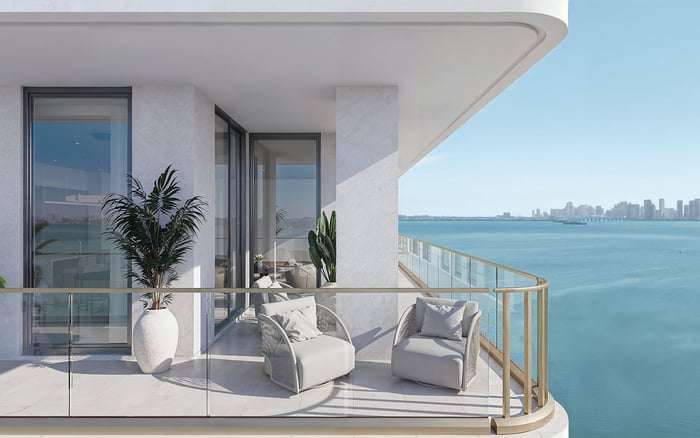
Floor-to-ceiling, wrap-around glass is the defining luxury gesture of contemporary bayfront living, but it is also the most misunderstood. In North Bay Village, where water views and proximity to Miami Beach are part of daily life, privacy becomes less about hiding and more about controlling sightlines, reflections, lighting, and behavior. This editorial examines how to evaluate privacy in a glass-forward residence, with buyer-oriented checkpoints that translate across South Florida’s most design-led towers.
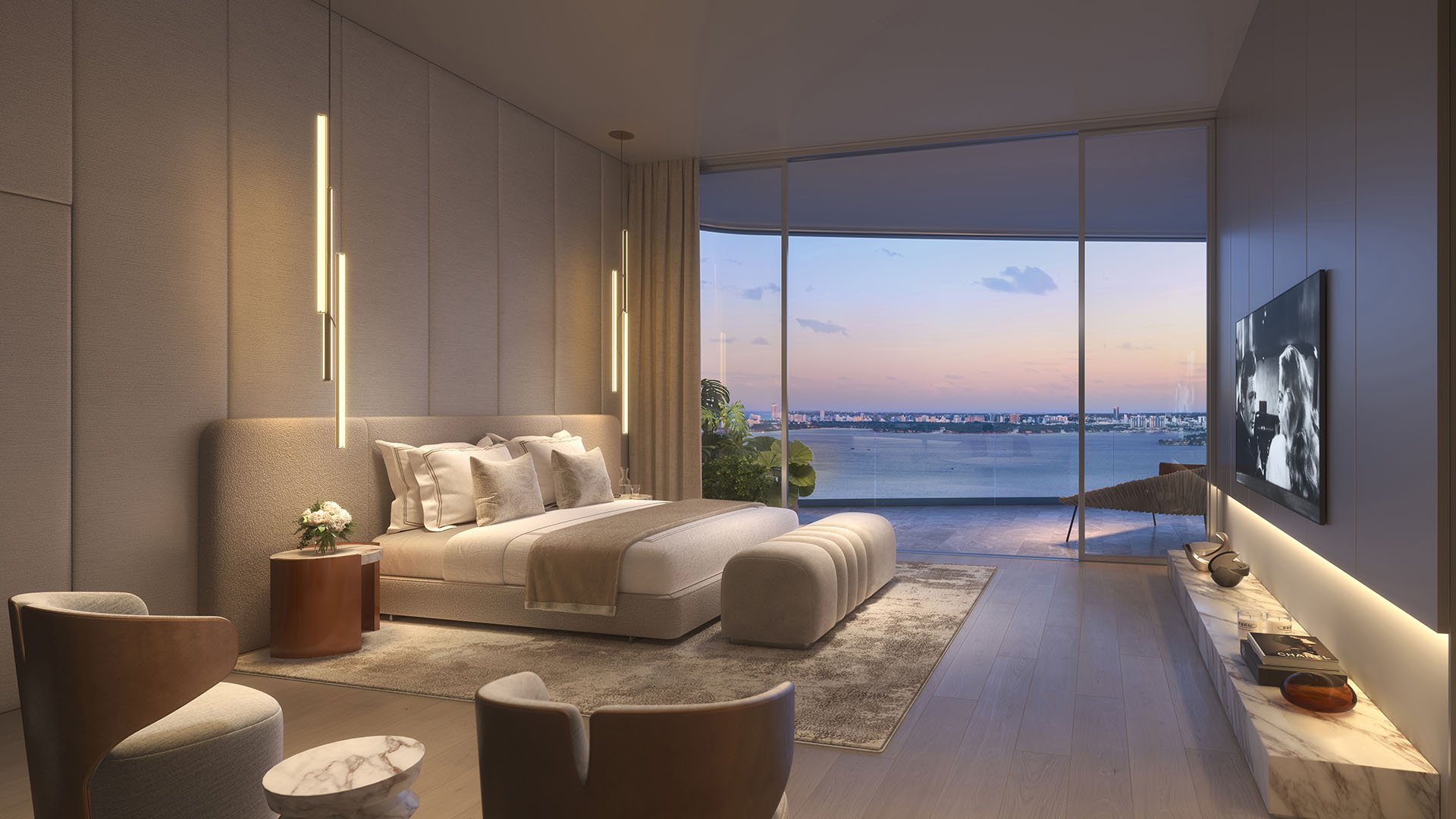
Floor-to-ceiling, wrap-around glass signals modernity and openness, but it does not automatically deliver discretion. For buyers considering Pagani North Bay Village, the most useful way to evaluate privacy is to define it across three categories: visual privacy (can someone see in), acoustic privacy (can someone hear), and lifestyle privacy (can you live naturally without feeling observed).
Wrap-around glazing amplifies views and daylight, but it also expands the home’s visible surface area. The goal isn’t to retreat behind heavy drapery; it’s to design a layered envelope that protects key sightlines while keeping the panoramic experience intact.
Privacy in a glass residence starts outside the unit. In North Bay Village, the “audience” can include adjacent buildings, passing boats, bridges, and nearby public vantage points. A wrap-around corner may feel secluded from one direction and exposed from another.
A practical way to assess exposure is to think like a cinematographer: identify the most likely camera angles. From the water, views are typically low and horizontal. From neighboring towers, views are higher and downward, which can reveal deep into interiors-especially when the balcony line is shallow or glazing sits visually flush to the slab.
If you’re comparing newer bayfront inventory in the same micro-market, it can also help to observe how privacy is addressed in other design-forward projects such as Shoma Bay North Bay Village and Continuum Club & Residences North Bay Village. Touring multiple towers sharpens your ability to read setbacks, balcony geometry, and how neighboring massing influences lines of sight.
Buyers often assume higher floors equal more privacy. Height can reduce visibility from pedestrians and roadway-level vantage points, but it can also increase exposure to neighboring high-rises with direct angles into your glazing. The more your view opens, the more your interior becomes a potential view for someone else.
When evaluating a specific residence, prioritize these questions:
Are there any buildings of similar height within a direct diagonal line of sight to the primary living areas?
Do the corner panes face a corridor of future development, where a new tower could eventually introduce direct views?
Does the unit’s balcony create a meaningful buffer, or is the glass visually “right there” at the edge?
In other words, privacy is often a function of geometry rather than floor number. A well-positioned mid-floor with disciplined angles can feel more discreet than a higher floor with a clean line from a neighboring terrace.
In wrap-around glass residences, the balcony isn’t just outdoor lifestyle space-it’s a privacy device. Depth matters because it shifts the angle at which someone can see into your living room. Overhangs and slab projections also help by limiting downward views from higher adjacent vantage points.
Consider how you actually live. If you entertain frequently, a deeper balcony line can keep the interior from reading like a stage when doors are open and lights are on. If you work from home, that outdoor buffer can reduce the sense that your desk is on display.
This is one reason some buyers gravitate to glass-forward coastal projects that pair transparency with outdoor buffering. Touring a true oceanfront building like 57 Ocean Miami Beach can be instructive: the best layouts treat outdoor space as part of the privacy envelope, not an afterthought.
During the day, glass can be more private than buyers expect. Bright exterior light creates reflectivity that makes interiors difficult to read unless an observer is close and positioned at the right angle. But this effect isn’t constant. Early-morning and late-afternoon sun angles can reduce reflection and increase visibility.
When assessing a unit, ask a more precise question: what does the façade do at 9 a.m., 2 p.m., and 7 p.m.? If you can, visit at different times. If that’s not realistic, mentally map the sun path and note where glare and reflection will land. Corner glazing adds complexity because each plane of glass can perform differently.
Interior contrast matters, too. A minimalist interior with darker finishes can read as more discreet behind glass during the day than a bright, white interior with high reflectance. Your palette is part of your privacy strategy.
At night, the relationship flips. When interior lighting is bright and the exterior environment is dark, your home can read like a lantern. This is often when owners realize the “open” look they loved in the afternoon can feel exposed after dinner.
The answer isn’t to abandon glass. It’s to plan a layered approach:
Use dimmable lighting and multiple circuits so you can create ambiance without over-illuminating the perimeter.
Favor warm, lower-level lighting (lamps, sconces, concealed LED) over bright overhead lighting that floods the entire volume.
Integrate window treatments early so they align with the architecture and don’t feel like an after-market fix.
For a comparative look at how glass-forward residences can still feel intimate at night, it can help to experience a highly designed urban product like 2200 Brickell. The neighborhood is different, but the lesson translates: lighting design is privacy design.
In a luxury glass residence, window treatments belong in the specification-not as a decorative add-on. The strongest solutions keep the view “on” while making the interior harder to read.
Key options to consider:
They soften the inward view while preserving the outward panorama.
Essential for bedrooms and any corner exposure.
One layer for daylight management, one for full privacy.
Track placement matters. With wrap-around glass, discontinuities at corners can create visibility gaps. A tailored solution at the corner condition often separates a polished residence from one that perpetually feels unresolved.
It’s easy to assume tinted glass will solve privacy on its own. In practice, tint is a tradeoff among heat control, color rendition, and visibility. Heavy tint can compromise the clarity of a bay view and darken interiors, increasing reliance on artificial light-and inadvertently intensifying nighttime exposure.
If additional privacy is desired, a professionally specified film can balance transparency with subtle reflectivity. The goal is to avoid a mirrored look that reads commercial or fights a refined façade. Any treatment should be evaluated from inside and outside, by day and by night.
Wrap-around glass magnifies your floor plan. Some zones are naturally more private because they sit deeper in the unit or face away from direct lines of sight. Others-especially corner living rooms-are inherently public-facing.
A few buyer-oriented planning principles:
Place dining and entertaining zones closer to the glazing; keep workstations and more personal seating deeper in the plan.
Use art walls, bookshelves, and sculptural partitions to interrupt inward views without sacrificing daylight.
Avoid placing mirrors directly opposite glass at night; they can amplify interior visibility.
For many residents, the most valuable privacy upgrade is simply deciding which daily moments belong at the glass line-and which belong a few feet back.
Visual discretion is only part of the equation. True privacy also includes whether you can take a call, have a conversation, or host guests without feeling exposed. Even in a well-built luxury tower, balconies and outdoor corridors can carry sound in unexpected ways.
If lifestyle privacy is a priority, think through how you’ll use the outdoor edge. A wrap-around balcony can be spectacular, but it also invites movement around your perimeter. Consider whether you prefer a single primary outdoor zone or multiple zones that encourage circulation.
Also consider your own “privacy behaviors.” If you like leaving doors open, cooking with music on, and entertaining late, you’ll want more robust shade planning and lighting control than someone who uses the home primarily as a quiet retreat.
Without relying on marketing language, you can evaluate privacy in any glass-forward residence with a short, high-signal checklist:
Is the corner framed in a way that supports continuous shades, or will there be gaps?
Is there meaningful depth to create a visual setback?
Are there direct lines from nearby towers into your primary rooms?
Can your lighting be dimmed in zones to prevent the “lantern effect”?
Do bedrooms have immediate privacy coverage that still feels elegant in daytime?
The takeaway is simple: floor-to-ceiling, wrap-around glass can feel exceptionally private when the envelope is treated as a system. Privacy is achieved through layers, angles, and control-not opacity.
Does floor-to-ceiling wrap-around glass mean I will have no privacy? Not necessarily. With smart sightline planning, shades, and lighting control, glass can feel discreet.
When is a glass home most exposed to view from outside? At night, when interior lights are brighter than the exterior environment.
Are higher floors always more private in North Bay Village? Height can help, but adjacent high-rises and diagonal angles can still create exposure.
Do balconies actually improve privacy, or are they just outdoor space? They improve privacy by increasing the distance and angle between observers and interiors.
Will tinted glass solve privacy concerns by itself? Tint can help in daytime, but it is not a complete solution, especially at night.
What window treatments work best for preserving views? Dual-roller systems with sheers for day and blackout or lined shades for night are common.
Can interior design choices improve privacy without covering glass? Yes. Furniture placement and partitions can interrupt sightlines while keeping daylight.
Is reflective film a good idea for luxury residences? It can be, but it should be specified carefully to avoid a mirrored, commercial appearance.
How should I think about privacy if I entertain often? Plan for layered lighting and fast, elegant shade control so the home never feels exposed.
What is the simplest way to test privacy before committing? View the unit in the evening and imagine normal lighting levels, not staged lighting.
For a confidential assessment and a building-by-building shortlist, connect with MILLION Luxury.
If branded residences are on your mind — as a home or as an allocation — we would be glad to share what we are seeing, privately.
Begin a quiet conversation